Households with little time to dry laundry
If you need your pillowcases again soon after a rainy day, compare the available hanging space and heating function without assuming a particular drying time.


If you only have a few pillowcases to dry indoors on a rainy day, a heated airer could be a good fit if you need plenty of hanging space and a heating function. However, this doesn’t guarantee a particular drying time. If you have enough time, an unheated airer avoids the extra electricity used by heating elements. Whichever type you choose, hang the pillowcases with space between them and make sure moisture can escape from the room. If you’re buying an electric model, check the documentation for that specific product too.
If you need your pillowcases again soon after a rainy day, compare the available hanging space and heating function without assuming a particular drying time.
If you regularly dry laundry indoors, remember to plan for a way to remove moisture from the room as well as choosing an airer.
A folding airer could be a good choice if you want to set it up for drying and then fold it away flat.
| What to consider | What to look for | Who it matters most to |
|---|---|---|
| How soon you can use them again | Check how many rails are available for the pillowcases, whether the airer heats up and what the care instructions say for the fabric. A heating function alone doesn’t guarantee a specific drying time. | If I need my pillowcases again soon after a wet commute, hanging space and a heating function matter. Around 40% of consumers put a short drying window first. |
| Moisture in the room | Choose a spot where you can ventilate the room, and leave enough space between the items. The German Environment Agency recommends airing the room regularly when drying damp laundry indoors. | When drying laundry at home, I want to be able to clear moisture from the air rather than relying on heat alone. Around 30% of consumers prioritise the indoor climate when drying laundry. |
| Space and storage | Compare the airer’s dimensions when open and folded, and check that you can hang the pillowcases with enough space between them. | If space is limited, the airer needs to fit while in use and be easy to put away afterwards. Around 20% of consumers prioritise floor space and ease of storage. |
| Electricity use | Consider whether you need a heating function at all, and take the rated power and planned running time into account. The rated power alone doesn’t tell you how long a pillowcase will take to dry. | If I have enough time, I don’t want to have to switch on a heating function. For a heated model, I check its power and running time. Around 10% of consumers put electricity use first. |
The stated power and the manufacturer’s description don’t tell you when a specific pillowcase will be dry in your room.
Choose based on how much time you have and how much hanging space is available. Don’t assume a set drying time based on the wattage alone.
Longer running times mean more electricity is used.
Water from the pillowcases still enters the air, even when they’re on a heated airer.
Plan to air the room regularly and choose a suitable place for the airer. The German Environment Agency recommends regular ventilation when drying damp laundry indoors.
An unheated model isn’t the same as a heated airer, and a similar model name isn’t enough to identify its design.
Check the full model name and heating function on the specific product page.
Confusing the designs could lead you to choose an airer without the heating function you want.
The Warmmat is a folding heated winged airer with adjustable temperature and a timer.
The AD 7821 is a folding heated winged airer. Adler lists its dimensions when open and folded.
The Airer Heater has three heated tiers rather than side wings.
The unheated Pegasus 180 Solid Plus is an alternative to consider if hanging space matters more to you than a heating function.
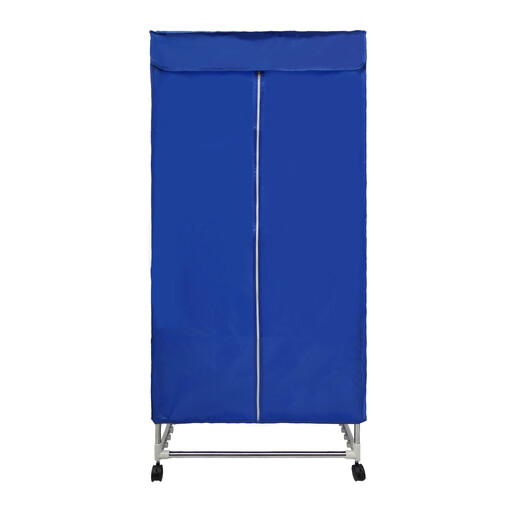
This selection from Joybuy is for drying wet laundry indoors. The product shown is a folding heated-air dryer, not an open clothes airer.
 No image available
For drying wet laundry indoors when a folding heated-air dryer is more suitable than an open clothes airer.
The product description lists a 1,200–1,500 W PTC heater, warm-air circulation, a single- or double-tier setup and four timer settings.
The dryer is described as foldable and lightweight, with wheels. Before buying, check the EU conformity information required for this specific product, including its CE marking, along with the instructions for use and safety information in German. A CE marking alone isn’t an independent safety test.
Hang them so you make good use of the available rails and the fabric isn’t crowded together. Check the care label on each pillowcase; the temperature listed for the appliance doesn’t mean every fabric is suitable for it.
Yes. Drying laundry indoors releases moisture into the air. The German Environment Agency recommends airing rooms regularly, especially when drying damp laundry indoors. A heating function doesn’t replace ventilation.
Multiply the rated power in kilowatts by the running time in hours to estimate energy use in kilowatt-hours. For the Adler AD 7821, rated at 220 W, three hours at its full rated power would work out to 0,66 kWh. This is a calculation, not a measurement of actual use or the time needed to dry your laundry.
For an electrical appliance, check that it has the CE marking required for that specific product, along with instructions for use and safety information in German. The German Federal Network Agency describes CE as a declaration made by the manufacturer under its own responsibility, not an independent quality mark. If a product is faulty, your statutory rights are generally against the seller; these are separate from any voluntary guarantee.