
Lieferung heute & morgen

Qualitätsgarantie

Willkommens-Angebote freischalten: KOSTENLOSE Lieferung | Bis zu 80 % RABATT | Kostenlose 30-Tage-JoyPlus-Testphase
App herunterladen
A pillow affects your sleeping position, how warm you feel and the amount of care it needs in everyday use. Even so, people often focus only on the price or a marketing term such as “ergonomic” when buying. When comparing pillows for sleeping, you should instead check whether the height, material and care instructions suit your individual needs.
Depending on its shape and height, an ergonomic pillow may feel comfortable for one person but be too high or too firm for another. With a neck-support pillow or memory foam pillow in particular, your sleeping position, shoulder width and mattress firmness all matter. A firm contour is not necessarily suitable for side, back and front sleepers alike.
“Natural”, “hypoallergenic” or “cooling” does not always describe the entire product. The specific composition of the filling and cover is what matters. For example, a feather pillow may have a cotton cover and a filling made entirely of feathers. With a latex pillow, you should also check the natural rubber content, other components and the care instructions.
A pillow described as hypoallergenic does not replace an individual assessment if you have a known allergy. According to the product information for the relevant listing, possible contact with latex allergens should also be taken into account with latex products.
Some pillows can be washed completely in a washing machine, while others only have a removable, washable cover. A memory foam pillow or latex pillow often must not be soaked. Before buying, you should therefore check the washing temperature, drying method and treatment required for the inner pillow.
The specification “8 cm” only describes one product measurement. How much height the pillow retains under pressure also depends on its shape, material and your body weight.
The classic 80x80 cm pillow offers a large surface to rest on, but it can take up a lot of bed space on a narrow mattress or for people with narrower shoulders. A 40x80 cm pillow is longer and leaves more room for your shoulders. Compact sizes are often easier to transport for travel, student accommodation or a guest room.
Special shapes such as a butterfly pillow or a U-shaped nursing pillow are designed for a specific purpose. They should not be chosen solely because of their distinctive shape.
Pay attention to the following details:
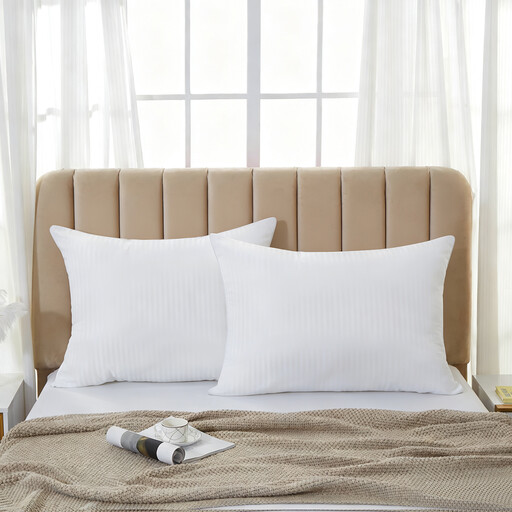
Why this product suits this profile: The 40×80 cm format is practical for students, guest rooms or smaller sleeping areas. The set of 2 is useful when two pillows are needed at the same time.
The clearly stated size prevents a large 80×80 cm pillow from taking up more space than intended.
Elongated standard format and delivery as a set of 2, according to the product name.
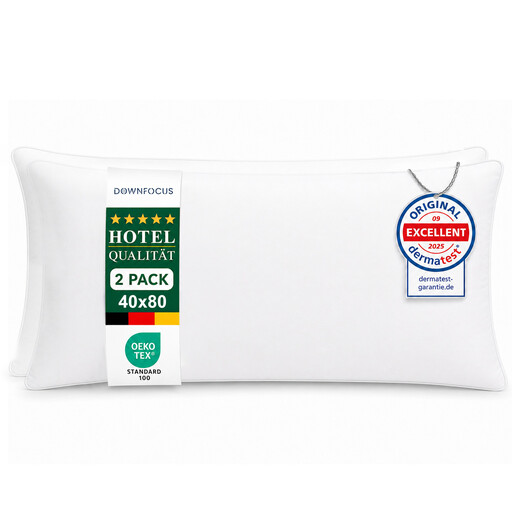
Why this product suits this profile: According to the product information, the filling consists of 100% feathers and the cover of 100% cotton. Öko-Tex and RDS certifications are also stated.
The filling, cover and washing temperature are clearly specified in the listing. This makes it easier to compare the pillow with products described less precisely.
40×80 cm format, 800 g feather filling and set of 2 according to the product description.
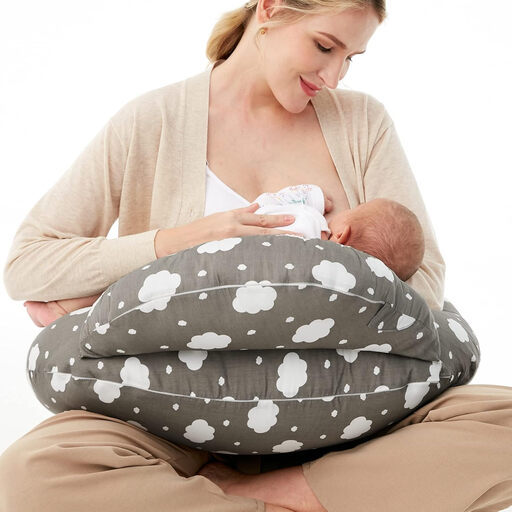
Why this product suits this profile: The U-shaped nursing pillow is designed for breastfeeding or bottle-feeding. According to the product information, it has a removable cotton cover, an adjustable strap and raised edging.
The specific purpose and cover-care instructions are stated clearly. The pillow is not intended for a baby to sleep on unsupervised.
Removable cover made from 100% cotton and adjustable waist strap according to the product description.
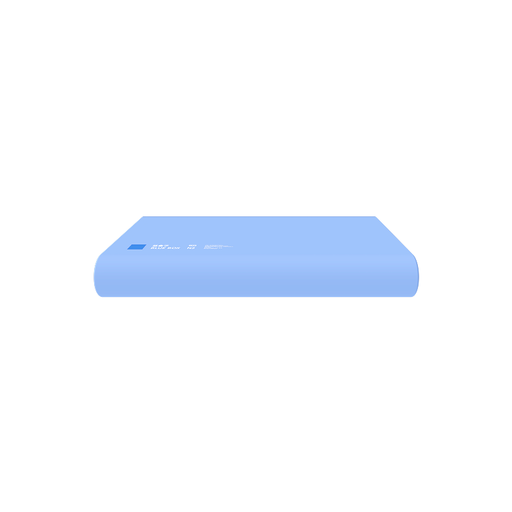
Why this product suits this profile: The specified height of 8 cm and memory foam material provide clear comparison points for adults and students, as well as for use in student accommodation, hotels or while travelling.
The low profile is clearly stated. This lets you check in advance whether a flatter pillow suits your sleeping position.
Memory foam material and 8 cm profile according to the product name.
We have put together a complete, regularly updated list of products that fully meet these strict selection criteria and the safety regulations applicable in the EU.
The useful life of a pillow depends on its material, the pressure placed on it, moisture and how it is cared for. A pillow should not only be checked once visible damage appears. Look out for permanent deformation, clumped filling, damaged seams or a cover that can no longer be cleaned hygienically.
Practical measures:
If you have allergies, consider the filling, cover, washability and any available certificates together. A hypoallergenic pillow is not a blanket guarantee of individual suitability.
A 40x80 cm pillow offers an elongated surface to rest on and usually leaves more room around the shoulders. The 80x80 cm format is larger and may suit people who prefer a wider surface. The right choice depends on your sleeping position, body shape and bed width.
There is no single replacement period that applies to every material. Check the pillow’s shape, odour, cleanliness and support properties regularly. If it has become permanently flattened or the filling can no longer be distributed evenly, replacing it is the obvious choice.
A neck-support pillow may encourage a particular head position, but it does not replace individual medical advice. Height, shape and mattress are all important. If you experience persistent or severe discomfort, discuss your choice with a medical professional.