Juicing pineapple with less washing-up
If you regularly juice pineapple at your holiday home, look for filters and pressing parts that are easy to reach and straightforward to clean straight after juicing.


For smaller batches of pineapple, a slow juicer is a suitable option if you feed in the pieces slowly and can clean the filter and pressing parts thoroughly. If you need several glasses in a short time, a centrifugal juicer may be a better choice; ETM TESTMAGAZIN describes this type as faster for larger quantities, but also noisier. Whatever the size of the feed chute, you’ll need to prepare the pineapple first: the Federal Centre for Nutrition recommends removing the peel.
If you regularly juice pineapple at your holiday home, look for filters and pressing parts that are easy to reach and straightforward to clean straight after juicing.
If you’re making several portions one after another, speed may be important. Weigh this up against the noise level and the space the appliance takes up.
If worktop and storage space are limited, compare the appliance’s actual dimensions and allow room for the parts you’ll remove when cleaning it.
| Priority | What to check | Who is it important to? |
|---|---|---|
| Cleaning | Check which parts are removable and dishwasher-safe according to the instructions, and whether a filter brush is included. | If I don’t want to spend ages cleaning the filter and pressing parts after juicing, ease of cleaning is particularly important to me. Around 36% of consumers say cleaning is their main priority. |
| Fibrous pineapple | Look for pressing parts that are easy to reach and follow the instructions for feeding in portions; a reverse function is no guarantee against blockages. | If pineapple is the main fruit you want to juice, look for a model that lets you feed in pieces in a controlled way. Around 29% of consumers say this is their main priority. |
| Several glasses | Compare the juice jug and pulp container capacities with the number of portions you plan to make; container capacity doesn’t tell you how much juice you’ll get from a pineapple. | If I want to make several glasses at breakfast, speed is what matters most to me. Around 21% of consumers put this priority first. |
| Space and noise | Measure your worktop and the clearance beneath wall cabinets; compare the stated dimensions and take the noise level into account. | In a small kitchen, or when other guests are still asleep, the space an appliance takes up and its noise level are decisive for me. Around 14% of consumers prioritise space and noise. |
A wide opening doesn’t mean you can juice a pineapple whole or with the peel on. The Federal Centre for Nutrition recommends removing the peel and preparing the flesh appropriately.
Have a knife and chopping board ready, and cut the fruit into pieces as instructed in the appliance manual.
Peeling and cutting the pineapple add to the preparation time.
Fibrous pineapple can make juicing more difficult. The design or power rating doesn’t prove that every fruit will yield a particular amount of juice in every model.
Feed in suitable pieces a portion at a time, and check how easy the filter and pressing parts are to reach. Don’t base your decision on wattage or speed alone.
If the appliance backs up or isn’t used correctly, you may need extra time to stop and clean it.
The appliance’s height and the space needed for removed parts can also matter in a small holiday-home kitchen.
Measure your worktop and the clearance beneath wall cabinets, and think about where you’ll clean the filter, containers and brush.
The examples include a slow juicer and centrifugal juicers, catering for different needs in terms of design and space.
The MultiJuice 7 SJ7000GY is a centrifugal option for making several portions.
The Avance HR1921/20 is a centrifugal alternative if you want to factor in the available settings and the appliance’s dimensions when planning your kitchen.
The H320N is a slow juicer with two filters, and could also be worth considering if you plan to use it regularly outside the holiday season.
This selection includes slow juicers for juicing portions at a time and centrifugal juicers for making several glasses. A large feed chute doesn’t mean you can skip peeling and cutting the pineapple appropriately.
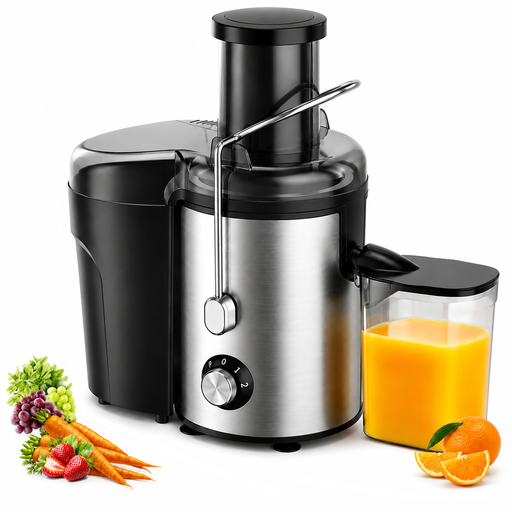 No image available
A centrifugal option if you want to juice several prepared portions quickly; ETM TESTMAGAZIN describes this type as faster for larger quantities, but also noisier.
The product title specifies 600 W and a 75-mm feed chute. According to the product description, it has two speed settings, a safety lock and a juice jug with a foam separator.
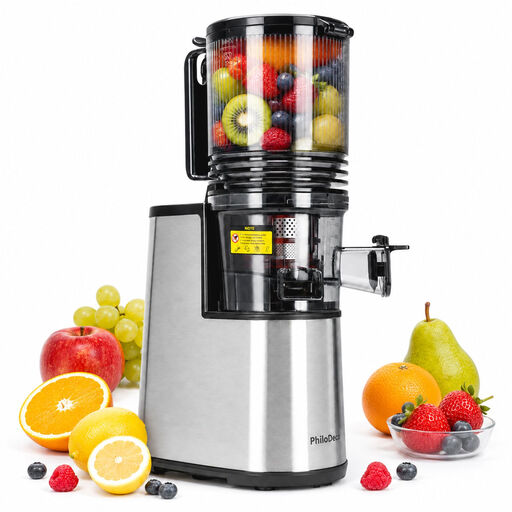 No image available
A slow juicer option if you want to feed in smaller portions slowly; prepare the pineapple appropriately, as outlined in the instruction manual.
The product title specifies a 250-W motor and a 1.000-ml pulp container. The description lists a REV reverse function for fibrous ingredients, removable parts and a safety lock.
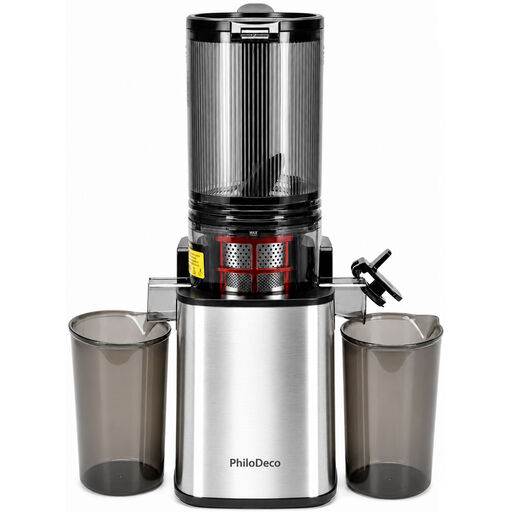 No image available
A slow juicer option for juicing portions at a time; the feed chute doesn’t mean you can skip peeling or cutting the pineapple.
The product title specifies a 110-mm opening, 40 Nm and a dual filter. The product description lists a reverse function to clear blockages and removable parts for hand-washing.
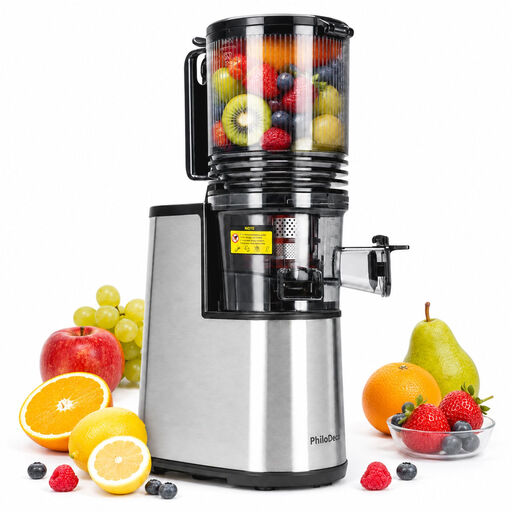 No image available
A slow juicer option if you want to feed in the pieces a portion at a time; a reverse function is no guarantee against pineapple backing up.
The product title specifies a 110-mm feed chute and 40 Nm. According to the product description, it has a REV reverse function to clear blockages and food-contact parts that can be fully dismantled.
 No image available
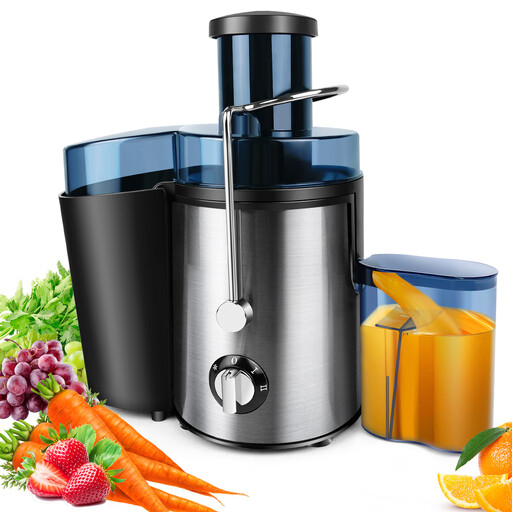
A centrifugal option for making several prepared portions; with this type, you’ll need to weigh up speed against noise.
The product title specifies 1.000 W and a 65-mm feed chute. The product description lists two speed settings, a 500-ml juice jug and a cleaning brush.
Yes. The Federal Centre for Nutrition recommends removing the peel and preparing the flesh appropriately. Cut the pineapple into pieces as instructed in the juicer manual; a reference to whole apples doesn’t mean you can juice whole pineapples.
Feed the pieces in slowly, one after another, rather than overfilling the appliance. If your model has a reverse function, the manufacturer says it can help free stuck ingredients; follow the instruction manual when using it.
Clean your hands, work surfaces and appliances when handling food. The Federal Centre for Nutrition points out that germs can spread to other food via shared kitchen equipment.
No. When you buy in Germany, the statutory warranty is a legal right against the seller; a guarantee is a voluntary service, and its scope depends on its terms and conditions. The Verbraucherzentrale explains that the two are not the same. Check the specific offer to see who the seller is and what guarantee terms apply.
Electrical equipment covered by the relevant EU rules must carry a CE marking. The Low Voltage Directive applies, among other things, to equipment with a rated voltage of 50 to 1.000 V AC. The European Union explains that the marking represents the manufacturer’s declaration of conformity; it isn’t an independent seal of approval. Check the marking, voltage information and safety instructions on the specific appliance.