
Lieferung heute & morgen

Qualitätsgarantie

Willkommens-Angebote freischalten: KOSTENLOSE Lieferung | Bis zu 80 % RABATT | Kostenlose 30-Tage-JoyPlus-Testphase
App herunterladen
A pink 4-piece mixing bowl set can make kitchen prep much more organised – provided the material, stability and storage suit your everyday needs. Many options look similar at first glance, but differ on important details. If you buy purely on colour or piece count, you can easily overlook limitations around heat, cleaning or space.
Stackable mixing bowls need compatible shapes and sufficiently graduated sizes. If the bowls are almost the same height or have prominent rims, the space-saving benefit in your kitchen cupboard is limited. Before buying, you should check the dimensions of each individual bowl and the total stack height.
Mixing bowls with a non-slip base can sit more steadily when mixing. However, the result depends on the surface: on dry, smooth worktops an anti-slip coating works differently than on wet or textured surfaces. The base should also be firmly attached and easy to clean, so that no residue builds up there.
With BPA-free bowls, you should check the specific product description or manufacturer labelling. BPA-free doesn’t automatically indicate suitability for the microwave, dishwasher or very hot foods. Even reusable kitchen bowls can have different temperature limits depending on the material.
For baking bowls and kitchen prep, lightweight plastic bowls are practical. They’re easy to move around and won’t break if dropped like ceramic ones. With plastic, what matters is whether the item is explicitly intended for food contact and what care instructions apply.
Stoneware or ceramic bowls are often suitable as salad bowls or serving bowls. However, they are heavier and can be damaged by knocks. For meal prep bowls with lids, you should also check whether the lids seal tightly and whether they can be cleaned separately.
A 4-piece bowl set makes sense when you’re preparing several ingredients at the same time. For dough, salad, chopped vegetables and portioned ingredients, different sizes are more helpful than four nearly identical bowls. If specific volume details are missing, don’t rely solely on product photos to judge the size.
Pay attention to:
“Easy to clean” is only meaningful if the care instructions are clear. Explicit dishwasher suitability makes everyday life easier. For the microwave, oven and freezer, separate approvals apply. Without specific manufacturer information, the product should not be exposed to high temperatures or extreme temperature changes.
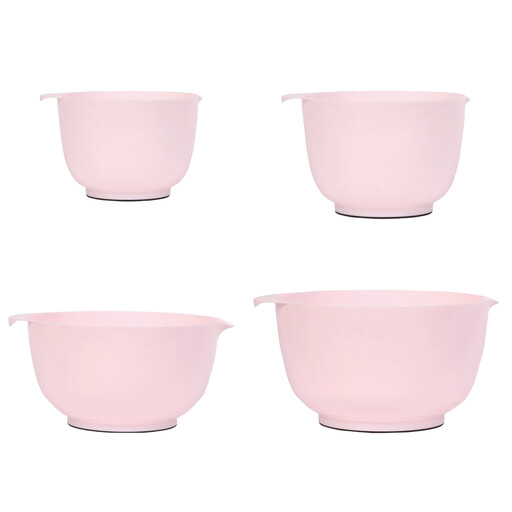
Why this product fits the profile: This set combines four bowls in a pink colourway with stackable storage and, according to the product details, a non-slip base. It is intended for salad, meal prep and baking.
The product name explicitly mentions stackability, a non-slip base and BPA-free material. This allows you to check key buying criteria before ordering.
Four pieces, reusable design, pink colour, plus according to the supplier a BPA-free and stackable construction.
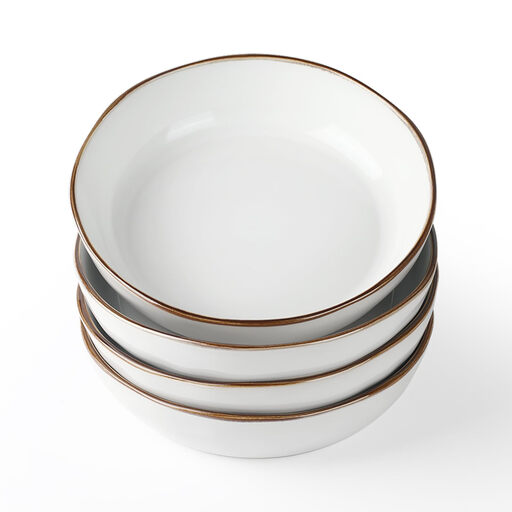
Why this product fits the profile: According to the product data, the four stoneware bowls each have a capacity of 900 ml and are intended for pasta, salad, soup and desserts. They complement a kitchen where serving is just as important as preparation.
The details state the material, volume, dishwasher and microwave suitability. At the same time, it advises careful handling and avoiding sudden temperature changes.
Four stoneware pieces, 900 ml capacity per bowl, plus according to the product description suitable for microwave and dishwasher.
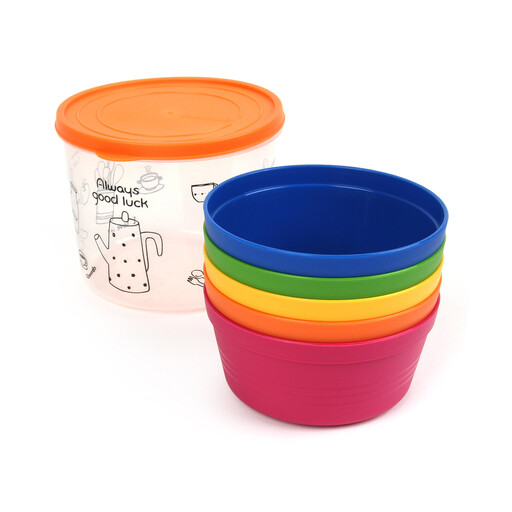
Why this product fits the profile: Five bowls with lids and a transport container are aimed at people who want to prepare portions for work, picnics, camping or on the go.
Lids, storage box and BPA-free polypropylene are specifically listed. For the microwave, the description states: remove the lid before heating.
Five stackable bowls, lids, transport container, lightweight, plus according to the product details BPA-free polypropylene.
We’ve put together a full, regularly updated list of products that fully meet these strict selection criteria and the safety regulations in force in the EU.
That depends not on the colour, but on the material, food contact approval and manufacturer instructions. With plastic bowls, you should observe the stated temperature limits. They are often practical for dough, dry ingredients, salad and cold meal prep portions. Using them in the oven or microwave is only advisable if explicitly approved.
After use, bowls should be cleaned promptly with a suitable washing-up liquid and dried completely. Abrasive sponges can scratch plastic or glaze surfaces. With bowls that have a non-slip base, you should also check whether the coating is peeling or damaged. Cracked, heavily deformed or damaged bowls should no longer be used for food.
Lids can make portioning, transporting and storing easier. What matters is a secure closure, suitable cleaning and clear instructions for microwave use. A lid should only stay on the bowl during heating if this is explicitly intended. For classic baking tasks, a lid is usually less important than a stable base and a shape that’s easy to grip.