
Lieferung heute & morgen

Qualitätsgarantie

Willkommens-Angebote freischalten: KOSTENLOSE Lieferung | Bis zu 80 % RABATT | Kostenlose 30-Tage-JoyPlus-Testphase
App herunterladen
Choosing the right filament is crucial for the success of any 3D print. The market for PLA filament 1.75mm is particularly vast, which can make the decision difficult. Failed prints, poor surface finishes, or clogged nozzles are common problems often caused by unsuitable material. This article serves as a guide, highlighting the key properties of PLA filaments and presenting a selection of products designed for various applications and requirements.
To find the right filament for your 3D printer, several fundamental criteria should be considered. These help align the material properties with your planned printing project and your specific printer.
The aesthetic of the finished printed object is largely determined by the filament's surface. Standard PLA often has a slightly glossy finish. For projects requiring a more premium look or where layer lines need to be concealed, matte PLA filament is an excellent choice. It creates a soft, non-reflective surface that makes fingerprints less visible and gives the object a professional feel. Additionally, there are filaments with special properties like High-Speed PLA, which is optimised for very high printing speeds.
One of the most critical technical specifications is the filament's dimensional accuracy. A consistent diameter of 1.75mm with a low tolerance (e.g., +/- 0.02mm) is crucial for a smooth and even material flow. Significant deviations can lead to under- or over-extrusion and, in the worst case, a clogged nozzle. Equally important is a neat and tangle-free winding on the spool. Automated machine winding ensures that the filament does not snag and interrupt a long printing process.
PLA (Polylactic Acid) is known for being a biodegradable filament, as it is made from renewable resources like corn starch or sugarcane. This makes it a more environmentally friendly alternative to petroleum-based plastics. Some manufacturers go a step further by using cardboard spools instead of plastic to further reduce their ecological footprint. Look for products made from pure raw materials without recycled waste to ensure consistent quality and colour uniformity. A 1kg PLA spool is the common standard for most projects.
Based on the criteria mentioned, we have compiled a selection of PLA filaments that stand out with specific features for different printing needs.

Why it stands out: This filament from CAILAB is distinguished by its exceptional matte surface. The special formula was developed to create a soft, natural finish that minimises the visibility of layer lines and gives printed objects a high-quality, artistic feel.
Advantages:
Who it's for: Users who place a high value on the aesthetics of their prints. Ideal for architectural models, prototypes, figurines, and design objects where a glossy plastic look is to be avoided.
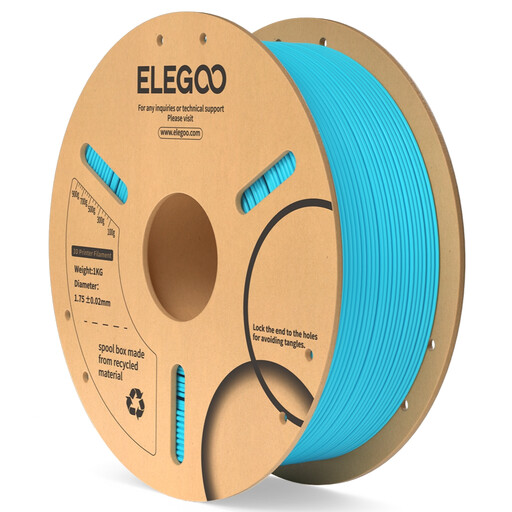
Why it stands out: Elegoo combines reliable printing performance with a focus on sustainability in this filament. The use of a cardboard spool reduces plastic waste and features viewing windows for a practical way to check the remaining filament level.
Advantages:
Who it's for: A versatile PLA 3D printer filament for everyday use. Suitable for beginners and advanced makers who are looking for a reliable material and also value more environmentally friendly packaging.
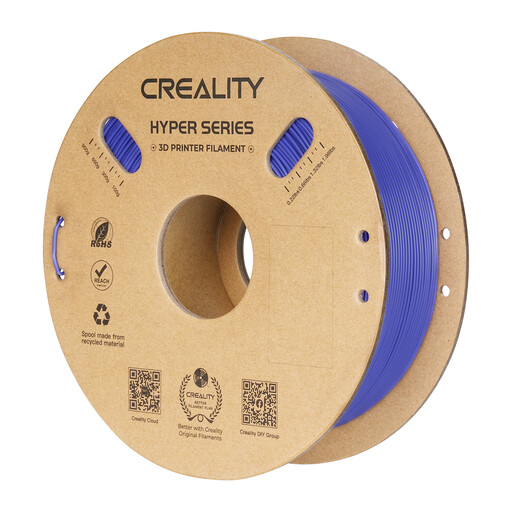
Why it stands out: Creality's Hyper PLA is specially formulated for the demands of modern high-speed 3D printers. It enables printing speeds of up to 600 mm/s without compromising the print quality or structural integrity of the model.
Advantages:
Who it's for: Owners of high-speed 3D printers who want to maximise their productivity. Perfect for professional users creating prototypes, as well as for ambitious hobbyists looking to accelerate their printing projects.
Blue is one of the most popular colours in 3D printing, and the products featured here represent just a small sample of the available shades and material properties. From sky blue and royal blue to special metallic or silk effects, there is a wide range to explore.
If you are looking for more options, you can find a comprehensive overview in our category.
Explore Our Full Range of Blue PLA Filament
PLA is hygroscopic, meaning it absorbs moisture from the air. Improper storage can lead to brittle filament and poor print quality (e.g., hissing at the nozzle, bubbling). Therefore, always store your filament in a cool, dry, and dark place. A resealable bag or an airtight box, along with a desiccant packet of silica gel, is ideal.
Dimensional accuracy refers to the consistency of the filament's diameter along its entire length. For most printers, the standard is 1.75mm. A low tolerance, such as +/- 0.02mm, means the diameter deviates from this nominal value by a maximum of 0.02 mm. High dimensional accuracy is critical as it ensures a uniform flow of material through the extruder and nozzle, thus preventing printing errors.
Yes, PLA is considered a biodegradable filament. It is made from renewable plant-based resources like corn starch. It can be broken down under industrial composting conditions (high temperature, humidity, and specific microorganisms). However, in a home compost pile or in nature, this process is much slower. Nevertheless, it represents a more environmentally friendly alternative to plastics derived from fossil fuels.