Joybuy Insights

PLA Filament Buyer's Guide and Common Mistakes

Choosing the right PLA filament can make or break a 3D print. Yet, the market is flooded with marketing promises that often create more confusion than clarity. Many users invest in material that fails to meet their expectations, leading to frustration, wasted time, and unnecessary costs. This guide focuses on the objective criteria that truly matter, helping you to avoid common pitfalls.

Three Common Pitfalls When Buying 3D Printer Filament

Before settling on a spool, it's crucial to understand the widespread misconceptions and quality issues that often only become apparent after the purchase.

  1. The "Biodegradable" Trap: The term biodegradable filament often suggests easy disposal in a home compost bin. The reality is that PLA (Polylactic Acid) only breaks down under specific industrial composting conditions (high temperatures and humidity). Improper disposal means the material will persist in the environment just as long as other plastics, failing to deliver on the expectation of an eco-friendly solution.
  2. Inconsistent Filament Diameter: Budget-friendly filaments often have a wide tolerance in their diameter (e.g., ±0.05 mm or more). These fluctuations can lead to uneven extrusion, poor surface finishes, and, in the worst-case scenario, a nozzle clog. A clogged extruder means failed prints and time-consuming maintenance.
  3. Moisture from the Factory: PLA is hygroscopic, meaning it absorbs moisture from the air. If a 1kg PLA filament is not delivered vacuum-sealed with a desiccant packet, it may already be too damp upon arrival. This manifests as brittle material that breaks easily, as well as crackling or popping sounds during printing, resulting in severely diminished print quality.

Key Parameters for Choosing the Right Filament

To avoid these problems, you should focus on verifiable technical specifications. These three parameters are central to achieving consistent and successful print results.

1. Dimensional Accuracy (Diameter Tolerance)

Dimensional accuracy is one of the most important indicators of a filament's quality. It is specified as a tolerance range for the nominal diameter (usually 1.75 mm).

  • Standard Tolerance (±0.05 mm): Sufficient for simple prints, but carries a higher risk of extrusion problems on complex or long print jobs.
  • High Precision (±0.02 mm to ±0.03 mm): This industry standard ensures a consistent material flow. The result is more precise layers, a better surface quality, and a significantly lower risk of nozzle clogs. For reliable results, a tight tolerance is essential.

2. Material Variants: PLA, PLA+, and Silk PLA

Not all PLA is created equal. The different variants are optimised for specific applications.

  • Standard PLA: The all-rounder for beginners and decorative objects. It is easy to print, low-odour, and available in a huge selection as coloured PLA filament. However, it is relatively brittle.
  • PLA+ Filament: A modified version of PLA blended with additives to improve its mechanical properties. PLA+ filament is typically more impact-resistant and has better layer adhesion than standard PLA. It is well-suited for functional prototypes or parts that need to withstand light mechanical stress.
  • Silk PLA: This material contains special additives that give the finished print a silky, high-gloss surface. Silk PLA is ideal for vases, figurines, and other aesthetic objects. However, its mechanical strength may be lower than that of standard PLA.

3. Compatibility with Print Speed

Modern 3D printers are achieving ever-higher speeds. However, standard PLA can run into issues with melting and flow at a very high pace.

  • Standard Speed (approx. 40-80 mm/s): Most PLA filaments are optimised for this range.
  • High Speed (up to 600 mm/s): For such speeds, special material like Creality Hyper PLA is required. This FDM filament is formulated to melt faster and ensure a constant flow at high throughput, which would lead to underextrusion with standard PLA.

Products Matching Your Needs

Based on these objective criteria, we have selected a few products for typical user profiles.
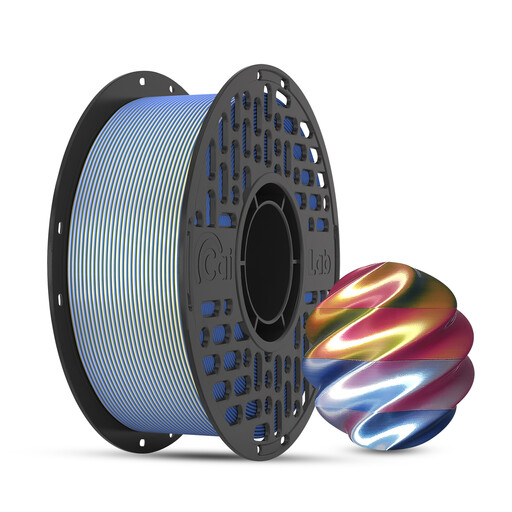
IDEAL FOR: AESTHETICS-FOCUSED USERS
CAILAB 3D Printer Filament PLA Silk Quad Color - Royal Mirage

CAILAB 3D Printer Filament PLA Silk Quad Color - Royal Mirage

Why It's a Match: Perfect for users who want to create decorative objects with an exceptional visual effect. The quad-colour effect produces unique colour gradients depending on the viewing angle and object geometry, without requiring a multi-material printer.

How It Avoids a Pitfall

This filament focuses on a clearly defined aesthetic purpose (silk gloss and colour gradient) and doesn't promise superior mechanical performance, thereby avoiding false expectations.

Key Advantage

Creates multi-coloured prints with a single extruder, simplifying the creation of complex visual effects.
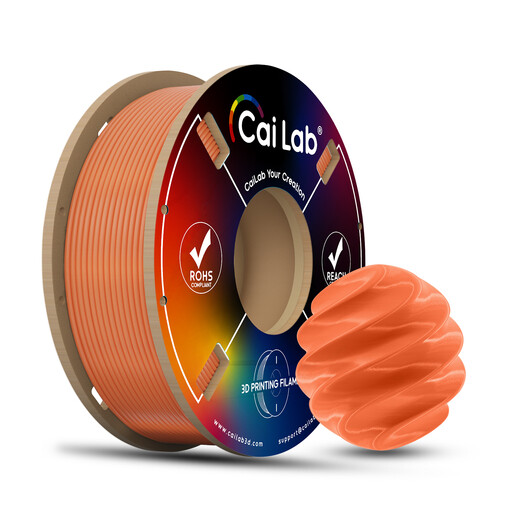
IDEAL FOR: PRAGMATIC PROTOTYPERS
CaiLab 3D Printer Filaments PLA+ Bio - Orange

CaiLab 3D Printer Filaments PLA+ Bio - Orange

Why It's a Match: As a PLA+, this filament offers greater toughness and resilience than standard PLA. It's a great choice for creating functional parts, enclosures, or mechanical prototypes that require a degree of durability.

How It Avoids a Pitfall

By focusing on PLA+ properties, it provides a reliable material base for functional prints that are less prone to breaking. Good winding and sealing also minimise the risk of moisture issues.

Key Advantage

Improved mechanical properties (impact resistance, layer adhesion) compared to standard PLA.
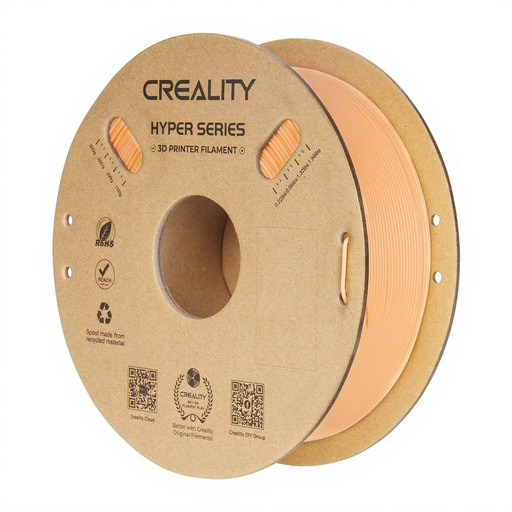
IDEAL FOR: SPEED OPTIMIZERS
Creality Hyper PLA Peach Powder 1KG

Creality Hyper PLA Peach Powder 1KG

Why It's a Match: Developed specifically for users with high-speed printers (e.g., Creality K1, Bambu Lab). According to the manufacturer, its formulation allows for print speeds of up to 600 mm/s while maintaining consistent quality.

How It Avoids a Pitfall

It directly addresses the problem of underextrusion at high speeds that occurs with standard PLA. Its high dimensional accuracy of +/-0.02mm also minimises the risk of clogs, which are particularly problematic during fast prints.

Key Advantage

Optimised for high fluidity and rapid cooling, enabling fast print times without significant quality trade-offs.

Looking for More Options?

We have compiled a complete, up-to-date list of products that fully meet these strict selection criteria and safety regulations.

Frequently Asked Questions (FAQ)

1. How do I properly store PLA filament to prevent moisture absorption?

The optimal way to store PLA filament is in an airtight container or the resealable bag it came in. Add a packet of desiccant (silica gel) to absorb any residual humidity. Store the spools in a cool, dry place, and avoid direct sunlight.

2. How can I tell if my PLA filament has become damp?

Typical signs of moist filament include:

  • Audible Noises: A crackling, popping, or hissing sound from the hot nozzle during printing. This is caused by the water in the filament instantly turning to steam.
  • Brittleness: The filament breaks very easily when bent, instead of flexing.
  • Poor Print Quality: Heavy stringing, rough or uneven surfaces, and poor layer adhesion are common consequences.

3. Is PLA filament food-safe?

In its pure form, standard PLA filament is often food-safe, but the added colour pigments and additives can change this. Furthermore, the FDM printing process creates tiny gaps between layers where bacteria can accumulate. For food contact, you should only use filament that is certified as food-safe and, if necessary, seal the finished object with a food-safe coating. Always check the manufacturer's specifications.