
Lieferung heute & morgen

Qualitätsgarantie

Willkommens-Angebote freischalten: KOSTENLOSE Lieferung | Bis zu 80 % RABATT | Kostenlose 30-Tage-JoyPlus-Testphase
App herunterladen
The selection of PLA filament on the market can be overwhelming. From different colours and finishes to special properties for high-speed printing, finding the right material is crucial for the success of your 3D prints. This guide is designed to give you clear direction. We'll introduce objective criteria and present a selection of filaments suited for various applications, helping you make an informed decision for your next project.
Before you decide on a product, several technical aspects should be considered. These parameters determine the print quality, compatibility with your device, and the final look of your model.
The most common standard for desktop 3D printers is 1.75mm filament. However, what's crucial is not just the diameter but also the dimensional accuracy—the tolerance of any deviation in thickness. A low tolerance, such as +/- 0.02 mm, ensures a consistent material flow, reduces the risk of nozzle clogs, and significantly contributes to clean, consistent print quality. Always check for compatibility with your 3D printer before purchasing.
The surface of the filament has a major impact on the aesthetics of the finished printed object.
Modern 3D printers are achieving ever-higher speeds, and the filament must be formulated to match.
Based on the criteria above, we have compiled a selection of filaments that stand out for their specific properties for different projects.
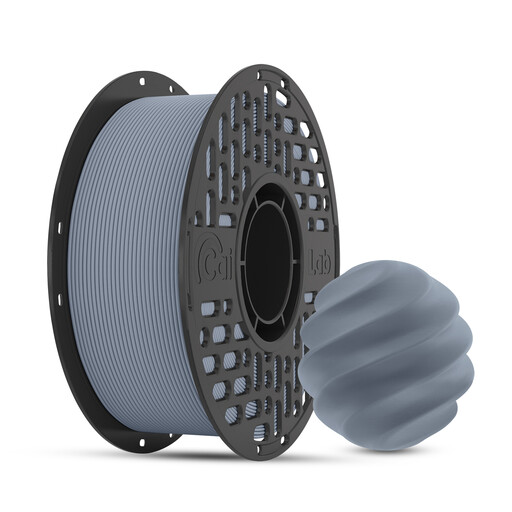
Why It Stands Out: This filament from CaiLab is distinguished by its new formula, which creates an exceptionally matte surface. The result is prints with a soft, natural aesthetic that hardly look like plastic, where the layer lines visually recede into the background.
Advantages:
Who Is It For? For users who value flawless aesthetics. Ideal for architectural models, product designs, artistic sculptures, and any object where a high-quality, non-plastic feel is a priority.
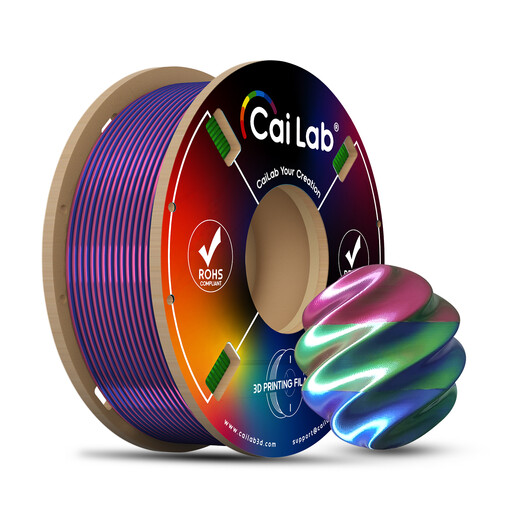
Why It Stands Out: This Silk PLA combines three colours (Red, Green, and Blue) in a single strand. During printing, the colours shift depending on the object's orientation, creating a dynamic, iridescent effect that makes every model unique.
Advantages:
Who Is It For? For hobbyists and creators who want to print eye-catching decorative items, gifts, toys, or artistic objects. Every printed part becomes a one-of-a-kind piece.
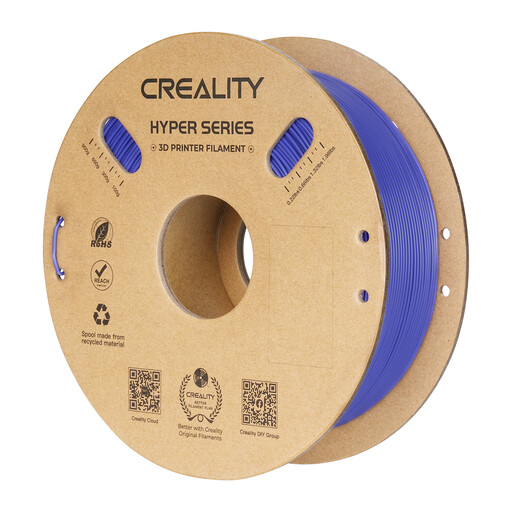
Why It Stands Out: Creality's Hyper PLA was specifically developed for use in high-speed 3D printers. According to the manufacturer, it enables print speeds of up to 600 mm/s without sacrificing quality.
Advantages:
Who Is It For? For owners of fast FDM printers (e.g., from the Creality K1 series) who need to produce functional prototypes, large models, or spare parts in a fraction of the usual time.
If the filaments presented here don't exactly meet your requirements or if you're looking for a different colour, there are many other options available. The selection is particularly vast in the blue PLA filament category, offering the right material for every application.
Discover our entire range of blue PLA 3D printer filament and find the perfect material for your project.
PLA+ (or PLA Pro) is a modified version of standard PLA. Through the addition of additives, it is generally more impact-resistant, less brittle, and exhibits better layer adhesion. It represents a good intermediate solution when the mechanical strength of standard PLA is insufficient, but you want to avoid the complexity of printing with materials like PETG or ABS.
PLA is hygroscopic, meaning it absorbs moisture from the air. Damp filament becomes brittle, breaks easily, and can lead to poor print quality (e.g., bubbling, poor adhesion). Therefore, always store your 3D printer filament in a cool, dry place. It's best to keep it in the provided resealable bag along with the desiccant (silica gel).
Yes, High-Speed PLA can generally be used on any FDM printer. However, its specific advantages, such as the ability to print cleanly at high speeds, will only be realised on printers designed for high acceleration and print speeds (typically above 150 mm/s). On a slower printer, it will behave similarly to normal PLA.