
Lieferung heute & morgen

Qualitätsgarantie

Willkommens-Angebote freischalten: KOSTENLOSE Lieferung | Bis zu 80 % RABATT | Kostenlose 30-Tage-JoyPlus-Testphase
App herunterladen
The selection of PLA filament on the market can be overwhelming. From high-speed materials to those with special finishes like matte or silk, making the right choice is crucial for the success of your 3D print. This guide is designed to help you understand the differences between various PLA types and make an informed decision tailored to your project's specific needs.
As a Joybuy Product Recommendation Officer, my mission is to provide you with objective and practical information so you can find the perfect 3D printer filament for your projects.
Before you choose a filament, there are some fundamental properties to consider. These factors determine not only the appearance of your print but also its print settings and performance.
With the development of faster 3D printers, specialised filament has become a necessity. High-speed PLA is formulated to melt and flow faster at higher temperatures. This allows for print speeds of 300 mm/s or more without issues like underextrusion. If you want to create prototypes quickly or print large models in less time, a fast PLA filament is a smart choice. For standard printers with lower speeds, conventional PLA is usually sufficient.
The filament's finish has a major impact on the visual appeal of the final object.
In addition to hundreds of single colours, there are also filaments with special colour effects. Multicolour PLA, often called rainbow PLA, changes colour along the length of the spool. This creates a smooth colour gradient on larger prints. Other variants, like co-extrusion filaments, combine two or three colours side-by-side, making the object appear to change colour depending on the viewing angle.
Here is a selection of PLA filaments that stand out for their specific properties, suited for various applications.
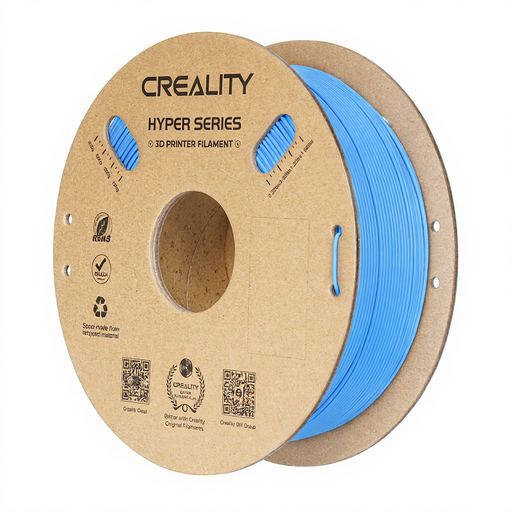
Why it stands out: Creality Hyper PLA is specifically engineered for high-speed printing. According to the manufacturer, it supports print speeds of up to 600 mm/s, which can significantly reduce printing time. Its high fluidity and rapid cooling ensure precise shaping even at high speeds. With a dimensional accuracy of +/- 0.02 mm, it is designed for consistent results.
Pros:
Who it's for: Users with high-speed 3D printers who want to produce functional parts, prototypes, or large models in the shortest possible time.

Why it stands out: This matte PLA from CAILAB is distinguished by its elegant, non-glossy surface. This quality helps to minimise the visibility of layer lines, giving printed objects a high-quality, finished appearance. The Maillard series colour palette also offers a selection of artistic, muted tones.
Pros:
Who it's for: Designers, artists, and hobbyists who value a unique aesthetic and want to create objects with a professional, non-plastic feel and look.
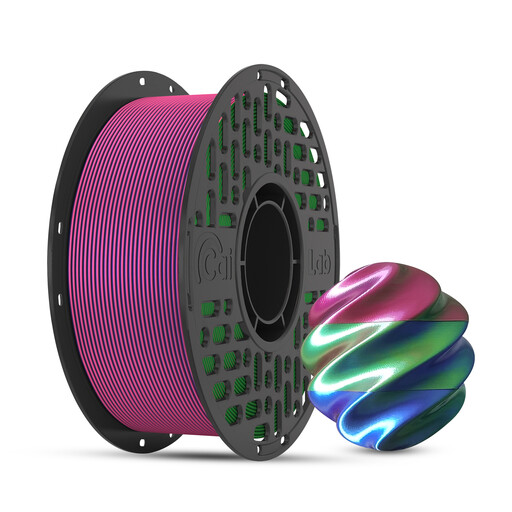
Why it stands out: This silk PLA combines three colours (Red, Green, and Blue) in a single filament strand. During printing, it creates a fascinating colour gradient that appears different depending on the object's geometry and viewing angle. The silky, high-gloss surface enhances this effect, making every print a unique piece.
Pros:
Who it's for: Users who want to print visually stunning objects like vases, figurines, toys, or decorations and are looking for a unique, dynamic colour effect.
If the options presented here don't perfectly match your requirements, or if you're looking for other colour variations, a wide range of alternatives is available. Every project has its own needs, and sometimes a very specific colour or property is required.
Explore our entire selection of blue PLA filament and find the perfect material for your next project.
High-speed PLA is an evolution of standard PLA. It has a modified chemical composition that allows for a higher flow rate and faster cooling. This enables the material to be processed at the high speeds and temperatures of modern 3D printers without compromising print quality or clogging the extruder. At such high speeds, standard PLA would lead to underextrusion and weak prints.
PLA is hygroscopic, meaning it absorbs moisture from the air. Damp filament leads to poor print quality (e.g., bubbling, brittle prints, poor layer adhesion). Therefore, always store your 1 kg PLA spools or other sizes in an airtight bag or box, ideally with a desiccant (silica gel). If the filament does become damp, it can be dried in a dedicated filament dryer or in an oven at a low temperature.
A heated print bed is not strictly necessary for PLA, but it is highly recommended. A bed temperature of around 50–60°C significantly improves first-layer adhesion and reduces the risk of warping (the corners of the print lifting off the bed). For most modern printers, a heated bed is standard equipment and should be used to achieve reliable results with PLA.