
Lieferung heute & morgen

Qualitätsgarantie

Willkommens-Angebote freischalten: KOSTENLOSE Lieferung | Bis zu 80 % RABATT | Kostenlose 30-Tage-JoyPlus-Testphase
App herunterladen
Choosing the right PLA filament can make or break your 3D print. But the market is flooded with options whose promises often don't match reality. As a Joybuy Product Recommendation Officer, I see the problems that arise during selection every day. Many users invest in material that leads to frustration instead of impressive results. This guide focuses on the objective criteria that will help you bypass common pitfalls and find a reliable filament for your project.
Before we dive into the technical details, let's look at the three most common issues that lead to failed prints and wasted material:
To avoid these problems, you should base your purchasing decision on verifiable technical parameters. The following three criteria are crucial for print quality and reliability.
The standard size for most desktop 3D printers is 1.75mm filament. However, the crucial factor here is not the nominal value, but the manufacturing tolerance. High-quality production ensures a maximum deviation of ±0.02 mm. This value ensures that the extruder can feed a consistent amount of material, resulting in uniform layer height and clean surfaces. Filaments with a higher tolerance (e.g., ±0.05 mm) are a common cause of the aforementioned nozzle clogs.
PLA (Polylactide) is the most popular 3D printer filament for hobbyists and prototyping professionals because it's easy to work with and is based on renewable resources. But not all PLA is created equal.
A good filament comes on a neatly and tightly wound spool. This prevents tangles during printing. The packaging is just as important. PLA is hygroscopic, meaning it absorbs moisture from the air. Moist filament leads to bubbling during printing (you might hear a faint crackling or hissing sound at the nozzle), poor layer adhesion, and a rough surface. Therefore, make sure the filament is vacuum-sealed and delivered with a bag of desiccant (silica gel).
Based on the criteria mentioned, we have selected a few products from our range that are suitable for different user profiles.
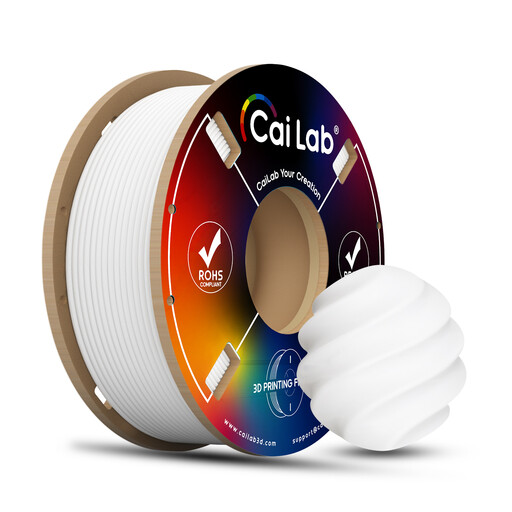
Why This Fits Their Persona: Ideal for users who want to print reliable and more mechanically robust parts. The neutral white color is excellent for prototypes that will be painted later, or for functional prints where color is secondary.
The PLA+ formulation is less brittle than standard PLA. This reduces the risk of breakage in functional parts and improves layer adhesion, which minimizes print failures due to delamination.
Improved toughness and good dimensional accuracy. Reliable processing on most FDM printers.
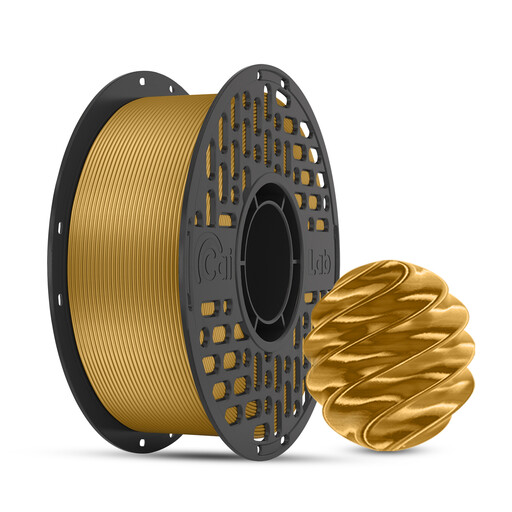
Why This Fits Their Persona: Perfect for users who want to print vases, figures, jewelry, or other decorative objects with a high-quality, glossy finish without complex post-processing steps like sanding or painting.
This silk filament delivers the promised glossy effect straight from the printer. It avoids the disappointment of buying a filament advertised as "silk" that ends up producing a matte finish.
Pronounced silk gloss for a metal-like appearance. Low warping and easy to print.
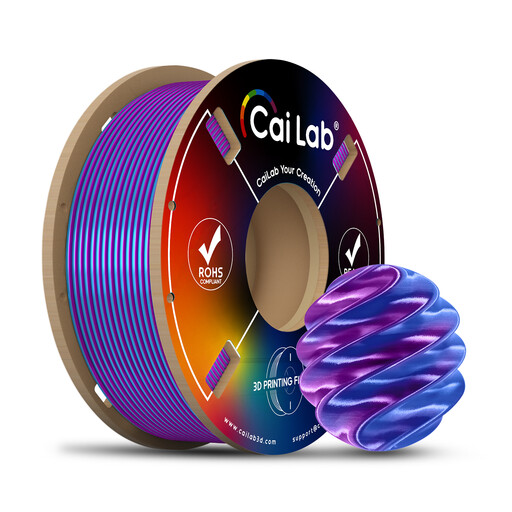
Why This Fits Their Persona: For makers and artists who want to create eye-catching, unique objects. This colorful filament produces a dynamic color-shifting effect that varies depending on the viewing angle and the model's geometry.
Instead of having to swap multiple single-color filaments to achieve a color effect, this material creates complex visual effects in a single, straightforward printing process.
Dual-color effect for iridescent objects. Combines the silk gloss with a color gradient for maximum visual impact.
We have compiled a complete, up-to-date list of products that fully meet these strict selection criteria.
Correct storage is crucial. Always keep opened spools in a resealable bag or an airtight box, ideally with the included desiccant packet. Store the filament in a cool, dry, and dark place to protect it from moisture and UV radiation, which can make the material brittle.
PLA+ filament is an enhanced version of standard PLA. According to many manufacturers, it is blended with additives that improve its mechanical properties. In general, PLA+ is tougher, less brittle, and has better layer adhesion than conventional PLA. This makes it a good choice for parts that need to withstand some stress, while retaining the easy printability of PLA.
Common causes for clogs are inconsistent filament diameter or impurities in the material. Check the manufacturer's tolerance specification; it should ideally be ±0.02 mm. Another cause can be a printing temperature that is too low. Every filament, especially colored or modified ones like CaiLab filament, may require slightly different temperature settings. Start with the manufacturer's recommended temperature and adjust it in small increments if necessary.