
Lieferung heute & morgen

Qualitätsgarantie

Willkommens-Angebote freischalten: KOSTENLOSE Lieferung | Bis zu 80 % RABATT | Kostenlose 30-Tage-JoyPlus-Testphase
App herunterladen
Choosing the right PLA filament can make or break your 3D printing projects. However, the market is saturated with options whose quality claims are often difficult to verify. Before you order another 1kg spool that leads to clogged nozzles or brittle models, you should understand the common pitfalls. Many users invest in filament that becomes unusable due to two critical but often overlooked flaws: inconsistent material diameters and insufficient factory drying. These issues lead directly to the most common frustrations in 3D printing—failed prints, material jams, and poor surface quality.
To avoid disappointment, it's crucial to focus on objective, technical parameters rather than marketing buzzwords. Two factors are non-negotiable for print quality and reliability.
The standard for most desktop 3D printers is a filament diameter of 1.75mm. However, far more important than this nominal value is the specified diameter tolerance. A tight tolerance, such as ±0.02mm, ensures that the material flow through the nozzle remains constant. Larger deviations can lead to uneven extrusion (over- or under-extrusion), which manifests as visible layer lines, messy details, and, in the worst-case scenario, a clogged nozzle. A filament with precise dimensional accuracy is a prerequisite for repeatable and reliable print results.
The choice of material depends directly on your intended application. It's important to know the fundamental differences to select the right material for your project.
Instead of making a one-size-fits-all recommendation, we have matched products to specific requirement profiles.
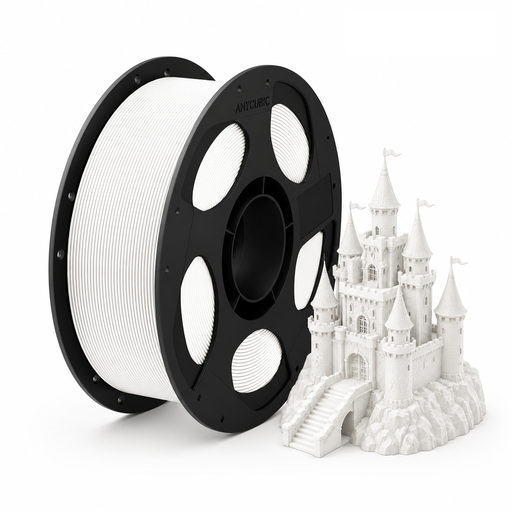
Why this product is a good fit: For beginners, a reliable and easy-to-process material is crucial. This standard PLA from Anycubic Filament is known for its straightforward handling and consistent quality, which significantly flattens the learning curve.
The specified diameter tolerance of ±0.02mm counteracts the problem of inconsistent extrusion, one of the main causes of failed prints for beginners.
High dimensional accuracy and reliability for a low failure rate, ideal for initial printing projects.
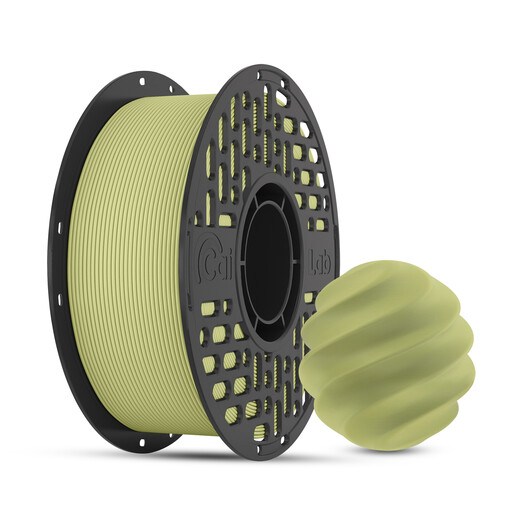
Why this product is a good fit: For users who prioritise a high-quality appearance, this Matte PLA offers a surface that lacks the typical plastic sheen. It is ideal for architectural models, figurines, and design objects.
This filament delivers a specific, verifiable characteristic—a matte texture. This is a clear product feature, not a vague marketing promise like those found with some "premium" filaments.
The matte surface effectively conceals layer lines, resulting in a smoother and more professional appearance for the finished print.
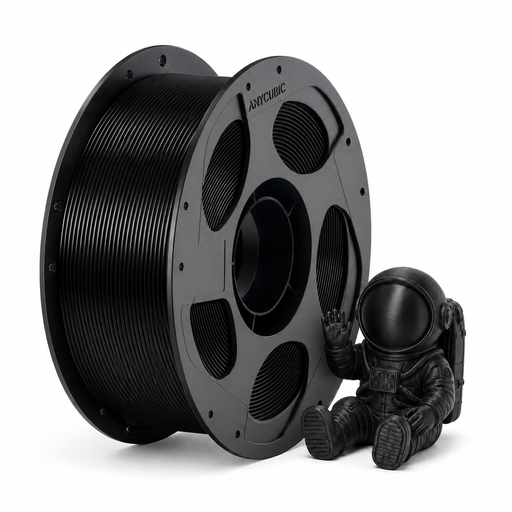
Why this product is a good fit: When prototypes or replacement parts require higher mechanical and thermal resistance, PETG filament is the right choice. It is more resilient than PLA and is suitable for enclosures, brackets, and other functional components.
Its clear designation as PETG prevents users from using unsuitable PLA for mechanically stressed parts that would fail under load or heat.
Increased strength, impact resistance, and temperature resistance compared to standard PLA.
We've curated a complete, up-to-date list of products that meet these strict selection criteria.
PLA and other filaments are hygroscopic, meaning they absorb moisture from the air. Moist filament becomes brittle and leads to poor print quality (e.g., bubbling, poor layer adhesion). Therefore, always store your filament spools in an airtight container or bag, ideally with a desiccant (silica gel). Open spools should not be left out in the open for extended periods.
The term "PLA+" is not a protected or standardized term. Manufacturers typically use it to describe a modified PLA formula that is claimed to have improved mechanical properties compared to standard PLA, such as higher impact resistance or better temperature resistance. However, the exact properties can vary significantly from one manufacturer to another. It is advisable to check the technical data sheets to understand the specific benefits of a PLA+ filament.
Most common consumer and hobbyist FDM 3D printers are designed for 1.75mm filament. As long as your printer supports this diameter, the filament is physically compatible. However, always check your printer's specifications. Some older or specialised models may use a 2.85mm diameter. In addition to the diameter, you should also consider the spool holder on the printer, although most 1kg spools fit on standardized mounts.