
Lieferung heute & morgen

Qualitätsgarantie

Willkommens-Angebote freischalten: KOSTENLOSE Lieferung | Bis zu 80 % RABATT | Kostenlose 30-Tage-JoyPlus-Testphase
App herunterladen
Glossy colour gradients are particularly eye-catching on figurines, vases and decorative 3D prints. At the same time, PLA Silk can be more demanding to print than standard PLA filament. If you buy based solely on the colour name or gloss effect, it is easy to overlook important factors: an unsuitable filament diameter, incorrect temperature settings or inadequate storage.
This buying guide explains what beginners and experienced hobbyists should look for in PLA Silk filament for 3D printers and which CAILAB variants suit different uses.
Silk filament for 3D printers is sensitive to temperature and speed. If the print speed is too high, the surface may appear uneven, while fine details on figurines or artistic models can lose their definition. According to the CAILAB user guide, slightly reducing the print speed can help produce a more even surface. However, the result also depends on the printer, nozzle and model.
With three-colour PLA filament or rainbow gradient filament, the colour areas do not change at the same point on every model. The gradient depends, among other things, on the amount of filament used, the model size and its orientation on the print bed. On small objects, the colour change may only be partly visible. If you are expecting a specific proportion of colours, it is therefore worth printing a test model.
PLA absorbs moisture in unsuitable storage conditions. According to the CAILAB guidance provided, possible consequences include stringing, bubbles, a rough surface, unstable extrusion and weaker layer adhesion. An opened spool should therefore be stored as airtight as possible with desiccant.
Many FDM printers use 1.75 mm filament. This measurement must match the printer’s extruder. Before buying, compare the printer manufacturer’s specifications with the product data. An unsuitable diameter can lead to incorrect material feeding.
The nozzle diameter and nozzle material are also relevant. For decorative objects, a standard nozzle is sufficient in many cases. Abrasive specialist filaments have different requirements; however, PLA Silk is primarily interesting for its glossy surface rather than for an abrasive fibre structure.
For CAILAB PLA Silk filament, the user guide provided specifies a nozzle temperature of 195 to 220 °C. The precise setting should be adjusted gradually to suit the printer, nozzle and speed. A temperature tower or small test object can help you compare surface quality and layer adhesion.
According to the product information, the print bed should be set to around 60 °C with an open printer, or approximately 45 to 60 °C in an enclosed print chamber. These values are starting points, not a guarantee for every print bed. On a glass plate, a solid glue stick can help improve adhesion. A PEI plate often requires no adhesive, provided the surface is clean and properly prepared.
After prolonged storage, drying may be advisable. The CAILAB guide specifies 50 °C for six to eight hours. Avoid using a high oven temperature, as this may damage the spool or the material. After drying, place the spool back in a sealed bag with desiccant.
A quick check is recommended before every larger print:
The following variants mainly differ in their colour combinations and gradients. Their suitability relates to typical uses such as decorative 3D prints, gifts and filament for artistic models.
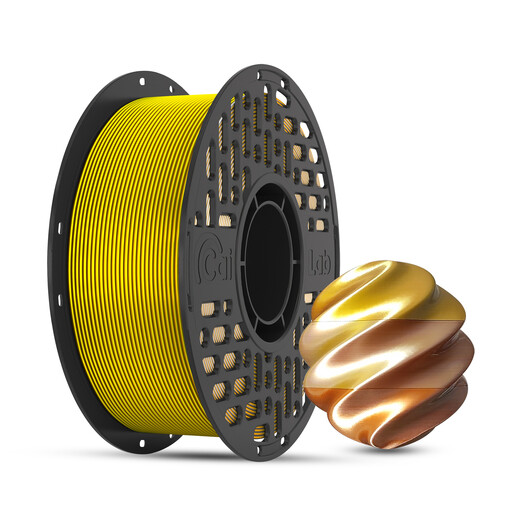
Why this product suits this profile: The combination of gold, silver and copper is ideal for first decorative projects, gift ideas and display pieces with a clearly defined colour contrast.
The visible three-colour gradient makes it easier to anticipate the colour effect. A small test model shows how the shades will be distributed across the size of the object before you start a larger print.
Tri-colour design in gold, silver and copper tones; according to the CAILAB guide, intended for decorative objects, gifts and artistic models.
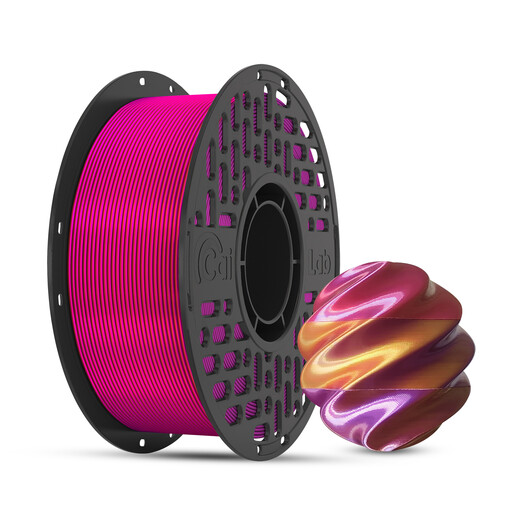
Why this product suits this profile: The vivid combination of red, gold and purple is designed for figurines, ornaments and objects where colour impact and gloss take centre stage.
The specified temperature ranges and recommendation to reduce the speed provide a clear starting point for repeatable test prints.
Three-colour PLA Silk design; according to the product guide, suitable uses include display pieces, gifts and decorative models.
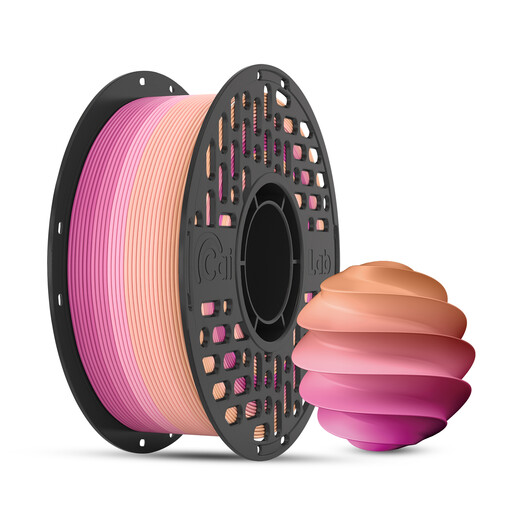
Why this product suits this profile: The Rainbow Gradient design gives frequent users a versatile option for different decorative projects, without having to plan every object in a single colour.
The gradient is not marketed as having an identical pattern guaranteed for every model. Test prints and suitable model orientation make it easier to plan the colour distribution.
Rainbow Gradient design in a plum colourway; suitable for figurines, decorations and projects of varying sizes.
For glossy PLA filament, consistent movements and a stable first layer are essential. If stringing occurs, lowering the nozzle temperature or increasing retraction may help. If layer adhesion is poor, carefully increasing the nozzle temperature may be beneficial. If bubbles or a rough surface appear, first check the moisture level of the spool.
PLA Silk is particularly suitable for decorative 3D prints, figurines, gift items and display models. For components subject to heavy mechanical loads, consistently high temperatures or functional applications, the material should not be chosen solely for its glossy effect. Other technical material properties are more important in these cases.
As a starting point, the CAILAB user guide specifies 195 to 220 °C for the nozzle. Depending on the printer enclosure and platform, the print bed may require approximately 45 to 60 °C. A small temperature test is advisable before starting a large model.
Not every new spool needs to be dried immediately. However, drying can be helpful after prolonged storage or if you notice stringing, bubbles or unstable extrusion. For the CAILAB Silk variants mentioned, 50 °C for six to eight hours is specified. The spool should then be stored airtight with desiccant.
There is no fixed shelf life, as this depends on the packaging, humidity and storage time. Unopened filament generally remains usable for longer than an open spool when stored in a dry, protected environment. The most important practical protection is to store the filament in a sealed bag with desiccant after every use.