
Lieferung heute & morgen

Qualitätsgarantie

Willkommens-Angebote freischalten: KOSTENLOSE Lieferung | Bis zu 80 % RABATT | Kostenlose 30-Tage-JoyPlus-Testphase
App herunterladen
The decision to make your own plant-based milk is often driven by a desire for freshness, fewer additives, and greater sustainability. A plant-based milk maker promises to simplify this process. However, the market is filled with appliances whose marketing promises don't always hold up to reality. Before you invest, it's crucial to understand the common pitfalls that can lead to disappointment and an unused appliance in your kitchen.
This guide, created by the Joybuy Product Recommendation Officer, will help you identify the essential features and make an informed decision.
Many appliances look promising at first glance but reveal their weaknesses only in daily use. Pay close attention to these three points to avoid a bad purchase.
To avoid the problems mentioned above, you should check three core technical aspects before buying. These are the primary determinants of the final quality and user convenience.
The ability to produce a truly smooth and residue-free plant-based milk depends directly on the rotational speed and the design of the grinding mechanism.
A simple blender can prepare cold plant-based drinks. A true vegan milk maker, however, offers more.
An effective self-cleaning function is the key to a positive long-term user experience.
Based on the criteria above, we have identified a few models that are well-suited for different user profiles and their specific needs.

Why It's a Good Fit: Ideal for families or individuals who want to try various plant-based milk alternatives without committing to a single type. The 8-in-1 functionality covers a wide spectrum from nut milk to soy milk and juices, and its 1-litre capacity is sufficient for the daily needs of 3-4 people.
The powerful 36,000 RPM motor and special internal rib design effectively pulverise ingredients, thus preventing the "filter-free" trap. The automatic cleaning function makes maintenance significantly easier.
8 preset programmes for high versatility. 12-hour timer for freshly made milk in the morning. Food-grade 304 stainless steel inner container.
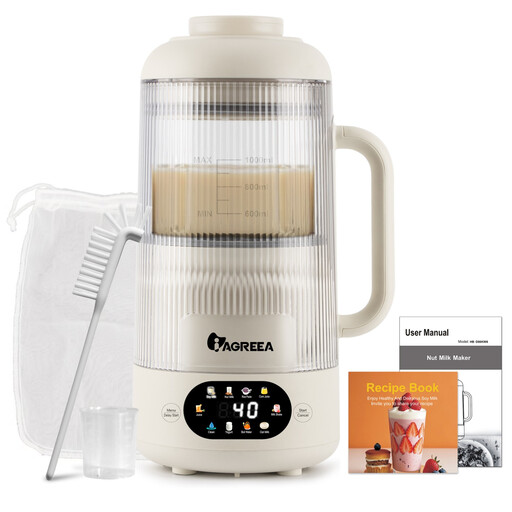
Why It's a Good Fit: Perfect for households where noise is a concern. The special soundproof cover allows for preparation early in the morning or late at night without waking the family. The focus is on maximum convenience through advanced, fully automatic cleaning.
Directly addresses the problem of loud motors with its soundproof cover. The self-cleaning with subsequent drying and sterilisation goes far beyond a simple rinse, completely solving the "hidden cleaning effort."
Extremely quiet operation. Fully automatic cleaning cycle including drying and sterilisation. High-quality borosilicate glass inner container that is heat-resistant and does not retain odours.
Properly caring for your appliance is crucial for its longevity and hygiene. Discover our range of cleaning products specially designed for kitchen appliances.
1. How much effort is really involved in cleaning a plant-based milk maker? The effort depends heavily on the model. Simple devices without a heating function and with removable parts are often dishwasher-safe. For models with an integrated heater, a good self-cleaning function is crucial. Look for programmes that use hot water to effectively dissolve stubborn residue. Models with an additional drying function offer the highest standard of hygiene and convenience.
2. Do I need to soak the nuts before using them in the nut milk maker? Soaking nuts (usually for 4-8 hours) is recommended for most machines. It softens the nuts, which leads to a creamier milk and is easier on the appliance's motor. Soaking also reduces phytic acid and enzyme inhibitors, which can improve digestibility. Some very powerful machines can also process dry nuts, but the result is usually better with soaking.
3. Is a plant-based milk maker worth it compared to store-bought drinks? Financially, the purchase can be worthwhile if you regularly consume plant-based drinks. The cost per litre of homemade milk is often significantly lower. Furthermore, you have full control over the ingredients—no added sugar, thickeners, or preservatives. Another advantage is the reduction of packaging waste (Tetra Paks), which contributes to a more sustainable household.