
Lieferung heute & morgen

Qualitätsgarantie

Willkommens-Angebote freischalten: KOSTENLOSE Lieferung | Bis zu 80 % RABATT | Kostenlose 30-Tage-JoyPlus-Testphase
App herunterladen
Deciding to make your own plant-based milk is often the first step towards a more conscious diet. Whether for health reasons, to avoid lactose, or simply for the pure, unadulterated taste—your own plant-based milk maker promises freshness without additives and packaging waste. But the market is flooded with appliances whose marketing promises often fall short in practice. Before you invest, it's crucial to understand the common pitfalls that lead to disappointment and an unused appliance gathering dust in a corner of your kitchen.
As your Joybuy Product Recommendation Officer, I'll help you separate the wheat from the chaff. We'll focus on the facts and the technical features that truly matter, so you can make an informed decision.
Many devices look promising at first glance, but only reveal their weaknesses during daily use. Pay close attention to these three points to avoid a bad purchase:
To avoid the problems mentioned above, you should base your selection on objective technical parameters. These three criteria are decisive for a satisfying result.
The creaminess of your plant-based milk depends directly on the appliance's ability to grind the ingredients extremely finely. Look for devices with high-speed motors (often with speeds over 20,000 RPM) and multi-blade systems made of stainless steel. This is the only way to ensure that even hard ingredients like almonds are completely pulverised, leaving no grainy residue. This is especially important if you want to make your own almond milk and achieve a silky mouthfeel.
The material of the blending container affects hygiene, durability, and taste.
A capacity of 800 ml to 1200 ml is generally sufficient for a household of 2 to 4 people.
Modern appliances take almost all the work off your hands. Features that make daily life easier include:
Based on the objective criteria above, we have identified a model that is suitable for different user groups.
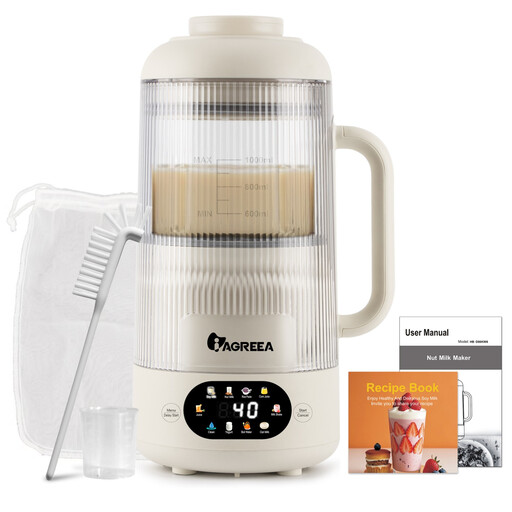
Why This Fits Their Persona: With a 1000 ml capacity, this appliance serves the whole family. The 12-hour delay start provides fresh plant-based milk right at breakfast time, without any morning stress. The fully automatic cleaning saves valuable time in a hectic family routine.
The automatic cleaning function, followed by sterilisation and drying, completely eliminates the pitfall of laborious manual cleaning.
12-hour timer and fully automatic cleaning cycle for maximum convenience.
Why This Fits Their Persona: Ideal for use in apartments or for early risers. The special soundproof cover significantly reduces operating noise, allowing the appliance to run at early or late hours without disturbing housemates or neighbours.
This model directly addresses the "unbearable noise" issue with its integrated soundproof cover, which effectively dampens the blending sound.
Soundproof enclosure for quiet operation and a durable copper motor for longevity.
Why This Fits Their Persona: Anyone looking to try different plant-based alternatives will benefit from the 10 preset programmes. Whether it's nut milk, oat milk, soy milk, or even corn juice—operation is intuitive thanks to the digital display and delivers reliable results without guesswork.
The 10-in-1 functionality solves the problem of limited versatility. Instead of an appliance that only does one thing well, this model offers a wide range of preparation methods.
10 automatic programmes for high versatility and a borosilicate glass container for hygiene and safety.
We have compiled a complete, real-time list of products that fully satisfy these strict selection criteria and UK safety regulations.
With a machine that has a dedicated programme for oat milk, the process is very simple. Typically, you just add oats and water to the container and start the programme. The maker heats the mixture to the correct temperature (to avoid a slimy consistency) and blends it. The entire process usually takes less than 30 minutes.
Soaking nuts (especially harder types like almonds) for a few hours or overnight is generally recommended. It softens the nuts, which leads to a creamier milk and reduces the strain on the machine's motor. Some very powerful models can process nuts without soaking, but the result is usually improved by soaking.
Since homemade plant-based milk contains no preservatives, its shelf life is limited. Stored in an airtight container in the refrigerator, it typically lasts for about 3 to 5 days. It's normal for the milk to separate after a while; just give it a quick shake before use.