
Lieferung heute & morgen

Qualitätsgarantie

Willkommens-Angebote freischalten: KOSTENLOSE Lieferung | Bis zu 80 % RABATT | Kostenlose 30-Tage-JoyPlus-Testphase
App herunterladen
Play equipment for children should suit their age, your home and how much activity they need. In practice, eye-catching product photos and long lists of features don’t automatically lead to the right purchase. What matters is clear information about age recommendations, dimensions, materials, weight limits and supervision.
Whether you’re looking for indoor play equipment for children, outdoor play equipment, a baby play gym or activity toys for older children, the following criteria can help you avoid a purchase you’ll regret.
A slide with a climbing wall, basketball hoop and tunnel sounds like it has plenty to offer. But in a small bedroom, it can quickly take up too much space. Before buying, consider the footprint, room to move around and storage. For a children’s bouncy castle, you’ll also need to factor in its inflated dimensions, weight and the clear space required around it.
A toy designed for children aged 2 and over isn’t suitable for babies. Conversely, a baby play gym may not offer enough of a challenge for older children. Always follow the manufacturer’s guidance and check warnings about small parts, climbing height and supervised use.
The stated maximum weight is a technical limit, not a recommendation for unsupervised play. If several children will be using the equipment, take account of their combined weight and how they move. Equipment with a swing, climbing or jumping feature also needs a suitable, level surface.
For babies, options include a baby playpen, a play mat for children or a baby play gym. A playpen should be placed on the floor, fully assembled and checked regularly for loose connections. With activity toys, make sure there are no small parts that could be swallowed.
For children aged around 2 and over, suitable options may include activity toys, movement toys and Montessori toys, depending on the product. A climbing frame for children should only be used when the age recommendation is appropriate and an adult can supervise them closely.
Measure not only the equipment itself, but also the clear space needed around it. A play mat measuring 100 × 190 cm provides a defined play area and can be rolled up after use. An indoor climbing frame measuring 127,5 × 83 × 110,5 cm, on the other hand, needs extra clearance from walls, windows and furniture.
Outdoor play equipment should be placed on a stable, preferably level surface. Climbing frames and swings may need a soft play mat or suitable impact-absorbing surfacing. Hard, uneven ground increases the risk of injury from falls.
Material details should be specific. Polyester, solid wood, MDF, plastic and Oxford fabric all have different care requirements. Washable fabric inserts make it easier to keep baby products clean. Electronic components should generally be kept away from water.
Look for clear standards and manufacturer information, too. For example, the roba playpens listed here refer to EN 12227:2010-12 or DIN EN 12227:2010-12. This doesn’t replace the assembly instructions or regular checks, but it does give you a specific standard to refer to.

Why this product suits this profile: This reversible play mat features a road design on one side and an animal design on the other. It’s designed for children aged 2 and over and rolls up neatly to save space after playtime.
The dimensions, polyester material and minimum age are clearly stated. This makes it easier to check that the mat will suit your space before you buy.
Reversible design, a 100 × 190 cm play area and easy cleaning with a damp cloth.

Why this product suits this profile: This baby playpen has three height-adjustable base positions, four castors with brakes and a washable fabric insert.
The maximum weight limit of 15 kg and suitability from birth to around 24 months are clearly stated. The brakes must be applied when the playpen is stationary.
Beech solid wood frame, a 100 × 100 cm area and a cover with care instructions for washing at 30 °C.
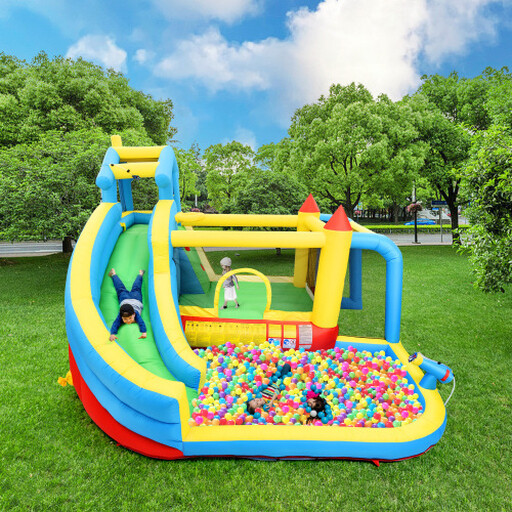
Why this product suits this profile: For families, nurseries or childminders with plenty of outdoor space, this model combines a bouncing area, slide, climbing features and water play.
The inflated dimensions of 364 × 315 × 239 cm, the limit of three children and the maximum weight of 135 kg are all stated. The blower must remain switched on while the castle is in use.
Designed for children aged 3 to 10; can be used dry or with water, provided the instructions are followed.
We’ve put together a complete, regularly updated list of products that meet these strict selection criteria and the safety regulations in force across the EU.
Suitable options may include a play mat, age-appropriate activity toys, a small climbing frame or a children’s slide. The key factors are the specific age recommendation, fall height, surface and whether you can supervise your child closely.
It depends on the product. As well as the manufacturer’s dimensions, you’ll need to allow extra room for movement and safety. For a bouncy castle, use the inflated dimensions; for a climbing frame, allow clear space in front of and behind it.
Its useful life depends on the materials, care, amount of use and storage. A playpen is usually limited by a child’s age and weight. A play mat may be used for longer, while climbing and jumping equipment needs regular checks for wear and stability.