
Lieferung heute & morgen

Qualitätsgarantie

Willkommens-Angebote freischalten: KOSTENLOSE Lieferung | Bis zu 80 % RABATT | Kostenlose 30-Tage-JoyPlus-Testphase
App herunterladen
Choosing a play kitchen can quickly become overwhelming given the sheer number of models, materials, and features. Many products overpromise and underdeliver, leading to disappointment in the playroom. As your Joybuy Product Recommendation Officer, I'm here to help you navigate the common pitfalls and make an informed decision that ensures long-lasting fun.
Before you make a decision, you should be aware of three common problems that often only become apparent after the purchase:
To avoid a bad buy, you should focus your attention on a few key parameters that determine the quality and durability of a play kitchen.
The choice of material is a fundamental decision. A wooden play kitchen is often made of solid wood or sturdy MDF boards. These models are typically heavier and more stable, which enhances safety. Wood is also considered a durable, long-lasting material. Many wooden kitchens, like the models from Theo Klein, are FSC-certified, indicating that the wood comes from responsible forestry.
Plastic kitchens often stand out for their lighter weight and integrated electronic features like light and sound effects. Brands like Miele often offer detailed replicas of their real-life appliances. For both materials, ensure compliance with safety standards such as EN 71 for toy safety, which mandates non-toxic materials and child-safe construction (e.g., rounded edges).
The worktop height is crucial for ergonomic and long-lasting use. Measure the height from the floor to your child's elbow to get an idea of the right counter height. A good worktop height is typically between 45 cm for toddlers and 55 cm for older children. Some models, like the Theo Klein 7199 Miele Kitchen, are even height-adjustable and grow with the child, significantly extending their lifespan.
Features like hobs with light and sound, a water tap with a pump function, or an ice dispenser on the fridge increase realism and play enjoyment. A mud kitchen for outdoor use, for example, offers the opportunity to play with real water and sand, which provides a valuable sensory experience.
Also, check if it's a play kitchen with accessories included. A starter set of pots, pans, and cooking utensils is often part of the package. High-quality play kitchen accessories made of metal or wood are generally more durable than simple plastic parts.
Instead of presenting an overwhelming list, we have selected models for specific user profiles.

Why This Fits Their Persona: Ideal for families who want to move playtime outdoors. This kitchen is specifically designed for play with water, sand, and natural materials, promoting sensory development.
The sturdy construction of FSC-certified solid wood prevents instability. Its play value remains consistently high thanks to the endless possibilities for creative play with natural elements.
Features a functional water tap with a reservoir and a removable plastic basin. The included accessories allow for immediate play right out of the box.
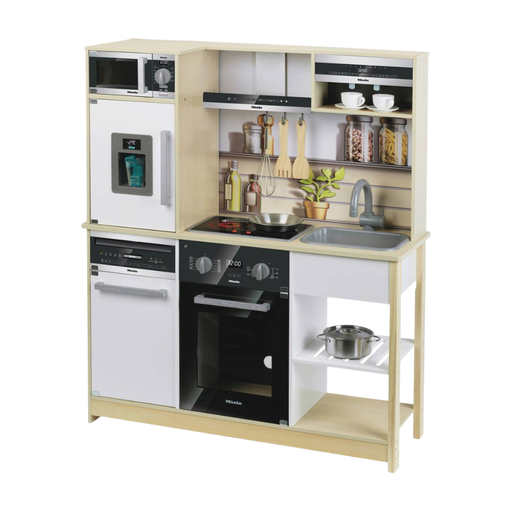
Why This Fits Their Persona: For parents who value a detail-rich design, high-quality materials, and a comprehensive feature set. This large Miele play kitchen is a statement piece for any playroom.
The FSC-certified wood construction ensures high stability. With a hob, microwave, espresso machine, and a fridge with an ice dispenser, play value is maximised and boredom is prevented.
The battery-operated hob with realistic sound and light effects, along with the high-quality metal and wood accessories, offers an authentic play experience.
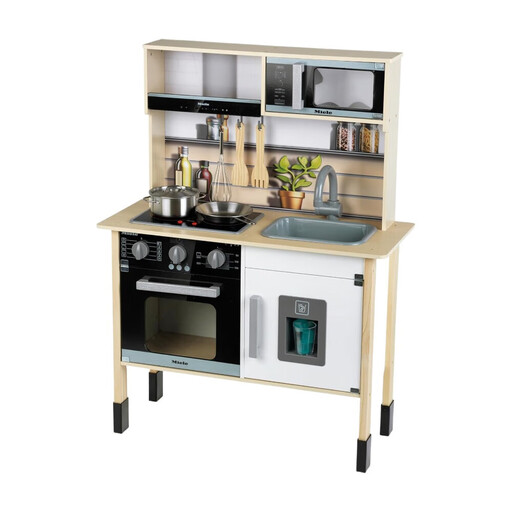
Why This Fits Their Persona: An excellent choice for families looking for a fully-equipped wooden kitchen with a modest footprint. It offers a balanced ratio of size, features, and quality.
The solid MDF construction provides the necessary stability. The good height of approx. 95 cm is suitable for children from 3 years and up, preventing it from being outgrown too quickly.
Features a hob with a light and sound module, a refrigerator with an ice dispenser, and comes with high-quality cookware made of metal and wood.
We have compiled a complete, up-to-date list of products that fully meet these strict selection criteria and German safety regulations.
A play kitchen is generally suitable for children aged 1.5 to 8 years. Simpler models or a mud kitchen are suitable for children as young as 18 months, as they promote grasping and basic motor skills. More complex kitchens with many details and electronic functions, like the Miele play kitchen models, are recommended for children aged 3 and up, as they are then able to fully immerse themselves in role-playing games.
A classic play kitchen is designed for indoor use and imitates a real kitchen with appliances like a hob, oven, and microwave. The focus is on mimicking cooking and baking processes. A mud kitchen, on the other hand, is a sturdy outdoor toy explicitly designed for play with water, sand, soil, and other natural materials. It encourages sensory experiences and creativity in the great outdoors.
While many play kitchens already come equipped with a basic set of accessories, additional items can significantly expand the play possibilities. Sets like the Theo Klein 9580 Bosch Breakfast Set or individual appliances like a hand mixer or a coffee machine can breathe new life into an existing kitchen and cater to a child's specific interests. They are a great way to increase the toy's play value over time.