
Lieferung heute & morgen

Qualitätsgarantie

Willkommens-Angebote freischalten: KOSTENLOSE Lieferung | Bis zu 80 % RABATT | Kostenlose 30-Tage-JoyPlus-Testphase
App herunterladen
The range of play kitchens is enormous, and at first glance, many models look promising. But once it's in the playroom, you quickly see which kitchen truly inspires creative play and which one ends up unused in a corner. Often, it's the small but crucial details that make the difference between a long-lasting favourite toy and a disappointing purchase.
Before you make a decision, it helps to know the most common pitfalls that can lead to disappointment:
To make an informed decision that meets your child's needs, you should check a few core parameters. These will help you objectively assess the quality and durability of a toy kitchen.
The choice of material affects stability, durability, and the tactile experience.
The worktop height is one of the most important yet most frequently overlooked factors. For a child to play comfortably over several years, the height of the worktop should match their body size.
A children's kitchen with light and sound can enhance the fun, provided the effects are realistic and not overwhelming. Cooking sounds or glowing hobs make role-playing more vivid. A functioning water pump at the sink is also a popular feature.
When it comes to accessories, less is more. Instead of a flood of small parts, a few well-made pots, pans, and cooking utensils are more sensible. High-quality play shop accessories can perfectly complement a play kitchen with accessories and expand the play possibilities. Models from brands like the Miele play kitchen or Bosch play kitchen often offer realistic and high-quality accessories.
Here are some recommendations tailored to different needs and play scenarios.
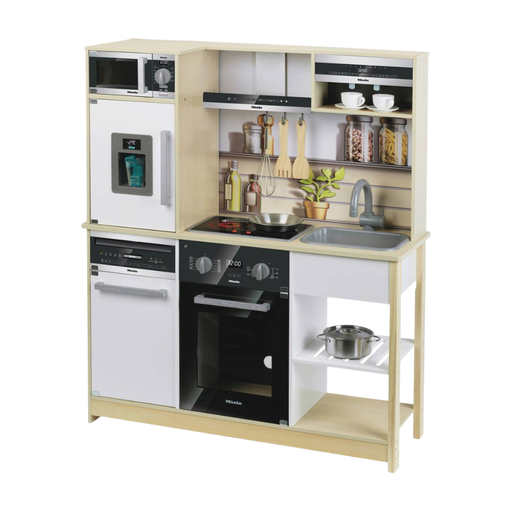
Why it's a great fit: For families looking for a durable, stable, and comprehensively equipped play kitchen. The FSC-certified wood and Miele design represent a high-value investment that will bring joy for years to come.
The robust wooden construction prevents instability. With a height of 101 cm, it offers an ergonomic playing height and avoids the trap of being too small. The metal and wood accessories are high-quality.
A combination of durability from wood, realistic features (hob with light/sound), and a generous, child-friendly size.

Why it's a great fit: Perfect for families looking for a long-term solution. The adjustable height ensures the kitchen remains ergonomically usable for several years, even with siblings of different ages.
The height-adjustability directly counters the problem of a child "outgrowing" the toy. The included stainless steel and wood accessories are of higher quality than typical mass-produced plastic sets.
A grow-with-me design that ensures long-term use, combined with robust materials and a hob with light and sound effects.
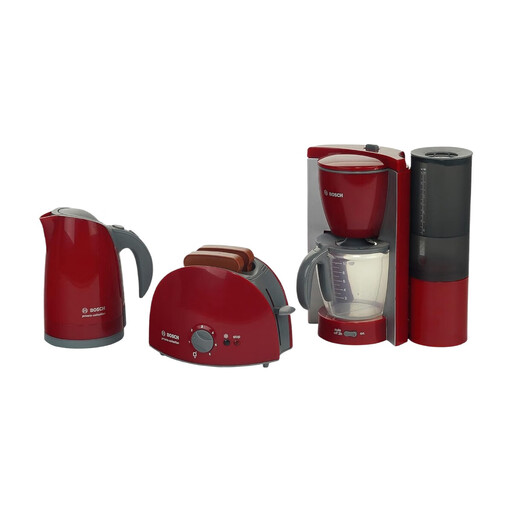
Why it's a great fit: Perfect for upgrading an existing, basic toy kitchen or for starting with a small but high-quality set. It specifically encourages role-playing around the theme of breakfast.
This set avoids the trap of "overloaded cheap accessories" by focusing on three appliances with realistic functions (mechanical toaster, coffee machine with water flow).
Branded accessories in a Bosch design with high play value, which work as a standalone set or meaningfully expand an existing kitchen.
We have compiled a complete, up-to-date list of products that fully meet these strict selection criteria and UK safety regulations.
Generally, a play kitchen is recommended from 3 years onwards. At this point, children's fine motor skills are sufficiently developed to handle the accessories, and the risk of swallowing small parts is lower. For younger children, there are special models without swallowable parts, but most complex kitchens are designed for children aged three and up.
To begin with, the basics are often enough to avoid overwhelming the child. A pot with a lid, a pan, a spatula, a cooking spoon, and a few plates and cutlery items are a good start. This can be supplemented with simple play food. Additional play shop accessories can be added later to create new play incentives.
A wooden play kitchen is easy to maintain if you follow a few points. For cleaning, a soft, slightly damp cloth is usually sufficient. Do not use harsh cleaning agents. It is important to wipe the surface dry immediately so that no moisture can penetrate the wood and cause it to swell. Removable parts made of plastic or metal can usually be cleaned normally with water and mild washing-up liquid.