
Lieferung heute & morgen

Qualitätsgarantie

Willkommens-Angebote freischalten: KOSTENLOSE Lieferung | Bis zu 80 % RABATT | Kostenlose 30-Tage-JoyPlus-Testphase
App herunterladen
A play kitchen can support creative role play over an extended period – provided its size, equipment and safety information are suitable for the child and the available space. There are clear differences between a compact children's play kitchen, a wooden play kitchen and electronic kitchen toys.
Anyone who focuses solely on lots of features or a familiar design can easily overlook important details. Three typical purchasing problems occur particularly often:
The label “play kitchen for children aged 3 and over” does not automatically mean that every accessory is suitable for younger children. Several of the products featured include manufacturer warnings about small parts and a potential choking hazard. The age recommendation should therefore be considered alongside the child’s actual stage of development.
If several children live in the household, it is also worth asking whether older siblings will be playing too. A set with lots of small parts may be appealing to older children, but younger children require particularly close supervision.
A wooden play kitchen is often made from MDF or other wood-based materials. Check the product description for details of the material, FSC certification, assembly requirements and cleaning instructions. Wooden surfaces should usually be cleaned with a soft, slightly damp cloth and then dried.
Plastic models are often lighter and, depending on their design, may be easier to wipe clean. For play kitchens with running water or mud kitchens, it is essential that all water is removed completely after play. For example, the manufacturer roba recommends emptying the containers and basin after every use and storing the product in a dry place when not in use.
Lights, sounds or running water can enhance role play, but they also require more checks. Look out for:
A toy kitchen with lights and sounds is not automatically suitable for every household. In smaller homes, a compact accessory, such as a children's coffee machine or hand mixer, can be a space-saving addition. For several children, however, models with two play sides or multiple work areas may be more appealing.
The following recommendations are based on clear product features such as material, dimensions, functions, age recommendation and what’s included.
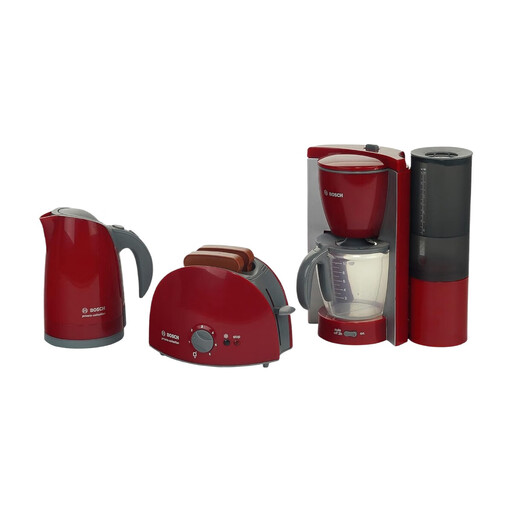
Why this product suits this profile: This set complements an existing play kitchen without the need to buy a large kitchen unit straight away. It contains a toaster, coffee machine and kettle and, according to the product information, is suitable for children aged 3 and over.
The contents are clearly limited to three appliances. This makes it easier to check which parts you already have and which additional items are still needed.
Mechanical toaster function, a water-filling function on the coffee machine and no batteries required according to the product information.

Why this product suits this profile: This height-adjustable wooden kitchen is a good choice for families looking for adaptable dimensions, FSC-certified wood and accessories made from stainless steel and wood.
The adjustable height reduces the risk of the worktop quickly becoming impractical as your child grows. Allow for assembly and two AA batteries.
Height-adjustable construction, sound and light effects on the hob and FSC-certified wood according to the product description.
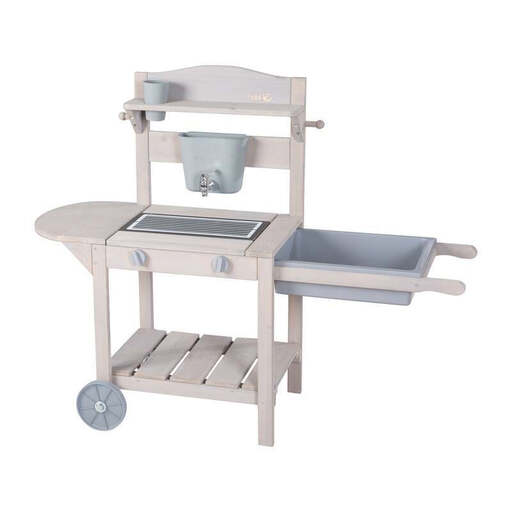
Why this product suits this profile: For families wanting to use role-play kitchen toys indoors and outdoors, this model offers wheels, a play basin and a water container with a tap.
The product description explicitly mentions indoor and outdoor use, as well as care after water play. This makes it easier to plan where and how to use it.
Worktop height of 52 cm, wheels and a water function; the stated overall dimensions are 114 × 37 × 89 cm.
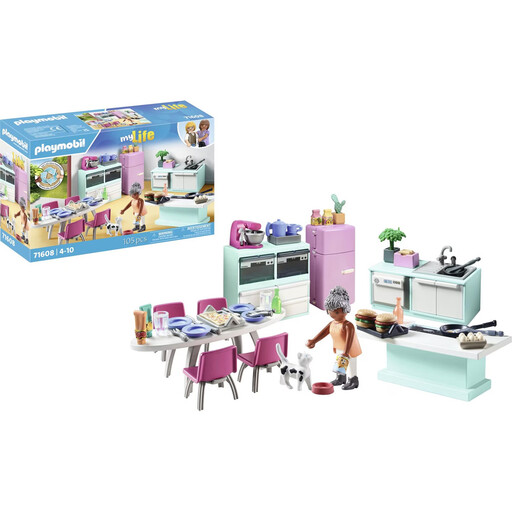
Why this product suits this profile: This compact set is aimed at children who enjoy incorporating figures, furniture and lots of small kitchen utensils into their stories. The age recommendation is 4 years and over.
The product details specify 105 pieces, the dimensions and manual operation. This makes it easier to assess the set’s scope realistically before buying.
No battery operation, freestanding fridge, kitchen island, dining area and accessories including a mixer, toaster and crockery.
We have put together a complete, regularly updated list of products that fully meet these strict selection criteria and the safety regulations applicable in the EU.
Not every play kitchen includes enough crockery, food or kitchen tools. Play kitchen accessories may include, for example, a Bosch hand mixer, a breakfast set, a play basin or additional food and crockery sets.
According to the product description, the Theo Klein 9574 Bosch hand mixer is battery-powered and has rotating beaters. The Play-Doh Magical Mixer Playset, on the other hand, focuses on mixing sounds, light effects and accessories such as a measuring cup and bowls. Before ordering, check whether batteries are required and whether the language of the instructions is relevant to your family.
With small collectibles such as MGA’s Miniverse Make It Mini Foods Diner, one point is particularly important: according to the description, the miniature ingredients included are not edible. The set contains small ingredients, tools and UV-curing resin, among other items. It should therefore only be used in accordance with the manufacturer’s instructions and under suitable supervision.
Models whose manufacturers state that they are suitable from age 3 and whose parts match the child’s stage of development are suitable. Also check the warnings relating to small parts. For electronic functions, the battery compartment and controls should be checked regularly.
This depends greatly on the model. A compact wooden kitchen may be around 70 to 91 cm wide, while larger models take up considerably more room. Before buying, consider the floor space, passageways and room needed to open doors. Accessory sets generally require less space.
Lights and sounds can enable additional play scenarios. However, they also involve battery consumption and a greater number of technical components. For families who prefer quieter play, a manual kitchen or non-electronic accessory may be a better choice. The key consideration is whether the features will actually be used in everyday life.