
Lieferung heute & morgen

Qualitätsgarantie

Willkommens-Angebote freischalten: KOSTENLOSE Lieferung | Bis zu 80 % RABATT | Kostenlose 30-Tage-JoyPlus-Testphase
App herunterladen
A play kitchen can become a permanent feature of a child’s bedroom for many years. However, toy kitchens vary considerably in terms of material, size, stability, accessories and interactive functions. A low price says little about whether a kitchen is suitable for the available space and the child’s age.
That is why it is worth taking a close look at the product specifications before buying. This helps you avoid common purchasing mistakes and choose a play kitchen for children that fits in with your family’s everyday life.
Lights, sounds and water functions may initially seem appealing. However, what matters is whether they add value to role play. A hob with sound can enhance play, while a hard-to-reach button or complicated battery compartment may prove impractical in everyday use.
You should therefore check:
A large wooden play kitchen requires more floor space than product images might suggest. Models over 80 centimetres wide should be measured at the intended location before purchase. The worktop height is also important: a kitchen that is too low can quickly become uncomfortable, while a very tall model may be difficult for smaller children to access.
If space is limited, a compact play kitchen set or individual appliances such as a blender, coffee machine or sink can be a practical alternative.
A large number of individual pieces does not automatically provide more opportunities for play. What matters is whether the pots, plates, cutlery, food items and kitchen tools match the play kitchen and can be stored neatly. Small parts should also be suitable for the recommended age, and all pieces should be accounted for after playtime.
A wooden play kitchen, or one made from wood-based materials, generally feels sturdy and is suitable for a permanent location. With MDF models, the edges and surfaces should be finished neatly. Wooden surfaces are best cleaned with a slightly damp cloth and then wiped dry. Prolonged moisture can cause wood-based materials to swell.
Plastic kitchens are often lighter and can be wiped clean easily. They may therefore be suitable if you need to move the kitchen regularly or if you are looking for individual kitchen modules. Regardless of the material, all parts should be checked for sharp edges, loose connections or damage before use.
The models featured are predominantly intended for children aged 3 and over. One reason is the potential risk of swallowing small parts. The manufacturer’s age recommendation should be viewed not only as guidance for play value, but also as important safety information.
You should also look for:
Toy kitchen sets for children aged 3 and over are not intended for preparing real food. Hobs, ovens and accessories are play objects and are not suitable for heating.
A play kitchen with lights and sounds will generally require batteries. Check the exact number and type of batteries, as they are not always included. With a children’s kitchen with a tap, or a toy sink with a pump, all water should be removed completely after each use. Moisture must not come into contact with electronic components or battery compartments.
Storage and care are also important for outdoor use. Water containers and sinks should be emptied, and the product should be stored somewhere dry or covered when not in use.
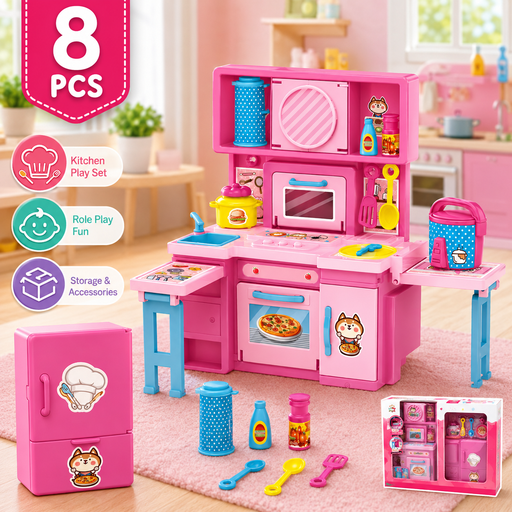
Why this product suits this profile: The 8-piece set offers an accessible introduction to kitchen role play and is suitable as an addition to existing play furniture.
The set is clearly limited to accessories. This makes it easier for buyers to check which parts they already have and whether additional storage space is needed.
8 pieces; designed for creative play, presents and family activities.
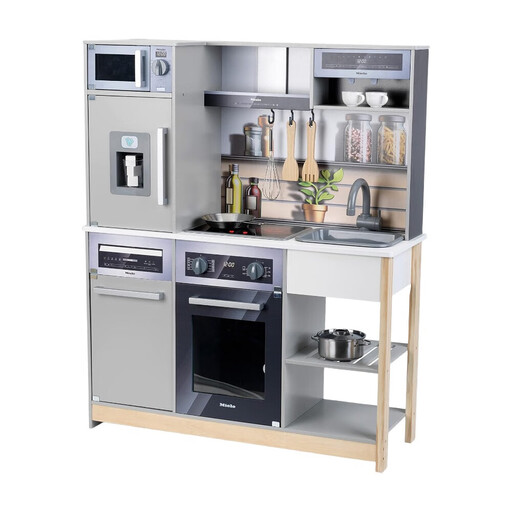
Why this product suits this profile: This large wooden kitchen is ideal for families looking for a dedicated play area with several integrated stations.
The dimensions of 83.5 × 30 × 101 cm and the weight of 16.3 kg make the space and assembly requirements clear. The intended location should be measured before purchase.
FSC-certified wood according to the product information; hob with sound and two-stage lighting; microwave, fridge and removable sink.
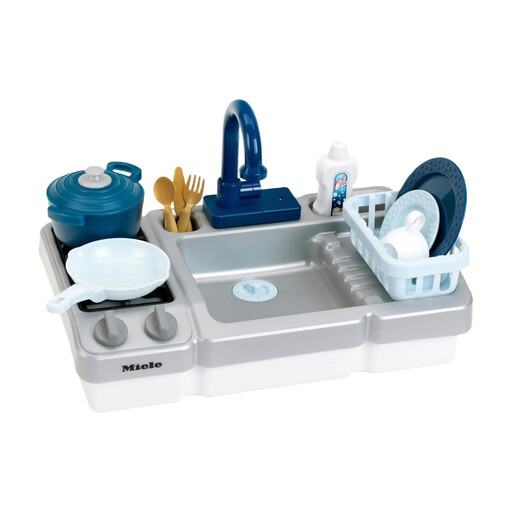
Why this product suits this profile: This compact sink is aimed at children who particularly enjoy washing, drying and water-based play.
The water pump function is clearly stated. This allows you to decide in advance whether you need a dry play area or a location that can be wiped clean.
Real water flow from the tap; hob, plate, saucepan, cutlery and draining rack included; recommended for ages 3+.
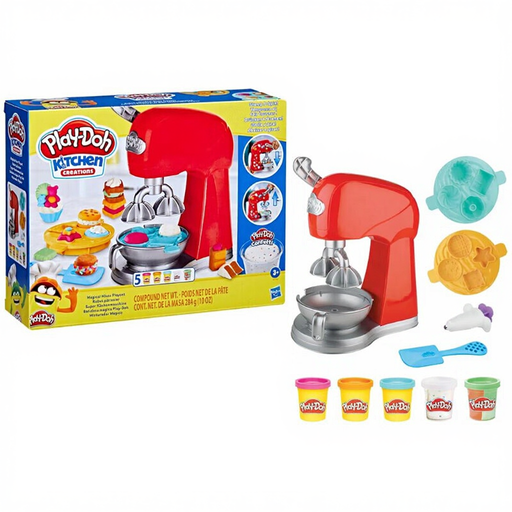
Why this product suits this profile: This compact mixer complements an existing play kitchen and offers a focused activity centred around mixing and baking.
The dimensions, material, age recommendation and accessories are clearly specified. Even so, the electronic functions should only be cleaned externally and with a dry cloth.
Mixing sounds and light effects; measuring jug, bowls and play ingredients included; product information states suitable from age 3.
We have put together a complete, regularly updated list of products that fully meet these strict selection criteria and the safety regulations applicable in the EU.
Individual additions can be used to expand an existing play kitchen in a targeted way. For a Bosch kitchen toy, for example, the Theo Klein 9574 Bosch Hand Mixer Set is a good choice. The mixer has removable beaters and rotating functions; according to the product information, it requires one battery.
For breakfast scenarios, the Theo Klein 9580 Bosch Breakfast Set includes a toaster, coffee machine and kettle. The coffee machine has a water-filling function, while the toaster is operated mechanically. If you are looking for a smaller accessory, you could also consider a children’s coffee machine with a water tank and flow function, such as the Theo Klein 9510 Barista Coffee Machine.
With water-based play, proper care is particularly important: empty and dry the accessories after use, and check them regularly for cracks or loose parts.
Many models are approved by the manufacturer for children aged 3 and over. Small parts may pose a risk to younger children. The specific age recommendation, the features and the level of supervision required are always decisive.
This depends on the model. Compact kitchens, for example, may have a footprint of around 70 × 30 cm, while larger versions can be over 80 cm wide. There should also be enough room around the kitchen for children to move safely. Before buying, measure the available space, door openings and assembled height.
A play kitchen with lights and sounds requires batteries, with consumption depending on how long it is played with and the range of functions. Models without electronic elements do not need batteries. With battery-powered play kitchen accessories, batteries should be removed if the product will not be used for an extended period, and the battery compartment should be kept dry.