
Lieferung heute & morgen

Qualitätsgarantie

Willkommens-Angebote freischalten: KOSTENLOSE Lieferung | Bis zu 80 % RABATT | Kostenlose 30-Tage-JoyPlus-Testphase
App herunterladen
A play kitchen can encourage creative role play and be enjoyed for years. But there are clear differences between compact sets, wooden play kitchens and fully equipped models. For parents, grandparents and anyone buying a gift, it’s not just about design: the right choice also depends on age recommendations, stability, space, materials and features.
Lights, sounds, water pumps and plenty of accessories may look appealing at first. What matters is whether the features are right for your child’s age and will be used regularly. Electronic components need batteries and must be kept away from water. If you’re considering a play kitchen with lights and sounds, check the volume, ease of use and whether the battery compartment closes securely.
A children’s play kitchen can be much larger than product photos suggest. Models with a fridge, microwave or side shelves need plenty of floor space. Before you buy, compare the width, depth and worktop height with the space you have available. In a small home, a compact model may be a better choice than a large family-style kitchen.
A play kitchen with accessories isn’t automatically more versatile. Check whether the included pieces suit the kitchen’s design and whether you can buy additional items separately. Small parts can also pose a choking risk, so check the age recommendation and warnings before buying and before first use.
Many of the models featured here are labelled as suitable as a play kitchen from age 3. That doesn’t mean every child of the same age can safely use every feature. Keep small accessories out of reach of younger siblings. Adults are responsible for assembling the kitchen, fitting the batteries and regularly checking screws and joints.
Before use, it’s worth checking the following:
A wooden play kitchen or a play kitchen made from wood is often made from wood-based materials such as MDF or from solid wood. Specific material details are more useful than vague claims such as ‘natural’ or ‘especially sturdy’. Wooden surfaces should generally be cleaned with a soft, dry or slightly damp cloth. Keep water away from electronic components and battery compartments.
A play kitchen designed for both indoors and outdoors has additional care requirements. Empty water containers and play sinks after every use. Outdoor models should be stored in a dry place or covered to prevent moisture and the weather from putting unnecessary strain on the materials.
The right worktop height makes it easier for children to play while standing. Height-adjustable models can be adapted to your child’s height. If the kitchen will be used regularly, also check whether it has enough storage for pots, crockery and play food.
These questions can help you choose:
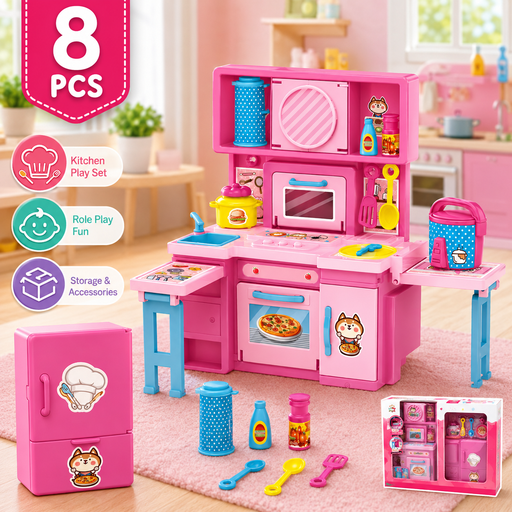
Why it suits this profile: This set of 8 offers a straightforward introduction to kitchen role-play toys and can be added to an existing play area.
The manageable number of pieces helps avoid unnecessary extras. Before buying, it’s still worth checking which kitchen items you already have.
Set of 8; designed for creative play and family role-play.
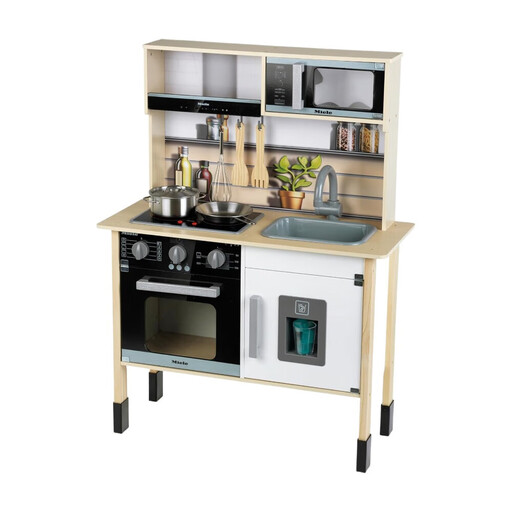
Why it suits this profile: This Miele play kitchen, made from MDF, features a hob, microwave, fridge and removable sink. It’s designed for children aged 3 and over.
The product details give dimensions of 70 × 30 × 95 cm and a weight of 9.5 kg. The lights and sounds require two AA batteries.
Wooden construction; hob with sound and two-stage lighting; metal and wooden accessories.
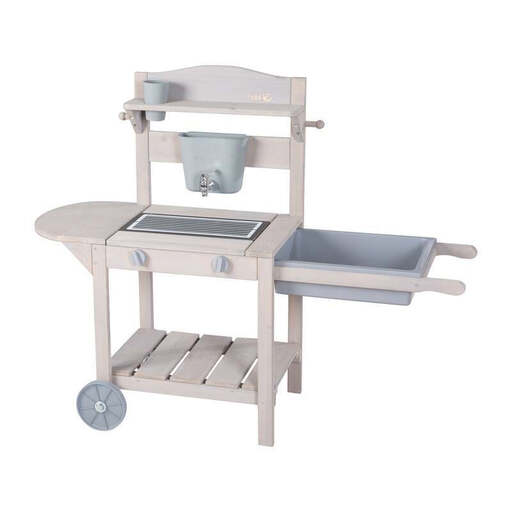
Why it suits this profile: This model is designed for indoor and outdoor play. It has wheels, a play sink, a water container with tap and a shelf.
The intended uses are clearly described. Empty the water after every play session and store the product in a dry place when it’s not in use.
FSC-certified wood according to the product details; 114 × 37 × 89 cm; work surface at a height of 52 cm; listed as suitable from 18 months.

Why it suits this profile: This height-adjustable wooden play kitchen is designed to last and suit children of different heights. It’s equally suitable for girls and boys.
The adjustable height helps prevent the worktop from becoming unsuitable as your child grows. Adults should assemble the kitchen and fit the batteries.
Adjustable height; 91 × 30 × 91 cm; hob with light and sound effects; metal and wooden accessories.
We’ve put together a complete, regularly updated list of products that meet these strict selection criteria and fully comply with the safety regulations in force in the EU.
Look for models that the manufacturer lists as suitable from age 3 and that have sturdy, fully assembled parts. Small pieces, batteries and accessories should be used with supervision and kept away from younger siblings.
How long it lasts depends on the materials, assembly, care and how often it’s played with. Regularly tightening the screws, storing it in a dry place and repairing or removing damaged wooden parts can extend its usable life. Protecting outdoor models from moisture is particularly important.
Mechanical models don’t need batteries. A play kitchen with lights and sounds may require AA batteries, which add to the cost. You can add accessories such as play crockery or food later, but they’re not essential for every model. Check the product details before buying.