
Lieferung heute & morgen

Qualitätsgarantie

Willkommens-Angebote freischalten: KOSTENLOSE Lieferung | Bis zu 80 % RABATT | Kostenlose 30-Tage-JoyPlus-Testphase
App herunterladen
A playpen should be a safe space where your baby can discover the world while you have your hands free for a moment. However, the market is flooded with models whose practical drawbacks often only become apparent in daily use. Before you make a decision, it's helpful to know the typical pitfalls that can lead to a purchase you'll regret.
As your Joybuy Product Recommendation Officer, I'm here to help you navigate the marketing noise and make an informed choice. We'll focus on the facts that truly matter.
Common Problems When Choosing a Playpen:
To avoid these problems, you should focus on three core areas: certified safety, thoughtful functionality, and high-quality materials.
A crucial quality indicator is certification according to the European safety standard EN 12227. This standard ensures that the product meets fundamental safety requirements. These include:
Look for "complies with EN 12227" or "manufactured in accordance with EN 12227" in the product description.
The material determines not only the look but also the durability and safety. A wooden playpen, often made of solid beech, is a popular choice. It's robust, durable, and blends well into most living spaces. Look for a smooth, splinter-free finish and food-safe varnishes, as babies love to suck or bite on the bars.
The shape is also an important factor. While classic square models (e.g., 100x100 cm) offer plenty of space, a hexagonal playpen can be an interesting and space-saving alternative that fits well in corners or as a freestanding feature in the room.
Functional details make all the difference in daily use:
Here are some models tailored to the specific needs of families, which successfully avoid the common pitfalls mentioned.

Why it's a great fit: Ideal for apartments where space needs to be used efficiently. It folds up quickly for storage without sacrificing essential features like height adjustment and mobility.
The folding mechanism is designed for durability to overcome the typical instability of collapsible models. The 2-level height adjustment also prevents back strain.
Compact folded size: Folds down to approx. 70 x 10 x 5 cm. Mobile: Integrated wheels for easy transport.
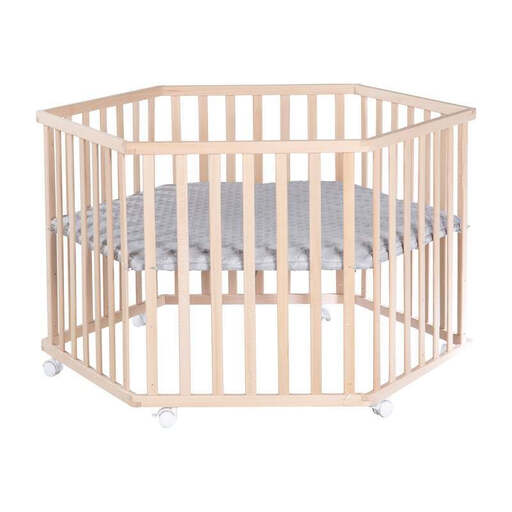
Why it's a great fit: For parents who value aesthetics and high-quality materials. The hexagonal shape and solid beech wood make it a stylish piece of furniture that combines safety and design.
The solid beech wood construction ensures maximum stability. The washable liner and safety certification according to DIN EN 12227:2010-12 address concerns about hygiene and sturdiness.
High-quality material: Frame made of solid beech wood. Functional: 3-level height adjustment and mobile thanks to six locking castors.

Why it's a great fit: A reliable all-rounder that combines all the essential functions for daily use. It's mobile, safe, and easy to clean—a pragmatic choice for parents who prioritise functionality.
The 3-level height adjustment provides long-term ergonomics. The padded fabric liner is removable and washable at 40°C, which significantly simplifies cleaning and prevents hygiene issues.
Easy to clean: Quilted microfibre liner is machine-washable. Safe and mobile: Developed in accordance with EN 12227:2010 and equipped with four locking castors.
A playpen isn't the only way to create a safe and stimulating play environment. Depending on your child's age and developmental stage, other products can be a useful addition or alternative:
A safe play area is just one part of your baby gear. Discover our carefully curated selection of developmental toys and activity centres.
1. From what age is a playpen useful? A playpen can be used from birth. In the first few months, with the base in the highest position, it serves as a safe bassinet substitute. It becomes most useful when your baby becomes more mobile, around 4 to 6 months, as they start to roll and crawl.
2. How high should the base of a playpen be set? The rule is simple: as long as your baby is only lying down, you can use the highest setting for back-friendly lifting. As soon as they can sit up independently or pull themselves up on the bars, the base must be lowered to the lowest setting for safety.
3. Can I put an extra mattress in the playpen? No, you should never place an additional mattress, pillows, or soft blankets in the playpen. These can pose a suffocation or entrapment hazard. Only use the custom-fit, thinly padded base liner provided by the manufacturer. Your child's safety is the top priority.