
Lieferung heute & morgen

Qualitätsgarantie

Willkommens-Angebote freischalten: KOSTENLOSE Lieferung | Bis zu 80 % RABATT | Kostenlose 30-Tage-JoyPlus-Testphase
App herunterladen
A pleated blind no-drill clamp fix is a practical choice for rented flats, owned homes, and frequently changing living situations. Installation is usually done with clamp brackets on the window frame or with adhesive holders on a suitable, smooth surface. This means no drill holes in walls or frames.
However, unclear measurements and blanket promises when buying often lead to wrong decisions. Three typical pitfalls are particularly relevant:
First, measure the glass width as well as the height of the entire window or door frame. For many models, it is recommended to choose an order width approximately 2 to 4 cm wider than the glass width. This improves the side coverage, but must not cover window handles or protruding fittings.
Also, pay attention to how the measurements are written: usually, width × height is given. A model measuring 65 × 100 cm is therefore 65 cm wide and 100 cm high.
For a pleated blind for doors or a patio door, you should also check that the fabric does not touch handles, seals, or the floor when opening. For particularly tall glazed areas, variants with a height of 140 or 200 cm may be useful.
A genuine pleated blind without drilling for windows can be fixed with clamp brackets, adhesive holders, or a combination of both. These systems are not freely interchangeable:
With some products, the total width including brackets is given. For the WOLTU Blackout Roller Blind 80 × 150 cm, the product description notes that the fabric width can be approximately 4 cm less than the total width.
A light-filtering pleated blind lets daylight into the room and, depending on the fabric, reduces direct glare. This is suitable, for example, for living rooms, kitchens, offices, or bathrooms. A dark fabric can also reduce visibility from outside during the day, but does not automatically replace a blackout pleated blind.
For bedrooms or children's rooms, opaque or so-called blackout variants are suitable. For the WOLTU Honeycomb Pleated Blind, an opaque polyester fabric with a honeycomb structure is specified. The product description also mentions a frame mounting for 10 to 23 mm thick frames and operation via top and bottom handles.
Terms like thermal pleated blind, UV protection, or sound reduction should be evaluated based on the specific product details. A coated back, a multi-layer construction, and the material specification are more meaningful than general advertising claims. For cleaning, a soft, damp cloth is usually recommended for the products presented here. Aggressive cleaning agents can damage the fabric or coating.
The following recommendations classify specific models according to usage situation, size, and features. They do not replace checking against your window measurements and the respective installation instructions.
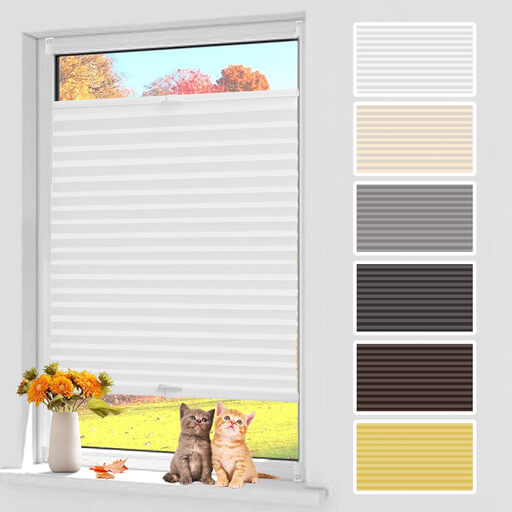
Why this product fits the profile: The compact size is suitable for smaller standard windows. The clamp-fix mounting requires no drilling, and the white polyester fabric is designed for light and privacy control according to the product description.
The dimensions are clearly stated as 60 × 100 cm. Before buying, you still need to check against your glass width and the permissible frame thickness.
60 × 100 cm, white polyester, tool-free clamp-fix mounting, and adjustable light coverage.

Why this product fits the profile: For bedrooms, workspaces, or windows with strong sunlight, this roller blind offers an opaque design and operation via the bottom rail without a pull cord.
The product description specifies the frame range of 16 to 22 mm and notes that the fabric width is less than the total width. These details help with size checking.
80 × 150 cm, clamp-fix or drill mounting, coated back, and operation without a pull cord.
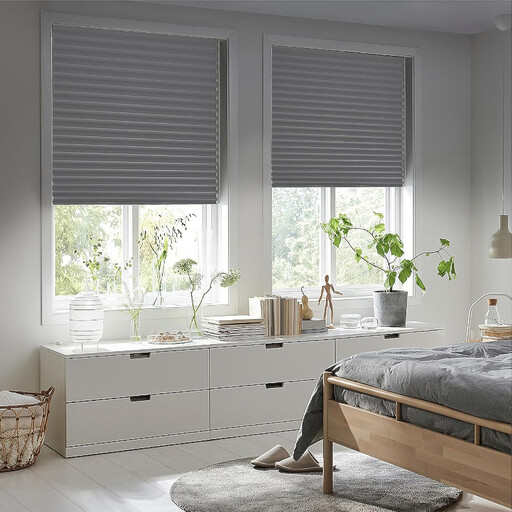
Why this product fits the profile: The semi-transparent design is suitable for rooms where you want to keep daylight, such as living rooms, kitchens, offices, or bathrooms.
The description "light-filtering" makes it clear that this model is not intended for complete room darkening. Clamp or adhesive holders can be used depending on the surface.
70 × 140 cm, light grey polyester, adjustable height, and no-drill mounting on windows or doors.
We have put together a complete, regularly updated list of products that fully meet these strict selection criteria and the safety regulations in force in the EU.
That depends on the mounting type and the condition of the frame. Clamp-fix brackets need a suitable frame area, while adhesive holders require a smooth, dry, and load-bearing surface. On rough, uneven, or damp surfaces, the fixing may be unsuitable.
A fixed lifespan cannot be given universally. It is influenced by factors including material, frequency of use, sunlight exposure, and correct installation. Regular stability checks and gentle operation can reduce wear and tear.
A manually operated pleated blind or clamp-fix roller blind does not need electricity. Running costs are therefore usually limited to cleaning and, if necessary, replacing brackets or accessories. For a thermal pleated blind, you should check the specific material and coating details rather than assuming general savings.
