
Lieferung heute & morgen

Qualitätsgarantie

Willkommens-Angebote freischalten: KOSTENLOSE Lieferung | Bis zu 80 % RABATT | Kostenlose 30-Tage-JoyPlus-Testphase
App herunterladen
A pleated blind without drilling is ideal for rented homes, refurbished rooms and windows where you want to avoid permanent drill holes. Depending on the model, installation is carried out using clamp brackets, Klemmfix brackets or adhesive pads. This means that windows and doors can often be fitted without any tools.
Despite the straightforward installation, there are several common buying and marketing pitfalls to watch out for. A wide choice of sizes, fabrics and mounting methods does not always make comparison easy. If you focus only on colour or price, you may end up with a pleated blind that does not fit the window frame or deliver the desired level of light control.
The stated width may refer to the overall width, including the brackets. With some roller blinds, the fabric is also narrower than the product dimensions. According to the product information, the fabric on the WOLTU Blackout Roller Blind is approximately 4 cm narrower than the overall width. For the most complete coverage possible, measure the glass width precisely and take the installation method into account.
A blackout pleated blind made from an opaque fabric significantly reduces the amount of light entering the room. However, light may still come through at the sides if the blind is narrower than the window pane or is not fitted directly into a guide. By contrast, a light-filtering or privacy pleated blind will still allow daylight through. These properties should not be confused.
A pleated blind with clamp fitting requires a suitable window frame and an appropriate clamping range. Depending on the model, frame thicknesses of 10–23 mm, 13–23 mm or 16–22 mm may be supported, for example. Roof windows, sliding windows, wooden windows or sloping windows may be unsuitable. Before buying, check the frame thickness, window shape and opening style.
A Klemmfix pleated blind is usually attached to the movable window sash. This is practical if you still want to tilt or open the window. When fitted correctly, clamp brackets normally leave no drill holes, but they must be securely attached.
Adhesive installation is suitable for smooth, clean and even surfaces. Uneven, rough or heavily soiled frames can impair adhesion. The surface should be cleaned and dried in accordance with the manufacturer’s instructions before installation.
For a living room, kitchen or office, a privacy pleated blind or light-filtering model may be a sensible choice. It protects against direct views while still allowing diffused daylight into the room. For example, the Dream-Seeker model in Light Grey, 90 × 120 cm, is described as a light-filtering option with light-regulating functionality.
For bedrooms or rooms exposed to strong sunlight, opaque fabrics or a blackout pleated blind may be suitable. The Dream-Seeker models in White, measuring 70 × 120 cm and 90 × 200 cm, are stated to feature blackout functionality. The actual effect also depends on the window’s orientation, the size of any gaps and the installation position.
A thermal pleated blind or thermal roller blind often has a coated reverse side. The WOLTU Blackout Roller Blind in White and Anthracite is described as having a silver-coated reverse side. According to the product description, this reflects some of the heat radiation and helps regulate the indoor climate. This does not allow any specific energy saving to be guaranteed in general.
For kitchens and bathrooms, moisture-resistant materials and easy cleaning are important. Polyester fabrics that can be wiped with a damp cloth are practical for normal indoor use. The products mentioned are not intended for constant exposure to moisture or outdoor installation.
Models without freely hanging cords can be an important practical feature for everyday use. The WOLTU Blackout Roller Blind is described as being operated using a handle on the lower aluminium rail. With the WOLTU Double Roller Blind, however, the chain must be installed and secured out of children’s reach. Small installation parts should also be kept away from children.
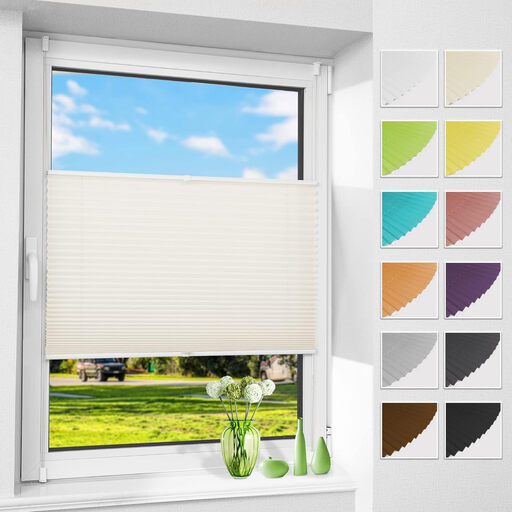
Why this product suits this profile: This clamp-fit pleated blind is designed for rectangular tilt-and-turn windows and has adjustable brackets for frame thicknesses of 10–23 mm. The light-filtering design is suitable for living rooms, kitchens, bathrooms or offices.
The stated clamping range helps you check compatibility before buying. The product description also clearly identifies roof, wooden and sliding windows as unsuitable.
Polyester fabric, aluminium rail, clamp fitting without drilling and cleaning with a damp cloth.

Why this product suits this profile: The honeycomb structure, metal frame and dual-sided operation appeal to buyers who value light control and a clearly defined construction. The frame is designed for 10–23 mm.
The stated maximum frame thickness and the warning that roof windows are unsuitable help prevent a choice based solely on fabric colour or the blackout description.
Opaque polyester, honeycomb structure, Klemmfix installation and stepless adjustment using upper and lower handles.

Why this product suits this profile: For bedrooms, rooms exposed to strong sunlight or balcony doors, this roller blind provides an opaque, coated polyester surface. The clamp bracket is specified for frame thicknesses of 16–22 mm.
The product information distinguishes between the overall width and the fabric width. It also advises you not to remove the securing strap until installation is complete.
According to the product description: 200 g/m² polyester, a silver-coated reverse side, clamp or screw fitting and cordless operation using a handle.
We have put together a complete, regularly updated list of products that fully meet these strict selection criteria and the safety regulations applicable in the EU.
Before installation, window frames and adhesive surfaces should be dry, clean and free from grease. With a pleated blind with clamp brackets, the brackets must be positioned evenly so that the blind does not hang crookedly or shift when the window is tilted. Handles and seals must not be obstructed.
For the fabrics mentioned, a soft, slightly damp cloth is generally sufficient for cleaning. Harsh cleaners, abrasive products and vigorous rubbing can damage coatings or the pleated structure. With cord-operated models, the operating chain and pull mechanism should be positioned securely.
If you need a special width, search specifically for a made-to-measure pleated blind. Standard sizes may be suitable for many windows, but they will not automatically fit unusual window widths, doors or large glazed areas. For balcony and patio doors, the clear height, door handle and range of movement are particularly important.
Depending on the design, it is attached either to the window sash using Klemmfix brackets or to the frame using adhesive pads. The permitted frame thickness and suitability for tilt, turn or door windows are stated in the relevant product description.
Its lifespan depends on the fabric, mechanism, exposure to sunlight, cleaning and correct installation. No general service life can be specified. Brackets should be checked regularly to ensure they are secure, and the blind should be operated without applying excessive force.
This type of installation is often practical in rented homes because it does not create drill holes in the wall or window. However, with adhesive installation, the condition of the underlying surface may still be a factor when removing the blind. For this reason, check the installation instructions and the suitability of the surface before buying.