
Lieferung heute & morgen

Qualitätsgarantie

Willkommens-Angebote freischalten: KOSTENLOSE Lieferung | Bis zu 80 % RABATT | Kostenlose 30-Tage-JoyPlus-Testphase
App herunterladen
A pleated blind without drilling can decorate windows and doors, create privacy and diffuse daylight without requiring wall plugs or drill holes. This type of installation is particularly practical in rented homes. However, not every model delivers the right result: unclear measurements, unsuitable fixings or an overestimated blackout effect can make your purchase unnecessarily expensive.
With Klemmfix pleated blinds, the stated width often refers to the entire product, including the brackets. The actual fabric width may therefore be smaller. If you only measure the window pane, you risk side gaps that let in light or a blind that obstructs the handle.
Before ordering, check the following:
A light-transmitting pleated blind diffuses incoming daylight but still lets some of it into the room. This is pleasant in a living room, kitchen or home office, but does not automatically provide complete blackout conditions in a bedroom. When directly backlit, the privacy effect may also differ from that in overcast weather.
Look for clear descriptions such as ‘light-filtering’, ‘semi-transparent’ or ‘privacy-screening’. General terms such as ‘sun protection’ alone reveal little about the actual level of light control.
A Klemmfix pleated blind is usually attached to the window sash. Clamp brackets are primarily suitable for compatible frame thicknesses and must not prevent the window from closing fully. Adhesive holders require a clean, dry and preferably smooth surface. According to the product description, suction cups are mainly suitable for smooth glass or tiles, but not for textured walls.
For balcony and patio doors, you should also check whether the fixing remains secure when the door is opened and closed frequently.
For a rented home, a rental-home sun blind without permanent alterations is particularly relevant. Clamp brackets can normally be removed without leaving any residue, provided they are fitted correctly to the frame. Adhesive holders, on the other hand, require careful preparation. Clean the surface and allow it to dry completely before attaching the pleated blind.
A roller blind without drilling or a no-drill Roman blind can also be an alternative. The key consideration is not just installation speed, but also compatibility with the window profile.
A pleated blind labelled 90 × 200 cm is generally 90 cm wide and 200 cm high. For some models, it is recommended that you use the glass pane width as a reference and allow for an additional overlap. This does not automatically apply to every product. Dimensions, fabric width and supplied brackets should therefore be considered separately.
For pleated blinds for windows and doors, the way the blind is operated is also important. A long fabric may touch the floor when fitted to a door or get in the way when the door is opened.
Polyester is widely used for interior pleated blinds because the fabric can be easy to wipe clean and retain its shape. Claims such as ‘UV-resistant’ or ‘sun protection’ should be understood as product properties, not as a guarantee of a particular room temperature or complete UV protection.
For a bright room, a light grey pleated blind complements many interior styles. Light-coloured fabrics usually diffuse daylight visibly, while darker materials can make the room feel more subdued. For kitchens or bathrooms, you should also check whether the material is merely moisture-resistant or actually designed for continuous exposure to water.
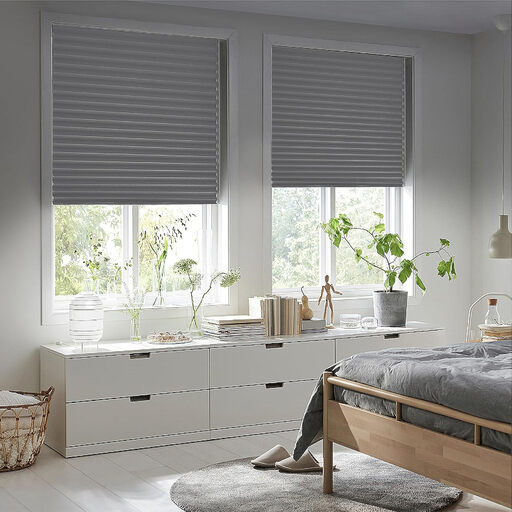
Why this product suits this profile: This model combines the stated 90 × 100 cm size with Klemmfix and adhesive holders. It is suitable for shoppers looking for a compact window solution with an adjustable position.
The product description includes specific measuring guidance, four adhesive holders and a note that it is not suitable for sloping roof windows. This allows you to check installation limitations before buying.
Woven polyester, light grey colour option, adjustable height and installation without drilling.
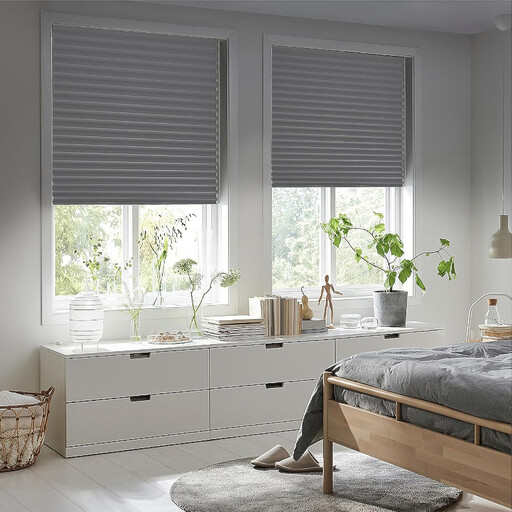
Why this product suits this profile: The 90 × 200 cm version covers a taller window or door and provides light-filtering fabric, privacy and an adjustable position.
The description mentions both clamp and adhesive installation and advises cleaning with a damp cloth. Before buying, you should still check compatibility with the frame and door.
90 × 200 cm, light grey polyester fabric, light-filtering design and suitability for windows or doors.
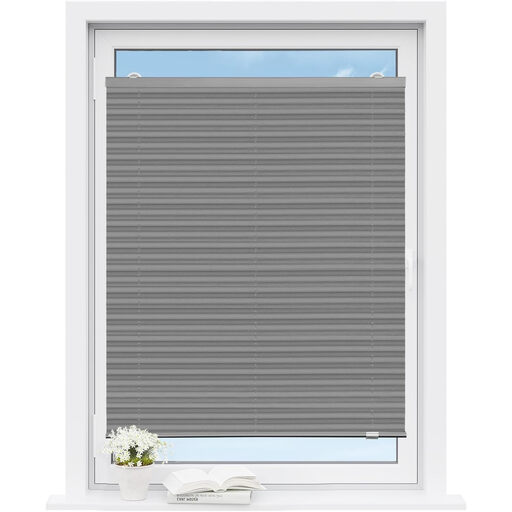
Why this product suits this profile: The suction-cup version is designed for smooth glass surfaces and may be suitable for balconies, skylights or standard windows, provided the surface is compatible.
The product information limits use to smooth surfaces such as glass or tiles. For textured walls or unsuitable frames, a different installation method should be chosen.
50 × 130 cm, grey semi-transparent polyester fabric, suction-cup installation and a wipe-clean, damp-resistant surface.
We have put together a complete, regularly updated list of products that fully meet these strict selection criteria and the safety regulations applicable in the EU.
For pleated blinds with cords, operating and fixing components should be kept out of children’s reach. Check the brackets regularly for signs of loosening, particularly on frequently used doors.
How long it lasts depends on the installation method, frame, surface and frequency of use. Clamp holders are generally stable when the frame thickness is suitable, while adhesive holders require a clean, dry surface. Suction cups are designed for smooth surfaces and should be checked regularly.
First measure the glass pane, then measure the full height of the window sash. Next, check the installation recommendation for the specific model. Some pleated blinds are ordered with a side overlap, while others are sized according to the frame width. There is therefore no single measurement formula that applies to every product.
That depends on how dark you want the room to be. A light-filtering pleated blind allows daylight through in a softened form and provides privacy. If you want to darken the room significantly, look specifically for a privacy-screening or blackout version and check the product description for possible light gaps.