
Lieferung heute & morgen

Qualitätsgarantie

Willkommens-Angebote freischalten: KOSTENLOSE Lieferung | Bis zu 80 % RABATT | Kostenlose 30-Tage-JoyPlus-Testphase
App herunterladen
A pleated blind without drilling is a practical solution for rented flats, modern window fronts and quick renovations. Depending on the design, it can be clamped to the window frame or fixed to smooth surfaces. However, not every model suits every window. Incorrect measurements, unsuitable mounting surfaces or a misleading description of light permeability can result in the blind hanging crookedly, not darkening the room sufficiently, or coming loose when you open the window.
This buying guide explains which features are important before purchasing a clamp-fit pleated blind and which models are suitable for different living situations.
A pleated blind for clamping is usually attached to the window sash with clamp brackets. Other versions use adhesive strips or suction cups. These systems have different requirements:
Before ordering, you should therefore check whether the window can be opened or tilted and whether the frame has the thickness specified by the manufacturer.
A light-permeable pleated blind filters daylight and reduces visibility from outside. However, it usually does not create complete darkness. For bedrooms or windows that receive strong sunlight, pleated blinds with a blackout or opaque coating are worth considering. The terms “sun protection”, “blackout” and “light-filtering” should not be used interchangeably.
With a privacy pleated blind, the focus is often on privacy, while a blind with sun protection can additionally reduce direct sunlight and glare. How strong this effect is depends on factors such as fabric colour, coating and mounting position.
For many models, the size refers to the total width of the pleated blind including the brackets. For other specifications, the fabric width is the key measurement. A difference of just a few centimetres can mean that the glass area is not fully covered or that the window handles are obstructed.
For many clamp-fit models, a pleated blind width of approximately 3 to 4 cm wider than the glass width is recommended. The height should usually match the full height of the window sash including the frame. The measurements and fitting instructions for each individual product remain crucial.
Clamp brackets are a practical solution for many uPVC windows when you want to avoid drilling holes. For the Dream-seeker model in 85 × 120 cm, the product information states that window frames with a thickness of 10 to 23 mm are suitable. The WOLTU day and night blind specifies a range of 13 to 23 mm, while another WOLTU clamp-fit blind is suitable for 16 to 22 mm.
For doors, balcony and patio doors, you should also check whether the blind will hit the handle, wall or adjacent sash when opened. For roof windows and sloping windows, different fixing solutions usually apply. Many of the models mentioned here are not suitable for sloping roof windows according to the product description.
Polyester is the predominant material for the products mentioned. It can be cleaned with a soft cloth and, depending on the design, is light-filtering, opaque or blackout. A light-coloured fabric such as white, beige or light grey usually has a more subtle effect in the room, while anthracite changes the light impression more noticeably.
Some product specifications mention moisture resistance, but also point out that the fabric is not waterproof. For bathrooms and kitchens, the pleated blind should therefore not be permanently exposed to direct water.
Models with a grip profile can usually be moved from the top or bottom. Versions with a chain or pull cord require special attention in households with children. According to the respective product warnings, cords and small parts should be kept out of the reach of children. Before use, you should also check that the clamp brackets, adhesive points or suction cups are securely in place.
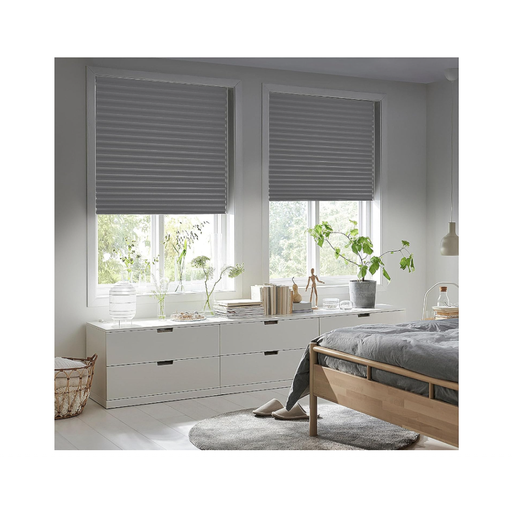
Why this product suits the profile: The compact size is suitable for many standard windows. The clamp-fit mounting and the light grey, light-filtering polyester offer a straightforward introduction to drill-free privacy screening.
The product information states a recommended width of approximately 4 cm wider than the glass width and includes four adhesive holders. This makes it easier to adapt the order to your specific window.
60 × 120 cm, light-permeable polyester fabric, adjustable position and tool-free mounting.

Why this product suits the profile: For bedrooms and home offices, stronger light reduction is a priority. This roller blind offers a clamp-fit option, operation via the bottom grip bar and a silver-coated reverse side according to the product description.
The frame thickness of 16 to 22 mm must be explicitly checked. This prevents a supposedly suitable clamp-fit roller blind from sitting unstably on a frame that is too narrow or too wide.
80 × 150 cm, cordless grip operation and, according to the product information, water-repellent polyester with a silver-coated reverse side.
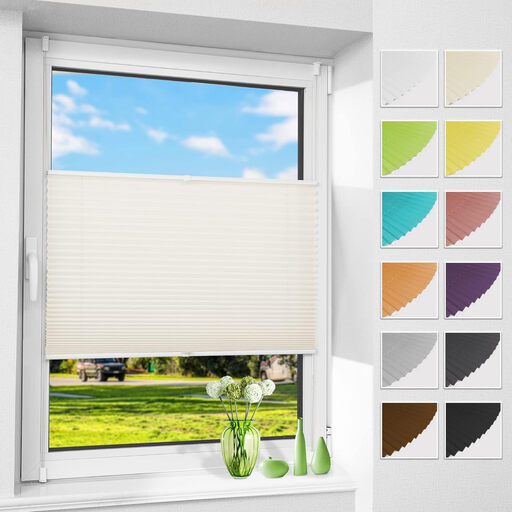
Why this product suits the profile: The adjustable brackets are designed for frame thicknesses of 10 to 23 mm according to the product information. This model is therefore suitable for users who prefer a flexible clamp mounting and adjustment from both sides.
The specifications exclude roof windows, wooden windows and sliding windows. If you take these limitations into account before buying, you will avoid an unsuitable installation.
Beige 90 × 100 cm, polyester with aluminium rod, handles on both sides and cleaning with a damp cloth.
We have put together a complete, regularly updated list of products that fully meet these strict selection criteria and the safety regulations in force in the EU.
For balcony and patio doors, larger heights such as 200 cm are available. For roof windows, however, you should specifically look for a solution designed for that purpose. A pleated roller blind without drilling is not automatically suitable for every slope.
Depending on the model, it is fitted with clamp brackets on the window sash, adhesive strips on the frame or suction cups on smooth glass. The right method depends on the frame thickness, surface and window type. Before fitting, surfaces should be cleaned and dried.
It is not possible to give a general lifespan. It depends on the material, sunlight exposure, frequency of use and the stability of the fixing. Regularly checking the brackets and adjusting the blind carefully can help extend its service life. Adhesive points and suction cups should be checked if their grip weakens.
For a manually operated pleated blind, there is usually no ongoing energy consumption, as no electrical control is needed. Costs mainly arise from the initial purchase and, if necessary, from replacement parts or a new fixing. The right size, the desired light effect and a suitable mounting method are therefore crucial for the value for money.