
Lieferung heute & morgen

Qualitätsgarantie

Willkommens-Angebote freischalten: KOSTENLOSE Lieferung | Bis zu 80 % RABATT | Kostenlose 30-Tage-JoyPlus-Testphase
App herunterladen
A pleated blind without drilling is a practical choice for rented homes, owned properties and temporary solutions: with suitable installation, window frames and walls remain largely untouched. However, not every model is suitable for every window. Incorrect measurements, an unsuitable fitting method or unrealistic expectations about light filtering and blackout performance often lead to disappointing purchases.
This Joybuy Product Recommendation Officer buying guide explains what to look for when choosing a clip-on pleated blind, adhesive fitting, suction cups and alternative roller blinds without drilling.
For many clip-on blinds and day-and-night roller blinds, the stated width includes brackets or profiles. As a result, the fabric area actually covered may be narrower. According to the product description, the fabric width of the WOLTU Blackout Roller Blind is approximately 4 cm narrower than the overall width.
For effective privacy and sun protection, you should therefore measure the glass width first. Several products recommend ordering a width equal to the glass width plus approximately 4 cm. At the same time, the blind must not obstruct the window handle.
A light-filtering pleated blind filters daylight and can provide privacy, while still allowing brightness into the room. This makes it suitable for living rooms, kitchens or home offices, for example. A blackout pleated blind, or a blackout roller blind, uses an opaque fabric or coating instead.
The term “sun protection” alone does not indicate how effectively a product darkens a room. If you want as little light as possible in the bedroom, look specifically for descriptions such as “Blackout” or “opaque”. For flexible light control, day-and-night roller blinds with alternating transparent and opaque stripes are an option.
A clip-on pleated blind is usually attached to the opening window pane. The frame must therefore be the right thickness. Several WOLTU models specify a frame thickness of 13 to 23 mm or 16 to 22 mm. Different measurements may result in an unstable fit or restrict how far the window can open.
Adhesive brackets require a clean, dry and smooth surface. Suction cups generally adhere to smooth surfaces such as glass or tiles, but are not reliable on rough or textured surfaces. Before buying, you should therefore check not only the window measurements but also the condition of the installation area.
Many suppliers offer pleated blinds in different sizes. The products provided, for example, range from narrow 65 cm models to versions measuring 100 cm wide. Some systems can be adjusted within a specified range, but modifications should only be made if this is expressly permitted in the product description.
Polyester is widely used in the models mentioned. The fabrics can usually be cleaned with a soft, slightly damp cloth. Moisture-resistant does not automatically mean waterproof. For bathrooms or kitchens, you should therefore check whether the specific product is suitable for humid rooms.
Operating chains, pull cords and small parts must be kept out of children’s reach. Before use, check that clips, adhesive brackets or suction cups are securely fitted. Depending on the model, restrictions may apply to roof windows or sloping windows.
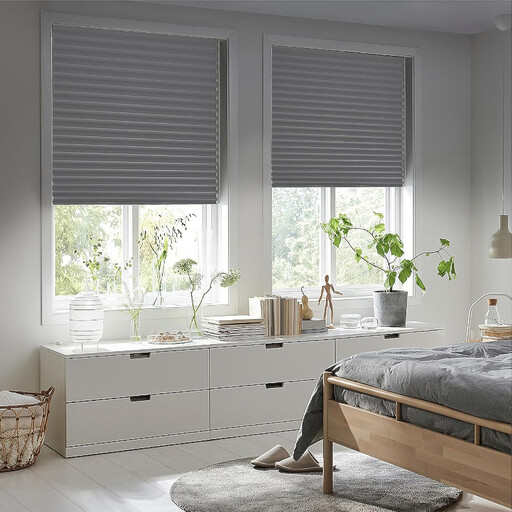
Why this product suits this profile: This light-filtering pleated blind offers straightforward clip-on or adhesive fitting for windows and doors. The 75 × 200 cm size is suitable for tall windows.
The product description explicitly refers to light filtering and does not equate it with complete blackout.
Polyester fabric, wipe-clean surface and two fitting options according to the product information.

Why this product suits this profile: For bedrooms and home offices where you want to keep incoming light to a minimum, the product description specifies a silver-coated back and an opaque design.
The information distinguishes between fabric width and overall width, and specifies the suitable frame range of 16–22 mm.
Cordless operation using the handle, wipe-clean polyester and clip-on or screw fitting.
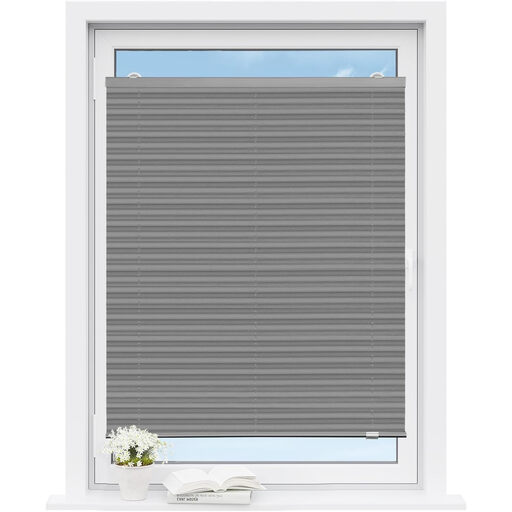
Why this product suits this profile: The suction-cup fitting is designed for smooth glass or tiled surfaces and can be used for temporary solutions, balcony doors or suitable roof windows.
Compatibility with smooth surfaces is clearly stated; rough or textured walls are not intended as installation surfaces.
Semi-transparent fabric, adjustable width of 50–90 cm according to the product information and wipe-clean surface.

Why this product suits this profile: This double roller blind is designed for households that want to switch between transparent and opaque fabric positions.
Light levels are controlled using alternating transparent and opaque stripes, rather than making a blanket promise of complete blackout.
Clip-on fitting for frames measuring 13–23 mm, chain control can be fitted on the left or right, and cleaning with a cloth or soft brush.
We have put together a complete, regularly updated list of products that fully meet these strict selection criteria and the safety regulations applicable in the EU.
A clip-on pleated blind can stay in place on a tilt-and-turn window if the opening pane, frame thickness and brackets are compatible. Before installation, the clips must be firmly secured and must not affect the seal or window handle. Adhesive fitting requires a smooth, dry surface.
Its lifespan depends on the fabric, frequency of use, exposure to sunlight and installation method. Clips should be checked regularly to ensure they remain secure. With adhesive and suction-cup systems, dust, moisture and temperature fluctuations can affect adhesion. It is therefore not possible to give a general expected service life.
Clip-on, adhesive and suction-cup models normally have no ongoing energy costs. They are operated manually. Potential follow-up costs may result from replacement brackets, reinstallation or replacing damaged fabric. This is why taking accurate measurements and choosing the correct fitting method are essential before you buy.