
Lieferung heute & morgen

Qualitätsgarantie

Willkommens-Angebote freischalten: KOSTENLOSE Lieferung | Bis zu 80 % RABATT | Kostenlose 30-Tage-JoyPlus-Testphase
App herunterladen
A pleated blind without drilling can quickly add privacy and sun protection to rented flats, owner-occupied flats and houses. The key advantage is that you won’t permanently damage your window frames or walls. However, not every no-drill pleated blind is suitable for every window. Incorrect measurements, unsuitable frames or unclear descriptions of light-blocking levels can often lead to the wrong purchase.
This buying guide explains what to look for when choosing a clamp-fit pleated blind, an adhesive mount or an alternative fitting option.
A size such as 75x200 cm or 90x120 cm usually refers to width × height. But the glass area isn’t the only measurement that matters when ordering. Many clamp-fit models are recommended at around 4 cm wider than the glass to help the blind cover the area more effectively.
So be sure to measure:
Made-to-measure blinds often follow different rules from ready-made sizes. A model shouldn’t be wider if that would block the window handle.
Product descriptions don’t always use terms such as room-darkening pleated blind, ‘blackout’ or ‘lightproof’ consistently. An opaque fabric may still let in diffused daylight. Many inside-mounted pleated blinds also leave visible gaps at the sides of the frame.
A light-filtering pleated blind is suitable for rooms where you want to retain daylight. A more room-darkening fabric is a better choice for bedrooms or home offices. Also check whether the description promises complete blackout, light filtering or simply glare reduction.
A pleated blind with an adhesive mount needs a clean, dry and preferably smooth surface. Clamp brackets, on the other hand, attach directly to the window sash and need to match the frame thickness. Suction cups mainly stick to smooth surfaces such as glass or tiles, so they’re unsuitable for textured walls.
Before buying, make sure you know which option is right for you:
A fabric that softly diffuses light is often a practical choice for living rooms and home offices. It reduces visibility from outside and cuts glare without making the room completely dark. A room-darkening pleated blind with a denser weave may be more suitable for bedrooms and children’s rooms.
Colours affect the look of a room, but they don’t tell you how much light a fabric lets through. A beige pleated blind or white pleated blind has a subtle look, while an anthracite pleated blind creates more contrast. The specific fabric finish is what matters most.
Polyester fabric is widely used in the models listed here. It can usually be cleaned with a soft, slightly damp cloth. However, moisture-resistant doesn’t mean waterproof. So avoid exposing a pleated blind in a bathroom or kitchen to frequent splashes.
Also look for:
Many models are designed for rectangular tilt-and-turn windows and balcony or patio doors. They may not be suitable for sloping roof windows, sliding windows, wooden frames or textured surfaces. Before ordering, check the product details against your own window.
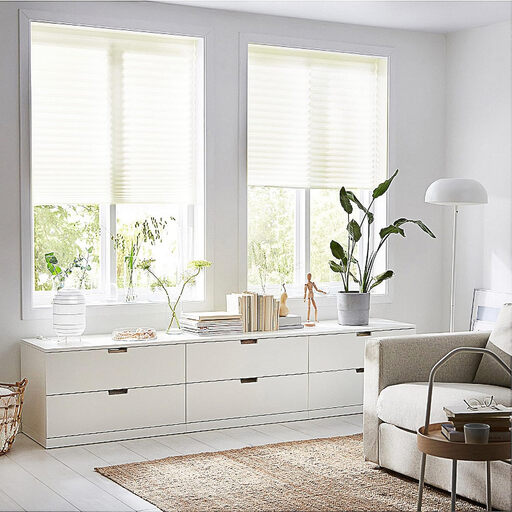
Why it suits this profile: The 75 × 200 cm size is suitable for windows or doors of the corresponding height. The beige colour is neutral, while the handle and cord controls let you position the blind flexibly.
The description makes clear that the fabric filters light rather than blocking it completely. This helps you set realistic expectations about how much light will enter the room.
Clamp-fit installation without drilling, four adhesive brackets, and a choice of colours and sizes.

Why it suits this profile: The honeycomb structure and metal frame are designed for people who want a dense fabric and precise adjustment from both the top and bottom.
It’s suitable for frames measuring 10–23 mm thick. This helps ensure you don’t order clamp brackets that won’t fit your frame.
Adjustable from the top and bottom, made from 100% polyester according to the product details, and designed for indoor windows and doors.
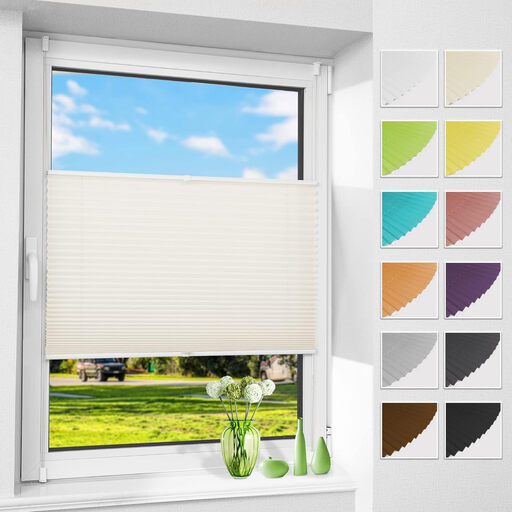
Why it suits this profile: According to the product description, the adjustable brackets fit frames 10–23 mm thick. This is useful if you need to check several windows with different frame sizes.
The instructions recommend allowing for the glass width plus around 3–4 cm, and choosing the next size up in length. This reduces the risk of ordering a blind that doesn’t cover enough of the window.
Operated using top and bottom handles, suitable for humid rooms according to the product details, and easy to clean with a damp cloth.
We’ve put together a complete, regularly updated list of products that meet these strict selection criteria and the safety regulations in force in the EU.
Don’t put adhesive mounts under heavy strain straight away. A pleated blind without drilling isn’t automatically suitable for sloping roof windows, either. Several of the models mentioned explicitly exclude sloping roof windows.
How long it lasts depends on the frame, fitting, how often it’s used and the weight of the fabric. A suitable frame and a clean mounting surface are essential. Pulling too hard on the cords or handles can put strain on the brackets and fabric. Check the fittings regularly.
Yes, some models are designed for balcony, patio or internal doors. However, the width you order mustn’t obstruct the door handle or restrict movement. For doors you use frequently, a sturdy clamp-fit option is often more practical than an adhesive mount alone.
An indoor pleated blind doesn’t need electricity. Ongoing costs are mainly for cleaning and, if necessary, replacing worn brackets. Motorised alternatives, on the other hand, may need batteries or a power connection.