
Lieferung heute & morgen

Qualitätsgarantie

Willkommens-Angebote freischalten: KOSTENLOSE Lieferung | Bis zu 80 % RABATT | Kostenlose 30-Tage-JoyPlus-Testphase
App herunterladen
As a Joybuy Product Recommendation Officer, I analyse market data daily to provide you with objective, practical shopping advice. My goal is to help you find the right products without falling for marketing hype. Today, we're tackling no-drill pleated blinds—a popular solution for renters and homeowners who want a damage-free installation.
Many people looking for a no-drill privacy screen for windows encounter promises that don't hold up in practice. Before you make a decision, you should know the three most common pitfalls that lead to frustration and unnecessary expense.
To avoid these problems, focus on three core aspects. These will determine whether a pleated blind for your window is a satisfying long-term solution.
Drill-free installation is the main advantage, but the systems differ significantly in their reliability.
The choice of fabric determines how much light and heat passes through your window.
Precise measurement is essential. Most manufacturers recommend the following procedure for optimal coverage:
Here are some product recommendations tailored to specific needs that successfully avoid the pitfalls mentioned.
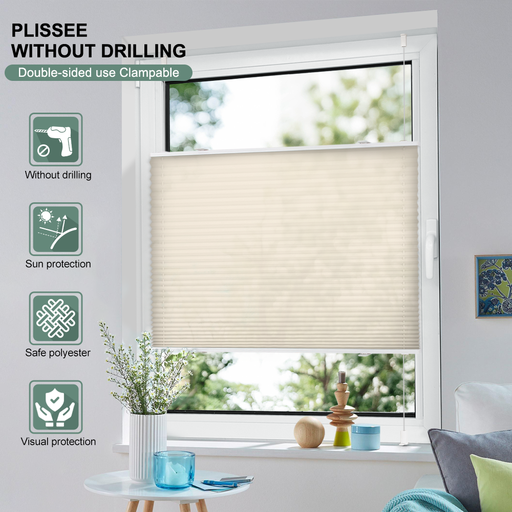
Why This Fits Their Persona: A straightforward and cost-effective solution for standard windows in rental apartments. The installation is tool-free and leaves no damage, which is crucial when moving out.
The product relies on a proven Klemmfix system designed for common uPVC windows. It bypasses the pitfall of unstable brackets with a simple yet functional design for standard use.
Offers a good balance of opaque privacy and light filtering. The infinitely variable adjustment from both the top and bottom allows for flexible positioning according to the sun's angle.

Why This Fits Their Persona: Ideal for those who value darkness, quiet, and energy efficiency. Perfect for bedrooms, nurseries, or rooms with direct sun exposure where temperature regulation is desired.
This thermal pleated blind solves the problem of misleading fabric descriptions. The honeycomb structure with internal air pockets and the opaque fabric ensure effective room darkening and thermal insulation.
In addition to blackout properties, the honeycomb structure provides noticeable sound and thermal insulation. The clamp brackets are designed for a wide range of window frame thicknesses (10-23 mm).
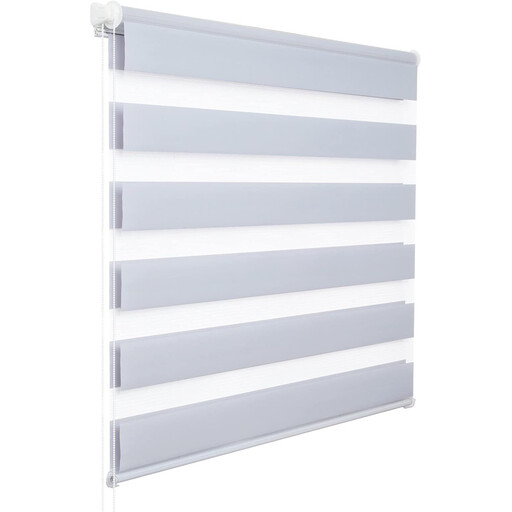
Why This Fits Their Persona: For anyone who needs flexible light control. Ideal for living rooms or home offices where you want to switch between full daylight, privacy, and partial dimming depending on the time of day.
This no-drill double roller blind solves the problem of rigid light control. Instead of just being "open" or "closed," the two fabric layers with alternating transparent and opaque stripes allow for continuous adjustment of light exposure.
Maximum flexibility in light management via the chain pull. The Klemmfix installation is robust and suitable for a variety of window frames. The fabric is also easy to clean and suitable for humid rooms.
We've compiled a complete, up-to-date list of products that fully meet these strict selection criteria and German regulations.
Yes, high-quality Klemmfix systems hold reliably even on tilted windows. Models that are also tensioned (with cords fixed at the top and bottom) are particularly well-suited for this, as they prevent the blind from swinging and keep it parallel to the window sash at all times.
The rule of thumb is: measure the width of the glass pane and add about 4 cm (2 cm per side) to minimise light gaps. However, always check the manufacturer's specific instructions. Ensure that the resulting total width does not interfere with the window handle or other protruding parts.
A pleated blind consists of a single, pleated fabric (like an accordion). It is often tensioned and can be flexibly moved from top to bottom and bottom to top. A double roller blind (also known as a zebra blind) consists of two parallel fabric panels with alternating transparent and opaque stripes. By shifting the panels relative to each other, the amount of incoming light can be continuously adjusted.