
Lieferung heute & morgen

Qualitätsgarantie

Willkommens-Angebote freischalten: KOSTENLOSE Lieferung | Bis zu 80 % RABATT | Kostenlose 30-Tage-JoyPlus-Testphase
App herunterladen
A pleated blind without drilling is a practical solution for rented homes, refurbished rooms and windows with delicate frames. Depending on the model, clamp brackets, adhesive holders or combined clamp-and-adhesive systems are used instead of screws and wall plugs. This usually allows you to install privacy and sun protection without leaving permanent drill holes.
However, not every model is suitable for every window. Common purchasing mistakes include inaccurate measurements, incorrectly assessing light transmission or choosing unsuitable clamp brackets. The following criteria will help you select a pleated blind for windows without drilling with confidence.
For many Klemmfix pleated blinds and roller blinds, the stated width covers the entire product, including the brackets. As a result, the actual fabric width may be several centimetres narrower. If you only use the glass width, you may end up with gaps that let light in at the sides.
As a practical guide, many models follow these measurements:
The manufacturer’s specifications take priority, as clamp brackets and fabric widths vary from one product to another.
A blackout pleated blind significantly reduces the amount of light entering the room, but gaps at the sides may still allow brightness in. In addition, suppliers do not always use terms such as “opaque”, “light-filtering” or “Blackout” consistently.
The specific fabric description is therefore crucial when choosing a product:
A pleated blind with clamp brackets is normally attached to the window sash. The frame must therefore fall within the specified thickness range. For example, some WOLTU models are designed for frame thicknesses of 13–23 mm or 16–22 mm. One WOLTU honeycomb pleated blind specifies 10–23 mm.
For adhesive holders, a smooth, clean and structurally sound surface is important. Rough, uneven or heavily soiled surfaces can reduce adhesion. Before installation, the holders should be securely attached and their stability checked afterwards.
Measure the glass width and the height of the entire window frame at several points. For doors, you should also check whether the pleated blind will get in the way when opening, tilting or walking through. A pleated blind for doors or a balcony door should therefore leave sufficient clearance around handles and movement areas.
For small to medium-sized windows, formats such as 60 × 100 cm, 70 × 120 cm or 90 × 120 cm may be relevant. A 90x120 cm pleated blind may be suitable for wider window areas if the frame and brackets allow it. The product details should always make clear whether the width or height is stated first.
A blackout roller blind without drilling can be a sensible choice for a bedroom. In living rooms and home offices, a light-filtering fabric is often more pleasant, as it allows daylight to remain while potentially reducing glare. For bathrooms and kitchens, pay attention to the information regarding moisture: moisture-resistant does not automatically mean waterproof.
Models with bottom and top rails can often be moved from both the top and bottom. Other versions are operated with a pull cord or chain. Cords and chains must be kept out of children’s reach. In households with children, a cordless roller blind operated via the handle rail may be a suitable option.
Pleated blinds in white, anthracite or light grey work well with a variety of interior styles. Light fabrics generally make rooms feel more open, while anthracite creates a stronger visual contrast. However, the colour does not automatically change the level of light protection.
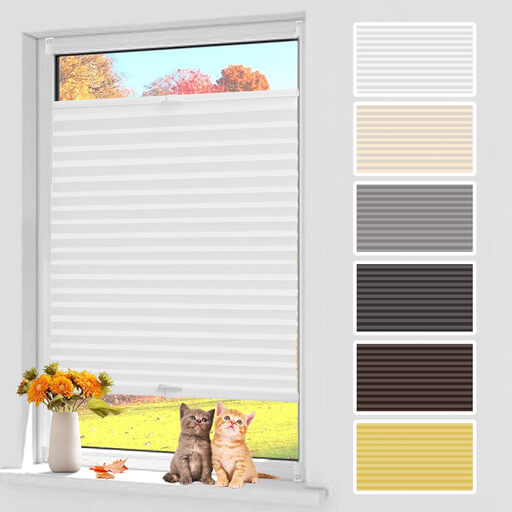
Why this product suits this profile: This compact white pleated blind is designed for smaller windows and straightforward indoor installation. Its height can be adjusted to control light and privacy.
The product details specify the dimensions, clamp installation and infinitely variable adjustment. You must still check the permitted frame thickness before buying.
60 × 100 cm, white polyester fabric, tool-free clamp installation and cleaning with a soft cloth.

Why this product suits this profile: The honeycomb structure, metal frame and top-and-bottom operation appeal to buyers who value design details and flexible positioning.
The specifications explicitly state suitable frame thicknesses of 10–23 mm and note that the product is not suitable for roof windows.
Honeycomb pleated blind with opaque polyester fabric, Klemmfix installation, handle rails and a moisture-repellent surface according to the product description.
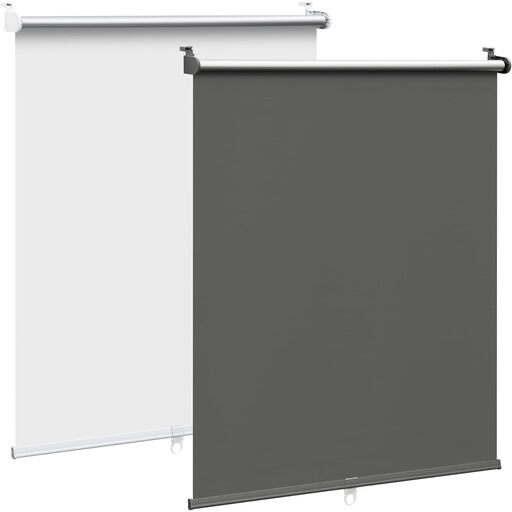
Why this product suits this profile: This cordless blackout roller blind is ideal for rooms where significantly reduced light and handle-rail operation are important.
The description specifies a frame range of 16–22 mm, a narrower fabric width and that the product is not suitable for roof windows.
85 × 150 cm, anthracite polyester, cordless handle operation and a silver-coated reverse side according to the product details.
We have put together a complete, regularly updated list of products that fully meet these strict selection criteria and the safety regulations applicable in the EU.
How long it lasts depends on the fabric, mechanism, use, frame surface and installation. Clamp brackets can be readjusted if necessary. With adhesive holders, a smooth, structurally sound surface is crucial. Regularly checking the brackets can help prevent the pleated blind from coming loose.
Yes, according to the product description, some models are designed for windows, balcony doors and glass doors. Before buying, check the door’s movement, handle position, frame thickness and available width. Many Klemmfix models are explicitly not suitable for roof windows or sloping windows.
There is no general answer. The price depends, among other things, on the size, fabric type, level of blackout, operating mechanism and mounting accessories. A basic light-filtering privacy blind may be priced differently from a thermal pleated blind or a cordless blackout roller blind. It is therefore important to compare the required function with the appropriate dimensions.