
Lieferung heute & morgen

Qualitätsgarantie

Willkommens-Angebote freischalten: KOSTENLOSE Lieferung | Bis zu 80 % RABATT | Kostenlose 30-Tage-JoyPlus-Testphase
App herunterladen
A pleated blind without drilling can be a practical solution for rented flats, offices and owned homes when you want to protect windows or doors from prying eyes, glare and direct sunlight. It is usually fitted to the window frame, either with clamp brackets or adhesive holders. This means there is no need to drill holes in the wall or frame.
Despite the straightforward installation, incorrect purchases often come down to three issues:
Before buying, first measure the visible glass width, followed by the height of the complete window sash. Several Dream-Seeker models recommend a pleated blind width approximately 4 cm wider than the glass width. For example, if the glass is 61 cm wide, a 65 cm-wide model may be suitable. The height should be based on the complete window frame.
Important: Product dimensions are listed as width × height. Options such as pleated blind 65 x 120 cm, pleated blind 75 x 120 cm and pleated blind 100 x 120 cm are therefore not interchangeable. Balcony or patio doors may require a greater height, such as 200 cm.
Also check:
According to the product details, the Dream-Seeker models described are not suitable for sloping roof windows. With the WOLTU suction-cup model, smooth surfaces such as glass or tiles are essential; rough walls are not suitable.
A clamp-fit pleated blind is attached to the window frame using clamp brackets. This option is particularly suitable for tenants, provided the frame shape and thickness are compatible. No holes need to be drilled in the frame. Before securing it permanently, check that the window can still be closed fully.
A pleated blind with adhesive holders requires a clean, dry and grease-free surface. After installation, the holders should be left for sufficient time to adhere properly. Some models come with four adhesive holders. If the adhesive strength decreases, the holders should be replaced to prevent the pleated blind from falling down.
Suction cups are another option for a pleated blind without drilling. They can be removed and repositioned relatively easily, but they require a smooth, stable surface. This system is not intended for textured or dirty surfaces.
The models mentioned are mainly made from polyester fabric. Polyester pleated blinds are easy to wipe clean and some versions are moisture-resistant, but they are not waterproof. They are therefore not suitable for permanent use in areas exposed to direct splashes, such as inside a shower.
Consider the function you want:
For the products mentioned, cleaning with a soft, slightly damp cloth is generally sufficient. Abrasive products, aggressive cleaning agents and vigorous rubbing can damage the fabric or coating.
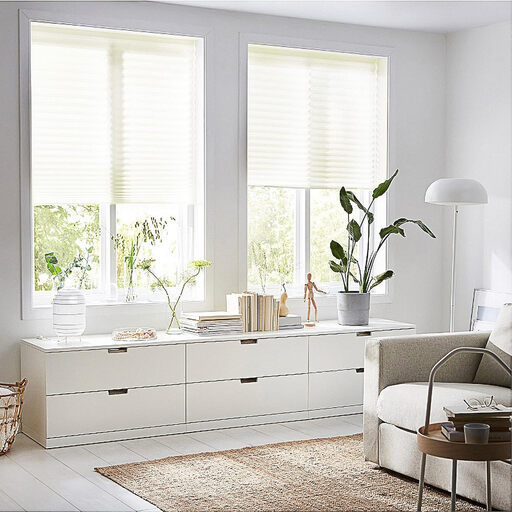
Why this product suits this profile: The beige pleated blind offers a common size for small to medium-sized windows and is fitted with a no-drill clamp-fit system.
The stated width and height make it easier to compare the blind with your own window. The product description also points out that it is not waterproof and is unsuitable for use on sloping roof windows.
Woven polyester fabric, adjustable positioning and clamp-fit installation on the window frame.
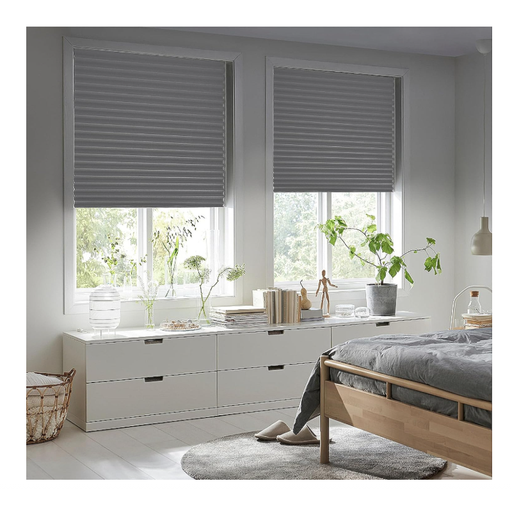
Why this product suits this profile: According to the product details, the light grey pleated blind has adjustable clamp brackets for frames measuring 10–23 mm thick.
The specified frame thickness clearly defines where the blind can be used. This allows you to check before buying whether the mounting system is suitable for your window.
85 × 120 cm, polyester with metal components and light-filtering fabric for softly diffused brightness.
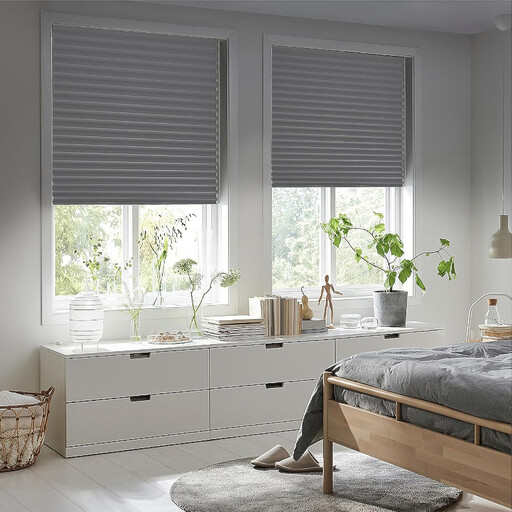
Why this product suits this profile: The 200 cm height is suitable for tall windows, balcony doors or patio doors, provided the frame and mounting method are compatible.
Installation requires a clean, dry surface. The product details also recommend careful operation and protection from sharp objects.
Long version with clamp or adhesive mounting and infinitely adjustable positioning for windows and doors.
We have put together a complete, regularly updated list of products that fully meet these strict selection criteria and the safety regulations applicable in the EU.
Durability depends on the installation method, frame, surface condition and daily use. Clamp brackets are mechanically attached to the frame. Adhesive holders and suction cups are more sensitive to dust, moisture and temperature fluctuations. Check the fittings regularly and replace the holders as soon as they begin to lose their adhesive strength.
Not on every door. The key factors are the dimensions, frame shape, clearance and weight of the pleated blind. With balcony and patio doors, you should also check that the blind will not catch on handles or other components when the door is opened. Sloping roof windows are expressly excluded for several of the variants mentioned.
That depends on your light and privacy requirements. A light-filtering pleated blind allows daylight through and can reduce visibility into the room. If you want the room to be significantly darkened during the day, check the specific fabric description and light-transmission details rather than relying solely on terms such as “sun protection” or “blackout”.