
Lieferung heute & morgen

Qualitätsgarantie

Willkommens-Angebote freischalten: KOSTENLOSE Lieferung | Bis zu 80 % RABATT | Kostenlose 30-Tage-JoyPlus-Testphase
App herunterladen
A pleated blind without drilling with clamp-fix fittings is practical for rented homes, owned properties and frequently changing interiors. It is fitted to the window frame or door without drilling holes and usually without any additional tools. To avoid making the wrong purchase, however, you should consider more than just colour and price.
The stated width may refer to the entire pleated blind, including the brackets. This means that on some models the fabric is narrower than the product dimensions. If you measure only the glass pane, you risk side gaps letting in light or incomplete coverage.
As a practical guide, the pleated blind width should often be around 3 to 4 cm wider than the glass width. You must also check that the window sash can still be opened and tilted easily with the clamp brackets fitted.
A privacy pleated blind protects against unwanted views, but may still allow daylight through. A light-filtering pleated blind is suitable for living rooms, kitchens or offices where you want to keep the room bright. For bedrooms or children’s rooms, a blackout pleated blind with light-blocking fabric may be more suitable.
The terminology used in product listings is not always consistent. Look out for specific descriptions such as “opaque”, “blackout”, “light filtering” or “translucent”, and bear in mind that side gaps may still allow light in.
A pleated blind with clamp fittings requires a suitable, sufficiently sturdy window or door frame. Depending on the design, clamp brackets may only be suitable for certain frame thicknesses. Adhesive fittings, on the other hand, require a smooth, dry and grease-free surface. Adhesion may be limited on rough, uneven or damp surfaces.
Before fitting, make sure the clamp brackets are secure and that the pleated blind hangs straight. If you have children or pets, pay particular attention to cords, loose small parts and secure fastening.
When measuring a clamp-fix pleated blind for windows, start by checking:
For balcony and patio doors, height is crucial. Models such as 90 × 200 cm or 80 × 200 cm may be suitable for tall glass surfaces. Smaller windows may require, for example, a 90 × 120 cm pleated blind or more compact dimensions. Suitability always depends on your frame and the product’s construction.
Polyester is commonly used for many internal blinds and pleated blinds. It can generally be cleaned with a soft cloth. For bathrooms and kitchens, you should also check the moisture-resistance information: moisture-resistant does not automatically mean waterproof.
A white pleated blind has a subtle appearance and often makes rooms look brighter. A beige pleated blind complements warm wood and natural tones. A light grey pleated blind works well with modern and neutral interiors. An anthracite pleated blind creates a darker accent, but in strong sunlight it may heat up more noticeably than a light-coloured fabric.
Colour alone does not determine the light effect. The construction, fabric density, coating and coverage of the window area are also relevant.
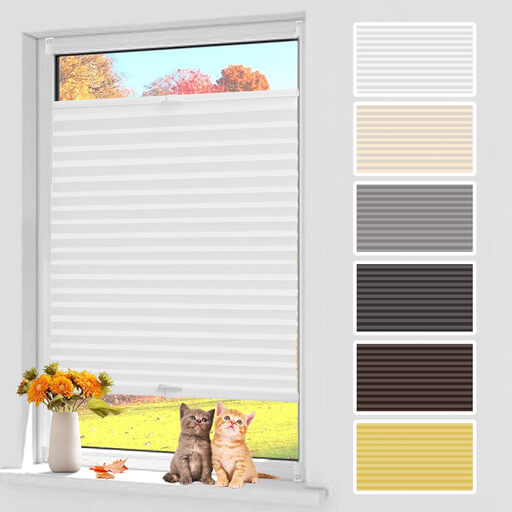
Why this product suits this profile: The compact dimensions are suitable for smaller standard windows. The clamp-fix fitting requires no tools, making it appealing to tenants who do not want to make permanent changes to the frame.
The product details clearly state the dimensions, material and clamp fitting method. You must still check compatibility with the frame thickness before buying.
Polyester fabric, 370 g weight, white finish and adjustable light and privacy protection.
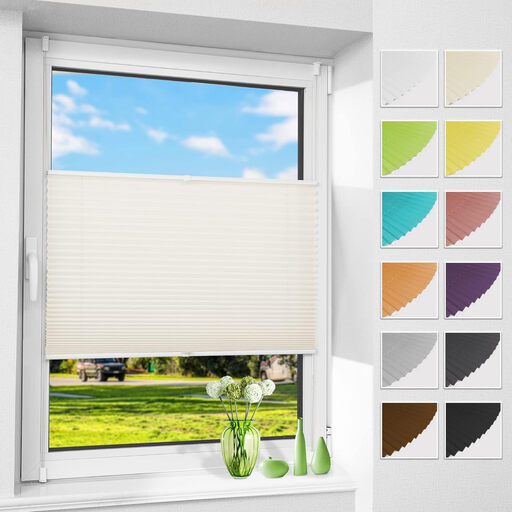
Why this product suits this profile: According to the product details, the adjustable brackets are designed for frame thicknesses of 10 to 23 mm. This is useful when the window dimensions do not exactly match a standard size.
The adjustable clamp brackets reduce the risk of choosing an unsuitable frame. However, according to the product details, this model is not intended for roof windows, wooden windows or sliding windows.
Polyester with aluminium rod, clamp fitting without drilling and operation using upper and lower handles.

Why this product suits this profile: For bedrooms, home offices or rooms with stronger incoming light, this model offers a light-blocking coating and cordless operation.
The details specify a suitable frame range of 16 to 22 mm, as well as the narrower fabric width. Both values should be compared with your window before buying.
Clamp fitting or drilling, 200-g/m² polyester, silver-coated reverse side and operation using a lower handle rail.
We have put together a complete, regularly updated list of products that fully meet these strict selection criteria and the safety regulations applicable in the EU.
Clean the frame with a suitable residue-free product before fitting and allow it to dry completely. With clamp brackets, position the bracket on the frame and tighten it evenly. With adhesive pads, remove the protective film immediately before attaching them.
After fitting, a quick stability check is recommended. The pleated blind should move smoothly without catching. For care, use a soft, dry or slightly damp cloth. Abrasive products, harsh cleaners and pulling too firmly can damage the polyester fabric or the brackets.
This depends on the frame thickness, brackets, weight and fitting surface. Clamp brackets must be compatible with the window frame. Adhesive fitting requires smooth, clean and dry surfaces. Check the stability regularly and follow the manufacturer’s instructions.
It is not possible to specify a fixed lifespan. Among other factors, it is affected by daily operation, exposure to sunlight, moisture and the quality of the fitting. Careful adjustment, proper cleaning and correctly fitted brackets can help extend its service life.
According to the product details, many models are designed for both windows and doors. For a balcony or patio door, however, the height, door handle, range of movement and bracket stability are crucial. With tall glass surfaces, pay particular attention to dimensions such as 90 × 200 cm and check in advance that the door can still be opened fully.