
Lieferung heute & morgen

Qualitätsgarantie

Willkommens-Angebote freischalten: KOSTENLOSE Lieferung | Bis zu 80 % RABATT | Kostenlose 30-Tage-JoyPlus-Testphase
App herunterladen
A pleated blind without drilling is ideal for tenants, families and homeowners who want to fit privacy and sun protection without making permanent changes to window frames or walls. To make sure it works reliably day to day, check the fitting method, measurements and fabric properties before you buy.
Many products look similar at first glance. The differences often only become clear during fitting, when you open the window or when you try to control the light.
The stated size does not always indicate the usable fabric width. Depending on the design, clamp brackets, guide elements or operating rails may take up extra space. If you measure only the glass and not the full area that matters, you could end up with gaps at the sides or problems with the window handle.
As a general guide for many pleated blinds, the order width should be around 3 to 4 cm wider than the glass. However, always follow the specific manufacturer’s measurements.
A privacy pleated blind prevents people from seeing in, but it may still let daylight through. A light-filtering pleated blind is a good choice for a living room, kitchen or home office if you want to keep the room bright. For a bedroom or child’s room, a blackout pleated blind made from opaque fabric may be more suitable.
The term ‘window sun protection’ alone does not tell you how much light a product blocks. Look for descriptions such as light-filtering, semi-transparent, opaque or blackout.
A no-drill pleated blind with clamp brackets is usually attached to the window sash. The frame must be the right thickness, with enough space between the glass, seal and handle. Some systems are only suitable for specific types of window.
Before you buy, check whether the window:
Measure the width of the glass, the full height of the window sash and the thickness of the frame. Also note the position of the window handle. For a pleated blind for windows and doors, check that the fabric or controls won’t get in the way as you walk through.
A made-to-measure pleated blind may be a good option for unusually sized windows. For standard sizes, ready-made options are often easier to compare. Unless the retailer says otherwise, measurements should always be read as width × height.
Clamp brackets allow you to fit a blind without drilling, making them practical for a pleated blind for a rented home. When used correctly, they generally leave no drill holes behind. Adhesive brackets, on the other hand, need a clean, dry and smooth surface. They may not stick as well to textured, dusty or damp surfaces.
After fitting, check that all the brackets are secure. If you often leave your windows tilted open, make sure the blind doesn’t swing about or rub against the frame.
Polyester fabric is widely used in the products listed here. It can usually be cleaned with a lightly damp cloth. However, moisture-resistant does not automatically mean waterproof. In bathrooms and kitchens, avoid exposing the blind to direct water for long periods.
Use these general pointers when choosing a blind for a room:
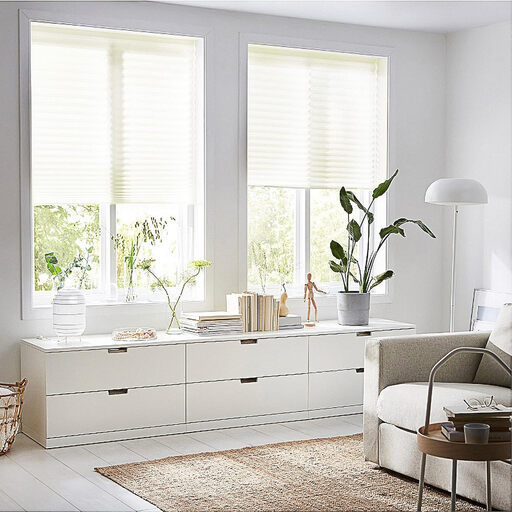
Why it suits this type of buyer: Its size is suitable for many standard windows. The light-filtering polyester fabric and no-drill clamp system make it an easy option for a living room, home office or kitchen.
The product details recommend allowing around 4 cm of extra width and confirm that it is suitable for fitting to window frames without drilling.
Adjustable height, a choice of colours and sizes, and easy cleaning with a damp cloth.

Why it suits this type of buyer: The double-layered blind lets you adjust the light gradually, alternating between light-filtering and more light-blocking sections. It can be fitted to windows or doors.
The product description distinguishes between clamp fitting and optional screw fitting, and specifies compatible frame thicknesses of 13 to 23 mm.
Double-layered design, a control chain that can be fitted on either side, and a chain tensioner to keep it neatly in place.

Why it suits this type of buyer: Its honeycomb structure and clamp brackets suit anyone looking to combine light control with flexible positioning on windows or doors.
The product details specify a suitable frame thickness of 10 to 23 mm and warn that handles or protruding parts must not be covered.
No drilling is needed, and the top and bottom handles let you position the blind flexibly. The fabric is described as opaque and moisture-repellent.
We’ve put together a comprehensive, regularly updated list of products that meet these strict selection criteria and the applicable EU safety regulations.
Dust can usually be removed with a soft cloth or a brush used gently. Harsh cleaning products, vigorous rubbing and prolonged exposure to direct moisture can damage the fabric. If the product has cords or chains, make sure the controls are secured out of children’s reach. Cords must not be left hanging loose.
How long a blind lasts depends on how it is fitted and used, how much sunlight it gets and how it is cleaned. Check the fittings regularly to make sure they are secure. If you use adhesive brackets, also keep an eye out for signs that they are losing their grip.
The most common options are clamp brackets, which hook over the window sash, or adhesive brackets. Before fitting, make sure the frame is clean and dry, and suitable for the bracket. The exact frame thickness and the product’s fitting instructions are key.
That depends on its width, bracket depth and design. Measure the distance to the handle and check that the fabric or rail can move freely when you open or tilt the window. Some products are specifically unsuitable for windows with certain fittings or designs.
A manual pleated blind needs no electricity and has no ongoing energy costs during normal use. You may need to pay for replacement brackets, cleaning or a replacement blind later on. So when choosing one, consider more than just the purchase price: the right fitting method and ongoing fabric care matter too.