
Lieferung heute & morgen

Qualitätsgarantie

Willkommens-Angebote freischalten: KOSTENLOSE Lieferung | Bis zu 80 % RABATT | Kostenlose 30-Tage-JoyPlus-Testphase
App herunterladen
A pleated blind without drilling is a good choice for rented homes, owner-occupied properties and any room where you want to avoid permanently damaging the window frame or walls. Clamp-fit pleated blinds are particularly popular for tilt-and-turn windows, as are pleated blinds for doors and models fitted with clamp brackets or adhesive.
Choosing one may seem straightforward at first. In practice, however, incorrect measurements, an unsuitable fitting method or unclear information about light transmission can often lead to the wrong purchase. The following tips will help you choose the right no-drill pleated blind for your window.
For many products, the stated measurement refers to the entire blind, including its brackets. The usable fabric width may therefore be a few centimetres smaller. If you measure only the glass, you may not get enough privacy at the sides.
As a general guide:
Always follow the fitting instructions for the product you choose. If you’re ordering a made-to-measure pleated blind, check the supplier’s ordering guidance too.
A light-filtering pleated blind softens daylight and can reduce glare and visibility from outside. However, it will not usually make a room completely dark. For bedrooms, media rooms or shift work, a blackout pleated blind with an opaque or light-blocking fabric is a better choice.
Check the specific product description:
A clamp-fit pleated blind is usually attached to the window sash. The frame thickness must be suitable for the specified clamping range. For adhesive fitting, the surface must be clean, dry, smooth and strong enough to hold the adhesive. Rough, porous or heavily soiled surfaces can affect how well it sticks.
Clamp fitting is often practical in rented homes because it avoids drilling holes. Even so, check before buying that the window can still open and tilt fully, and that the brackets won’t get in the way of the handle.
Measure the width and height in several places, as windows are not always perfectly even. You should also check:
Many clamp-fit models are suitable for rectangular windows, but not for roof windows, sloping windows or certain wooden and sliding windows. Check any restrictions against the product description before buying.
A pleated blind with clamp brackets attaches to the window frame without drilling. The brackets can usually be removed, making this a good option for renters. Adhesive fitting can be an alternative on smooth surfaces, but it depends more on the surface condition and careful preparation.
Before fitting:
Beige, white, grey or anthracite pleated blinds are easy to coordinate with living spaces. Lighter shades tend to make rooms feel more open, while anthracite creates a stronger contrast. Colour alone, however, does not indicate how well a blind will block light.
For kitchens and bathrooms, check the product details to make sure the material is suitable for higher humidity. Polyester is common in the products mentioned and can usually be cleaned with a slightly damp cloth. However, this does not automatically mean the fabric is waterproof.
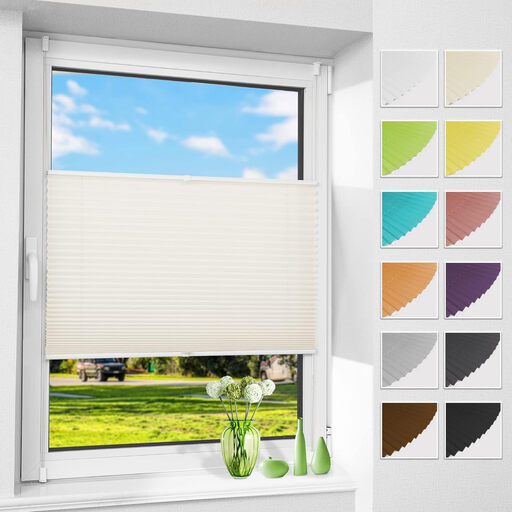
Why this product suits this need: This beige 90 × 100 cm blind is suitable for smaller rectangular windows in living rooms, kitchens, bathrooms or offices. According to the product details, its adjustable brackets fit frames measuring 10–23 mm thick.
The measurements and specified clamping range make it easier to check compatibility before ordering. The description also highlights restrictions for roof windows, wooden windows and sliding windows.
No-drill clamp fitting, polyester fabric and cleaning with a damp cloth, according to the product details.

Why this product suits this need: This model is designed for bedrooms and other rooms where you want to block out more light. It fits window frames measuring 16–22 mm thick and is operated using a handle.
The product description gives the compatible frame thickness and notes that the blind is not suitable for roof windows. This helps you check in advance whether no-drill fitting is a practical option.
Light-blocking fabric, clamp-fit installation, cordless operation using the bottom handle and wipe-clean care.

Why this product suits this need: The honeycomb structure may appeal if you want to combine light control with an extra layer of fabric in a bedroom, office or bathroom. According to the product details, the clamp brackets fit frames measuring 10–23 mm thick.
The description gives the compatible frame thickness and notes that the model is not designed for roof windows. Make sure the blind’s width also leaves the window handles unobstructed.
Polyester honeycomb pleated blind, adjustable top and bottom handles, and no-drill fitting.

Why this product suits this need: At 200 cm high, this blind could suit tall windows or doors. It is described as a light-blocking pleated blind with adhesive fitting for indoor use.
The instructions specify that the fitting surface must be smooth and clean. Adhesive fitting should not be used on rough or uneven surfaces.
90 × 200 cm size, white finish, no-drill fitting and fabric described as light-blocking.
We’ve put together a complete, regularly updated list of products that meet these strict selection criteria and comply fully with the safety regulations in force in the EU.
With a clamp-fit pleated blind, clamp brackets are attached to the window sash and then connected to the blind. Alternatively, some models come with adhesive pads or brackets. Before fitting, make sure the frame or adhesive surface is clean, dry and free from grease. Once fitted, check that the window can still open and tilt fully.
Its lifespan depends on factors such as fabric quality, how it is operated, exposure to sunlight and how it is fitted. Don’t pull sharply on handles or cords, and clean the fabric only as instructed by the manufacturer. Check adhesive brackets regularly to make sure they remain secure. If you have children, keep operating chains and cords out of their reach.
Yes, as long as its light-control properties and size suit your needs. A light-filtering pleated blind lets daylight into the room, making it better suited to privacy and reducing glare. For greater light reduction, consider a blackout pleated blind or a model described as blackout. Also check for light gaps at the sides and make sure the blind is fitted in the right position.