
Lieferung heute & morgen

Qualitätsgarantie

Willkommens-Angebote freischalten: KOSTENLOSE Lieferung | Bis zu 80 % RABATT | Kostenlose 30-Tage-JoyPlus-Testphase
App herunterladen
A pleated blind without drilling is ideal for rented homes, frequently changing living arrangements and windows whose frames you don’t want to alter permanently. However, not every model is suitable for every window. The key factors are the fitting method, frame thickness, measurements and how much light you want to let through.
As a Joybuy Product Recommendation Officer, I assess product details against practical selection criteria. This helps you avoid common buying mistakes without relying solely on terms such as “thermal”, “blackout” or “Easyfix”.
With clamp-fit pleated blinds, the stated width may refer to the entire product, including the brackets. The actual fabric can therefore be narrower. Some models, however, use the fabric or glass width as their reference.
Before buying, check:
A light-filtering pleated blind lets daylight into the room while helping to reduce direct views inside. However, this may not be enough for bedrooms, children’s rooms or rooms exposed to bright street lighting.
An opaque privacy blind prevents direct views inside, but does not necessarily darken the room. A blackout pleated blind with a coated backing is designed to let in much less light. Product descriptions should therefore clearly distinguish between the following:
A pleated blind with clamp brackets is usually attached to the window sash. The frame needs to be deep enough to accommodate them. Adhesive brackets require a clean, dry and preferably smooth surface. Suction cups work best on smooth surfaces such as glass or tiles, and are not designed for textured walls.
For a pleated blind for a window without drilling, you should also check that the window can still be opened fully or tilted. Depending on the product, there may be restrictions for roof windows, wooden windows or sliding windows.
The classic clamp-fit pleated blind attaches to the window frame without a drill. The supplied brackets must suit the frame thickness. Available models typically fit frame thicknesses such as 10 to 23 millimetres, 13 to 23 millimetres or 16 to 22 millimetres.
Adhesive brackets are a good option if the frame is not deep enough for clamp brackets. Clean the surface before fitting. If the finish is delicate or the coating is old, test it carefully in an inconspicuous area first.
A light-filtering pleated blind can be a good choice for a living room, office or kitchen if you want to keep some daylight. For a bedroom, consider a blackout pleated blind or a thermal pleated blind with a coated backing.
According to the product description, a silver-coloured coating can reflect light and some of the sun’s rays. However, this should not be taken as a general promise of a particular room temperature or energy saving. The effect depends on factors such as window size, orientation, fitting distance and ventilation.
Models with handles on the top and bottom rails can be positioned at any height. Chain- or cord-operated blinds need to be securely fitted and kept out of children’s reach. A roller blind without drilling with a small operating handle may be a simpler option for children’s rooms or frequently used windows.
Before use, check the brackets, adhesive strips, cords and tension. Do not continue to use any damaged parts.
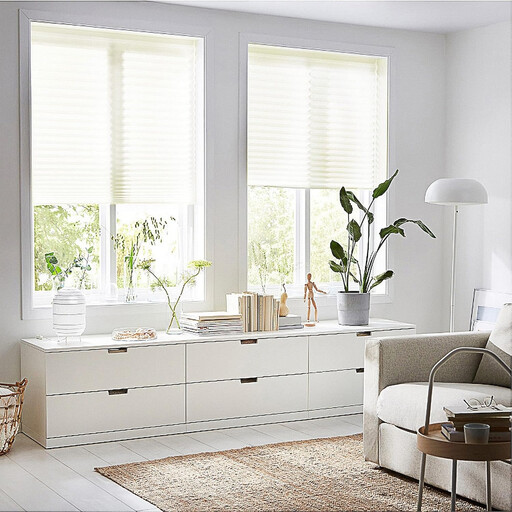
Why this product suits this need: Its compact size and choice of clamp or adhesive fitting make it suitable for smaller standard windows in rented homes, bedrooms or offices.
The product details give the dimensions as 75 × 100 cm and specifically advise checking the frame surface before fitting.
Polyester fabric, adjustable height and no-drill fitting.

Why this product suits this need: Its honeycomb structure and adjustable clamp-fit brackets may appeal if you want to combine light control with a close fit.
The product description specifies a suitable frame thickness of 10–23 mm and notes that the model is not designed for roof windows.
Opaque polyester, top and bottom handles, and a moisture-resistant surface according to the product details.

Why this product suits this need: This model is designed for bedrooms, studies or other rooms where you want to reduce light more substantially and prefer cordless operation.
The description gives a frame thickness of 16–22 mm and points out that the fabric may be around 4 cm narrower than the overall width.
Cordless operation, clamp or screw fitting, and a coated backing according to the product details.
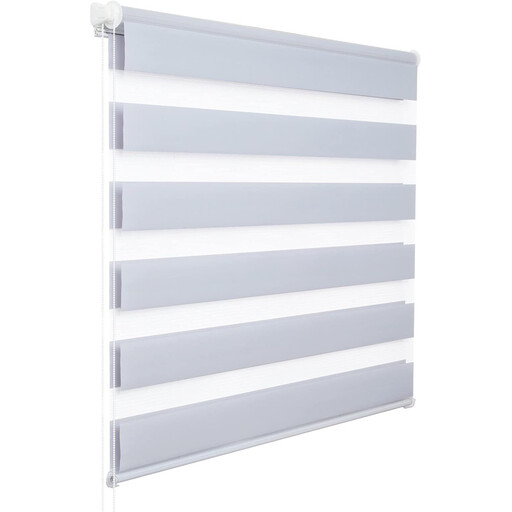
Why this product suits this need: This double roller blind is suitable for living rooms, kitchens or offices where you want to adjust privacy throughout the day.
Alternating sheer and opaque fabric strips make it clear how the blind affects light, rather than simply promising to darken the room.
Clamp fitting for frames measuring 13–23 mm and a choice of chain position on either side, according to the product description.
We’ve put together a complete, regularly updated list of products that meet these strict selection criteria and the safety regulations in force in the EU.
Depending on the model, it can be fitted using clamp brackets, adhesive brackets or suction cups. Clamp brackets hook over the window sash and require a compatible frame thickness. Adhesive brackets and suction cups need a smooth, clean surface.
Its lifespan depends on the materials, how it is operated, how often the window is moved and how securely it is fitted. It’s a good idea to check the brackets regularly. With adhesive fittings, temperature, moisture and dust can affect how well they stick.
Not every model does. A light-filtering pleated blind reduces views inside and glare, but still lets daylight through. A blackout pleated blind or a coated roller blind can reduce the amount of light more substantially. Depending on the design, however, it may not be possible to eliminate gaps at the sides of the window completely.