
Lieferung heute & morgen

Qualitätsgarantie

Willkommens-Angebote freischalten: KOSTENLOSE Lieferung | Bis zu 80 % RABATT | Kostenlose 30-Tage-JoyPlus-Testphase
App herunterladen
A pleated blind without drilling is ideal for rented flats, frequently changing room layouts, or windows where the frame must not be damaged. Depending on the model, installation is carried out using clamp brackets, adhesive holders, or a combination of both systems. This allows you to fit flexible privacy and sun protection to your window without using a drill or wall plugs.
However, not all products are built the same. Three typical buying mistakes often lead to the wrong purchase:
Before ordering, you should measure the glass width, the height of the entire window sash, and the thickness of the window frame. For several Dream-seeker models, it is recommended to choose a blind width approximately 4 cm wider than the glass width. The height is based on the total window height including the frame.
Also check:
According to the product specifications, the WOLTU Honeycomb pleated blind is designed for frame thicknesses of 10 to 23 mm. A clamp-fit pleated blind therefore does not automatically fit every window frame. For very narrow, rounded, or uneven frames, a pleated blind without drilling and gluing using clamp holders may be a more suitable option than a purely adhesive model.
A light-filtering pleated blind or a semi-transparent polyester pleated blind filters daylight and can reduce direct visibility. It is suitable for living rooms, kitchens, offices, or bathrooms where you want the room to remain bright.
A blackout pleated blind, on the other hand, uses a fabric that blocks light more effectively. The actual level of darkness also depends on side light gaps, the installation position, and the coverage of the window area. Terms like “blackout” should therefore always be considered together with the specifications for fabric, width, and installation.
For balcony and patio doors, sufficient height is also important. A pleated blind for windows and doors should be easy to adjust and sit securely on the moving sash.
Clamp brackets are attached to the window sash and are often suitable for rented flats. Adhesive holders require a clean, dry, and smooth surface. On rough, dusty, or uneven surfaces, adhesion may be limited.
Polyester is widely used in the products mentioned. It can usually be cleaned with a slightly damp cloth. However, moisture-resistant does not mean waterproof. In the kitchen and bathroom, the pleated blind should therefore not be permanently exposed to direct water.
Also pay attention to the operation: models with handles can be adjusted from the top and bottom, while other variants are adjusted using a pull cord. Cords and operating elements should be kept out of the reach of children.
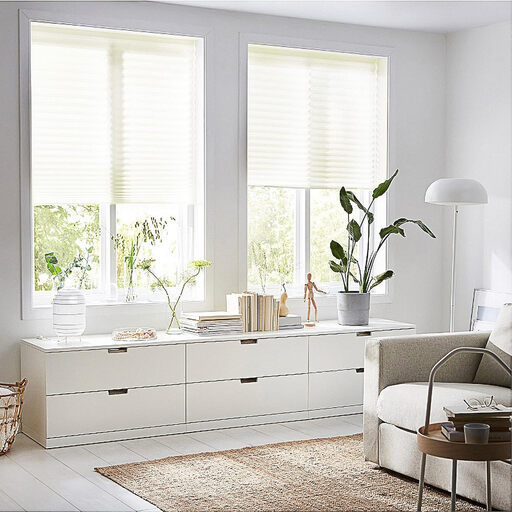
Why this product fits the profile: The 85 × 120 cm size and beige colour are suitable for smaller to medium-sized windows in living and working spaces. The adjustable clamp holders allow installation without drilling.
The product description indicates that the fabric does not provide complete blackout. This allows you to realistically assess its function as privacy and glare protection.
Beige polyester fabric, adjustable height, and tool-free clamp installation. The stated width is 4 cm wider than the recommended glass width.

Why this product fits the profile: The double honeycomb structure and opaque polyester fabric are designed for light blocking and precise operation with top and bottom handles.
The suitable frame thickness of 10–23 mm and the maximum width without overhang at handles should be checked before purchase.
100% polyester according to the product specification, clamp-fit installation without drilling, and cleaning with a damp cloth.
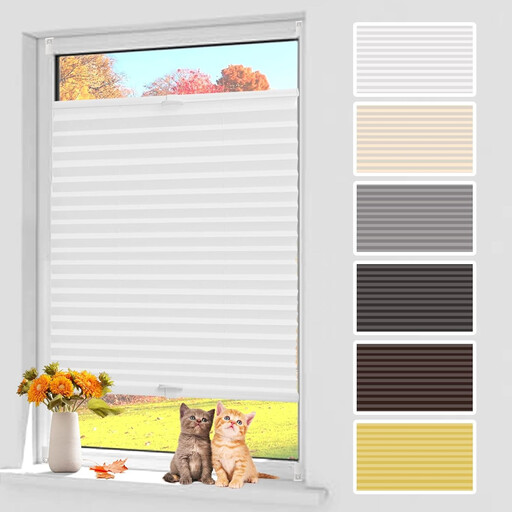
Why this product fits the profile: For bedrooms, children’s rooms, or rooms with direct sunlight, the stated blackout function provides stronger light blocking than a light-filtering pleated blind.
The adhesive holders require a clean, smooth surface and, according to the product specification, are not intended for rough or uneven surfaces.
White finish, 70 × 120 cm, installation without drilling, and polyester fabric with stated blackout function.
We have compiled a complete, regularly updated list of products that fully meet these strict selection criteria and the safety regulations in force in the EU.
For roof windows with a sloping surface, the models described here may not be suitable in some cases. Therefore, check the product specifications before purchasing. For a special roof window, you can also browse the range for roof window pleated blinds without drilling.
A clamp-fit pleated blind is attached to the window sash using adjustable clamp brackets. Alternatively, adhesive holders fix the pleated blind to a smooth, clean surface. Which variant is suitable depends on the frame thickness, material, and window shape.
Clamp holders do not require drill holes. However, with adhesive holders, residues or changes to sensitive surfaces cannot be completely ruled out. Test the suitability of the surface and follow the manufacturer’s instructions.
The lifespan depends on factors including installation, operation, sunlight exposure, and cleaning. Check the holders regularly, avoid jerky pulling, and protect the fabric from sharp objects. This will help reduce typical damage and premature loosening of the fixing.