
Lieferung heute & morgen

Qualitätsgarantie

Willkommens-Angebote freischalten: KOSTENLOSE Lieferung | Bis zu 80 % RABATT | Kostenlose 30-Tage-JoyPlus-Testphase
App herunterladen
A pliers set can cover a wide range of tasks: gripping, cutting, bending, loosening, clamping or securing. However, the purchase price alone says little about whether a tool is suitable for the work you have planned. The key factors are the design, opening width, material and intended application.
A set containing numerous pliers may appear versatile at first glance. However, if it includes several almost identical models but no suitable specialist pliers, it may lack important functions for the job at hand. For plumbing work, for example, you may need water pump pliers or pipe pliers, while circlips require circlip pliers with suitable tips.
A wide jaw opening can be useful, but it says nothing about whether the pliers are suitable for delicate or hard-to-reach components. Coarse-toothed water pump pliers can leave pressure marks on chrome-plated fittings. For oil filters, hose clamps or thin pipes, pliers specifically designed for each application are usually the better choice.
Plastic or TPR handles can make a tool more comfortable to use. However, they do not automatically provide electrical insulation. Ordinary combination pliers must therefore never be used on live wires. Electrical work requires tools that are specifically approved and insulated for this purpose.
For frequent use, specifications such as chrome vanadium steel, hardened carbon steel or heat treatment can provide useful guidance. They describe the construction, but do not replace checking the joint play, jaw design and overall finish.
A blackened, nickel-plated or otherwise treated surface can help protect against corrosion. Even so, pliers should be cleaned and stored dry after use in damp environments. Moving joints benefit from a thin film of oil during longer periods of storage.
Longer pliers usually provide greater leverage, but they can be more difficult to position in confined areas. For work in an engine compartment, flexible pliers with a Bowden cable may be more suitable than a short, rigid model. Before buying, check:
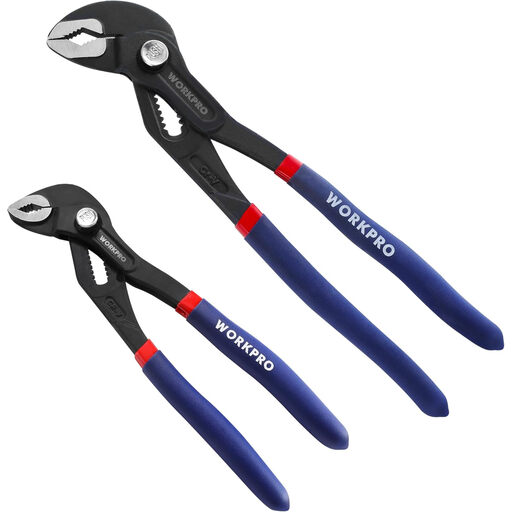
Why this product suits this profile: Two lengths cover smaller repairs and larger gripping tasks around the home, in the garage or during basic plumbing work.
The two different sizes prevent a single pair of pliers from being used for every opening width. The maximum openings are specified as 33 mm and 43 mm.
Chrome vanadium steel, push-button adjustment and serrated gripping surfaces; the handles are made from resin.
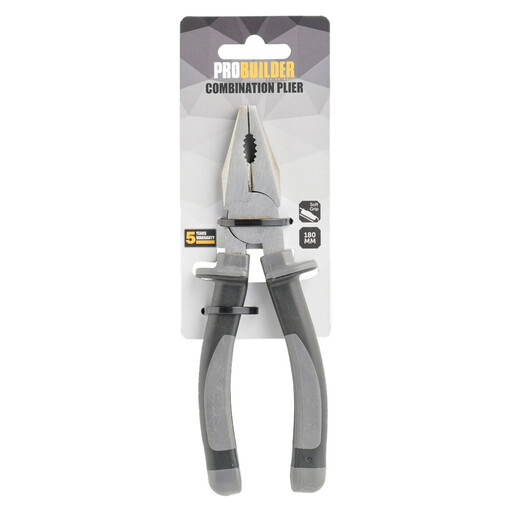
Why this product suits this profile: For users looking for one versatile hand tool for electrical installations with the power switched off, mechanical work and general repairs.
Flat and round gripping zones are clearly designed for different workpiece shapes. The cutting edges are specified for nails and soft, medium-hard and hard wires.
180 mm design, steel construction, and PP and TPR handles. The handles are not specified as providing electrical insulation.
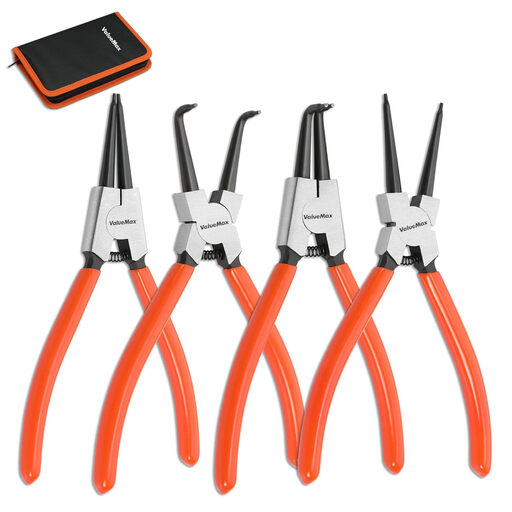
Why this product suits this profile: For mechanics, automotive DIY enthusiasts and assembly users working with internal and external circlips in straight or angled installation positions.
The set includes straight and 90° angled versions for internal and external circlips. This allows you to match the pliers to the circlip type and available working space.
Four pairs of pliers with 1.6 mm tips, opening widths of up to 33 and 36 mm respectively, plus a storage pouch.
Why this product suits this profile: For users who need a clamping tool alongside their pliers for woodworking, gluing, assembly and DIY projects.
The protective caps reduce direct contact between the clamp and the workpiece. The specified clamping force of 272 kg must not be exceeded.
Two clamps with a 150 mm span and two with a 300 mm span; the throat depth is 80 mm.
For pliers for car repairs, hose clamp pliers, oil filter pliers and, where necessary, circlip pliers are useful additions. Flexible hose clamp pliers with a 67 cm cable provide access to confined areas and feature a locking mechanism to hold the compressed clamp. Plastic line clamp pliers are suitable for delicate flexible lines; according to the product information, they are not intended for hard, reinforced or high-pressure lines.
When choosing pliers for plumbing work, opening width, jaw profile and sufficient leverage are important. For larger pipe diameters, 305 mm water pump pliers with a maximum opening of up to 50 mm may be suitable. For visible fittings, it is advisable to place a protective layer between the jaw and the surface.
For tools for woodworking, screw clamps or adjustable clamping pliers are often more important than another pair of gripping pliers. Pay attention to the clamping span, throat depth, permitted clamping force and pad material. Workpieces should be held securely without being deformed by excessive tightening.
We have put together a complete, regularly updated list of products that fully meet these strict selection criteria and the safety regulations applicable in the EU.
For general repairs, combination pliers, water pump pliers and side cutters provide a practical foundation. Depending on the application, you may also need circlip pliers, hose clamp pliers or oil filter pliers. A set should be chosen according to the tasks you actually need to complete, not simply the number of pieces included.
Service life depends on the material, workload, care and storage conditions. Rust, damaged cutting edges, excessive joint play or deformed tips are all signs of wear. Pliers should not be used as a hammer, lever or substitute for a spanner unless the manufacturer expressly permits it.
The price depends on the number of tools, steel quality, adjustment mechanism and specialist functions. A small set may be sufficient for occasional household tasks; for automotive, plumbing or assembly work, the right specialist pliers are often more useful than a large set containing unused pieces. Before buying, therefore, check the dimensions and application limits of each individual tool.