
Lieferung heute & morgen

Qualitätsgarantie

Willkommens-Angebote freischalten: KOSTENLOSE Lieferung | Bis zu 80 % RABATT | Kostenlose 30-Tage-JoyPlus-Testphase
App herunterladen
A pliers set can usefully complement individual tools or provide a basic toolkit for the workshop, home and vehicle. However, it is only worth buying if the type, material and dimensions of the pliers match the intended task. Otherwise, an inexpensive multipack containing unsuitable pliers may go unused, while you later need to buy another tool for the job you actually need to do.
A set containing numerous pairs of pliers may appear versatile at first glance. What matters, however, is whether the models included actually cover different functions. For general repairs, for example, combination pliers, side cutters and long-nose pliers are useful. Plumbing work, on the other hand, requires adjustable water pump pliers with a sufficiently wide opening.
Specialist tools such as hose clamp pliers, circlip pliers or crimping pliers each perform a clearly defined task. They cannot be sensibly replaced by ordinary combination pliers.
The maximum opening width alone says little about practical suitability. When pliers are opened very wide, the gripping area on the workpiece may become smaller. This affects power transmission and can damage delicate surfaces.
You should therefore consider the combination of opening width, jaw shape and serration. Curved, serrated jaws are suitable for nuts, fittings and pipes with different shapes. For thin wires or small components, narrower precision pliers are usually easier to control.
A plastic or TPR handle can be slip-resistant and comfortably shaped. This does not mean, however, that the pliers are approved for work on live cables. For electrical work, you must look for explicitly stated insulation and the appropriate marking. The handles mentioned in the product descriptions for general pliers sets are not automatically insulated.
For pliers that are used frequently, details such as chrome vanadium steel, carbon steel, the forging process and heat treatment are relevant. Chrome vanadium steel, for example, is specified for several WORKPRO models. Heat treatment can affect the hardness and load-bearing capacity of the tool head, but it is no substitute for suitable construction and proper use.
You should also look for:
Water pump pliers or pipe pliers should adjust to the workpiece without requiring unnecessary force. Push-button or sliding mechanisms allow quick adjustment. Check that the mechanism locks securely into place and that your typical workpieces fall within the stated range.
With locking pliers, on the other hand, the clamping function is the key feature. Once adjusted, they hold a workpiece securely and are suitable for assembly or repair work, for example. However, locking pliers do not replace pliers designed for turning, as their construction is intended for securing objects rather than continually loosening seized connections.
Longer pliers often provide greater leverage, but they also require more space. A shorter model may be better suited to confined areas in an engine bay or beneath a sink. For vehicle repairs, swivelling heads, flexible shafts or a locking mechanism can also be useful.
A slip-resistant handle helps you maintain control. For longer jobs, you should also consider the weight and hand position. Safety goggles and suitable gloves are advisable when cutting. Pliers with plastic handles that do not have specified electrical insulation must not be used on live circuits.
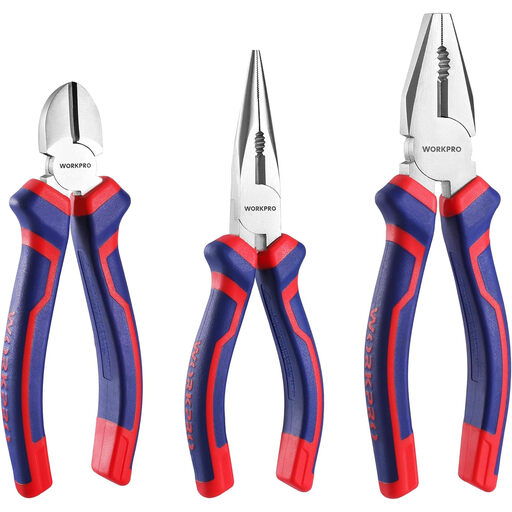
Why this product suits the profile: This set combines long-nose pliers, side cutters and combination pliers for typical household, DIY and assembly tasks.
Instead of many similar pairs of pliers, the pack contains three different basic types with clearly separate functions.
Heat-treated carbon steel with PP/TPR handles; the set includes models measuring 160 mm and 180 mm in length.
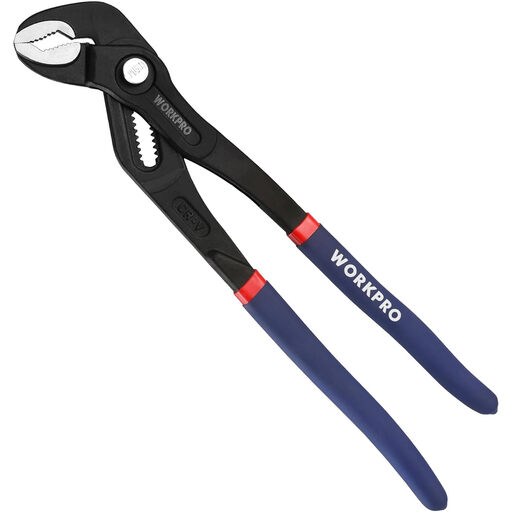
Why this product suits the profile: Measuring 305 mm in length, this single pair is aimed at users who need greater leverage and a wider opening for pipework and assembly tasks.
The specified maximum opening of 50 mm and push-button mechanism are more meaningful than a blanket claim such as “for all pipes”.
Chrome vanadium steel, heat treatment, serrated jaws and a specified opening width of up to 50 mm.
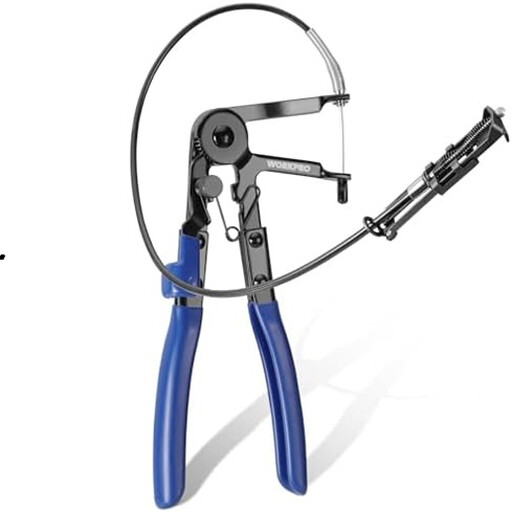
Why this product suits the profile: For vehicle repairs involving awkwardly positioned spring clamps, the flexible design offers a clearly defined application.
The 67 cm flexible shaft is designed for confined areas; its intended use is not confused with that of general-purpose pliers.
Ratchet lock, clamping range of 10 to 50 mm and PVC-coated handle according to the product information.
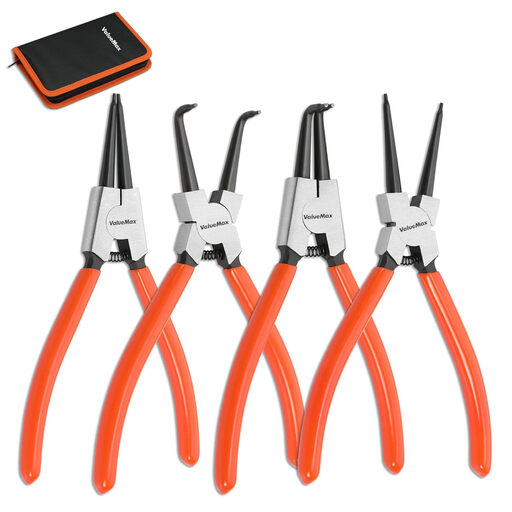
Why this product suits the profile: The set covers internal and external circlips, as well as straight and 90° angled designs.
The four clearly identified variants prevent an unsuitable straight pair of pliers from being used in hard-to-reach areas.
Carbon steel, 1.6 mm tips, opening widths of up to 33 and 36 mm respectively, plus a storage pouch.
We have put together a complete, regularly updated list of products that fully meet these strict selection criteria and the safety regulations applicable in the EU.
Always use the type of pliers intended for the task at hand. Water pump pliers should not be used for cutting, and combination pliers are not designed for pipe connections of any size. When working with hose clamps, check that the hose is flexible enough and that the stated clamping range is sufficient.
After use, a few simple measures can help preserve their function:
For general repairs, a DIY pliers set containing combination pliers, side cutters and long-nose pliers is a sensible starting point. If you regularly work with pipes, fittings or hose connections, you should also have a pair of water pump pliers. The specific tasks you need to carry out matter more than the number of pieces alone.
Water pump pliers with adjustable, serrated jaws are often used for plumbing work. Before buying, check the required diameter, opening width and available working space. With delicate surfaces, protective jaws or suitable material placed between the pliers and the workpiece can help reduce scratching.
It is not possible to give a reliable fixed service life for every set. Longevity depends on the material, load, care, corrosion and whether the usage limits are observed. Clean joints, dry storage and using the right tool can help reduce wear. Pliers should be replaced if the handles are damaged, cracks appear, the joint develops significant play or the cutters become deformed.