
Lieferung heute & morgen

Qualitätsgarantie

Willkommens-Angebote freischalten: KOSTENLOSE Lieferung | Bis zu 80 % RABATT | Kostenlose 30-Tage-JoyPlus-Testphase
App herunterladen
A pliers set can replace many individual tools – provided the types of pliers included are suitable for the jobs you have planned. For DIYers, installers, electricians, mechanics and DIY enthusiasts, it is therefore not just the number of pieces or a low price that matters. The design, material, dimensions and safe, appropriate use are all crucial.
A set containing numerous pliers may seem versatile at first glance. However, if it includes several similar models but no suitable combination pliers, diagonal cutters or long-nose pliers, important applications remain uncovered. You should therefore make a specific list of tasks before buying:
For a pliers set for DIYers, a well-balanced basic selection is generally more practical than a large, unexplained number of pieces.
Claims such as “suitable for all materials” are no substitute for specific technical data. For cutting pliers, it should be clear which types and diameters of wire they are designed for. Combination pliers or diagonal cutters are not automatically suitable for hardened wire, nails or cables of every thickness.
The maximum jaw opening is also important for water pump pliers. The shape of the workpiece – round, flat, square or hexagonal – also affects whether the serrations will grip securely.
TPR, PP or PVC handles can be non-slip and comfortable to hold. However, they are not automatically tested electrical insulation. For pliers for electrical work, the manufacturer’s information on insulation and the intended voltage range must be checked explicitly. Work on live installations should be carried out by suitably qualified personnel.
For frequent use, heat-treated alloy steel or chrome vanadium steel are relevant specifications. They describe the material basis, but alone they do not indicate the tool’s overall service life. You should also look for:
After use, metal surfaces should be wiped dry and the joints lightly oiled when necessary. Dry storage reduces the risk of corrosion.
Longer handles can provide greater leverage for loosening seized connections, but they are less manageable in confined areas. Adjustable pliers with quick adjustment save time when working with different diameters. For smaller assembly tasks, a 180 or 200 mm model may be easier to control, while 250 or 305 mm versions offer greater reach.
For pliers for plumbing work, adjustable, serrated jaws are useful for pipes and fittings. However, the jaws should be positioned carefully to avoid unnecessarily damaging delicate surfaces.
Hose clamp pliers are designed for flexible hoses and are not automatically suitable for rigid, reinforced or high-pressure lines. For automotive repairs, flexible hose clamp pliers with a long Bowden cable can make it easier to reach difficult-to-access areas.
For woodworking, clamping tools are more suitable. A clamping pliers set, a screw clamp set or a reversible clamp and spreader can hold workpieces in place during gluing and assembly. The clamping force must match the material thickness and surface; protective caps help prevent pressure marks.
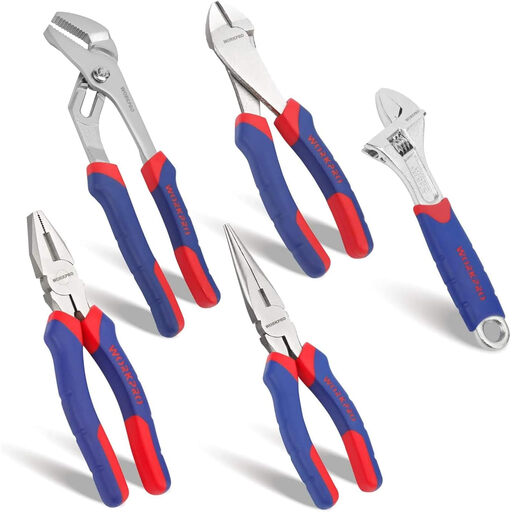
Why this product suits the profile: The 5-piece set covers basic household, repair and DIY tasks without the need to assemble several individual tools.
The included types are clearly specified: water pump pliers, combination pliers, diagonal cutters, long-nose pliers and an adjustable spanner.
Heat-treated alloy steel, nickel plating and TPR+PP handles; lengths range from 190 to 250 mm.
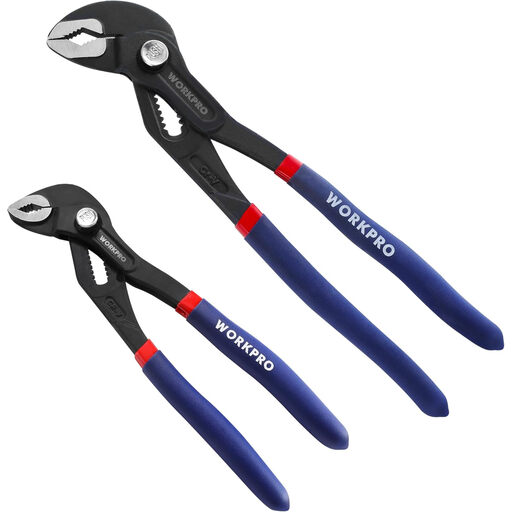
Why this product suits the profile: Two sizes with quick adjustment are suitable for recurring work on pipes, nuts and differently shaped workpieces.
The maximum jaw openings are specified as 33 mm and 43 mm respectively. This makes it easier to compare suitability with the workpiece before buying.
Chrome vanadium steel, push-button adjustment and serrated gripping surfaces; the set contains 180 and 250 mm pliers.
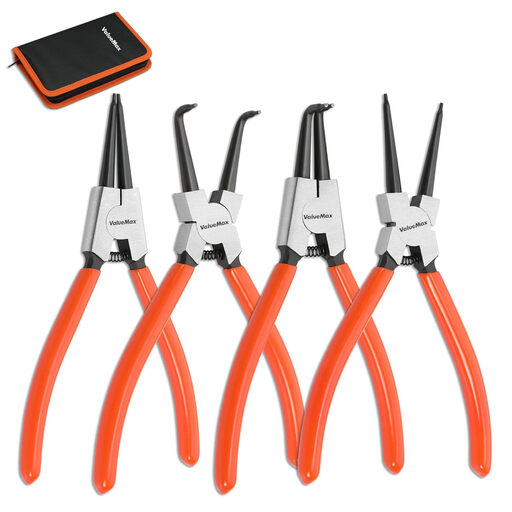
Why this product suits the profile: For mechanical, assembly and automotive work involving circlips, the set offers several tip shapes for internal and external rings.
The four variants – straight and 90° angled for internal and external rings – are clearly listed; the tip diameter is 1.6 mm.
Carbon steel tools, rubber handles and a storage pouch; the specified opening extends up to 33 or 36 mm, depending on the variant.
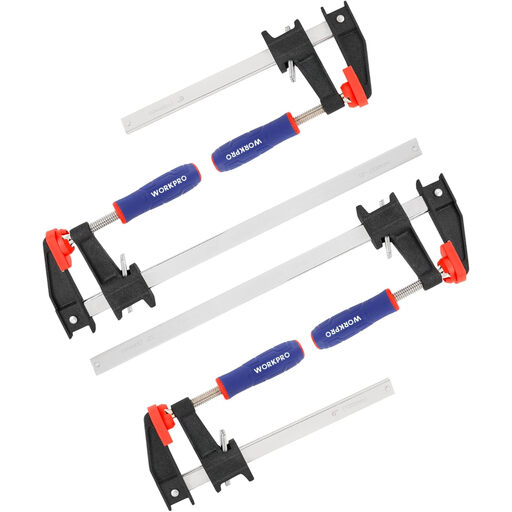
Why this product suits the profile: When gluing, aligning and securing wood or workpieces, the focus is on clamping rather than gripping with conventional pliers.
Two sizes with clamping capacities of 150 and 300 mm make the limits of use clear. Protective caps can help prevent pressure marks on delicate surfaces.
Four clamps made from coated alloy steel, an 80 mm throat depth and a specified clamping force of 272 kg.
We have put together a complete, regularly updated list of products that fully meet these strict selection criteria and the safety regulations applicable in the EU.
Wear safety goggles when cutting wire and nails. Pliers must not be used as a hammer, lever or substitute for a spanner unless they are specifically designed for that purpose. Damaged cutting edges, loose joints or cracked handles are reasons to stop using the tool.
For general repairs, combination pliers, diagonal cutters, long-nose pliers and water pump pliers provide a sensible foundation. An adjustable spanner complements the set for nuts and fittings. For automotive or woodworking tasks, specialist pliers or screw clamps can be added.
The key factors are the required jaw opening, the length and the shape of the serrated jaws. A 180 or 200 mm model may be sufficient for smaller fittings. For larger pipe diameters, a 250 or 305 mm version may be more suitable. The specifications for the product in question should be compared with the workpiece.
After use, remove dirt and moisture with a dry cloth. The joints can be lightly lubricated with suitable oil. Dry, protected storage prevents unnecessary corrosion. Cutting edges should not be reground unless the manufacturer provides instructions for doing so.