
Lieferung heute & morgen

Qualitätsgarantie

Willkommens-Angebote freischalten: KOSTENLOSE Lieferung | Bis zu 80 % RABATT | Kostenlose 30-Tage-JoyPlus-Testphase
App herunterladen
At first glance, a pliers set seems like a straightforward purchase: several tools, one price and plenty of possible uses. In practice, however, the combination of plier type, material, sizes and adjustment mechanism determines whether the set is suitable for your tasks. Combination pliers cannot replace water pump pliers, and a small pair of precision pliers is not designed for seized pipe connections.
Many sets contain several variants that differ only slightly in everyday use. If important tools such as side cutters, long-nose pliers or circlip pliers are missing, you may need to buy them separately later. Before buying, you should therefore identify the specific area of use:
A wide jaw opening does not automatically mean that pliers are suitable for high forces. Jaw geometry, the serration, the joint and the material construction are all important. Pliers with a wide opening may be suitable for large fittings, while smaller pliers offer better control in confined work areas.
A non-slip handle improves handling, but it cannot replace a suitable jaw shape. Likewise, a black or polished finish is not a reliable indication of service life. More useful details include chrome vanadium steel, carbon steel, heat treatment and clearly stated dimensions.
Combination pliers combine gripping and cutting functions, making them suitable for cables, wires and general assembly work. Side cutters, on the other hand, are designed for cutting through suitable materials. For working on small components, long-nose pliers, flat-nose pliers or a precision pliers set are more practical.
Water pump pliers are often used for pipes, nuts and workpieces with different shapes. Check the maximum jaw opening and adjustment options. For car repairs, oil filter pliers are also useful when filters need to be loosened without a suitable gripping surface. Hose clamp pliers make it easier to access spring clamps and hoses, while circlip pliers are designed for internal and external circlips.
For regular use, jaws made from chrome vanadium steel or heat-treated steel are relevant details. They describe the material base, but are not by themselves proof of a specific load capacity. You should also look for:
For pliers used in car repairs, the design should suit the available space in the engine bay. Long pliers can provide greater leverage, but they require sufficient room to manoeuvre.
Length affects leverage and handling. A 180-mm model is easy to control for many general tasks, while 250 to 305 mm models can offer greater reach and a wider opening. With oil filter pliers, specific ranges are more important than general claims about compatibility. For example, models with 60–102 mm or 63–103 mm cover different filter diameters.
Do not use pliers beyond their specified capacity. Cutting jaws are not designed for hardened steel, bolts or materials that exceed their cutting capability. When working on electrical systems, remember that a plastic or TPR handle is not automatically electrical insulation. Only suitable tools specifically marked for the purpose may be used on live wires.
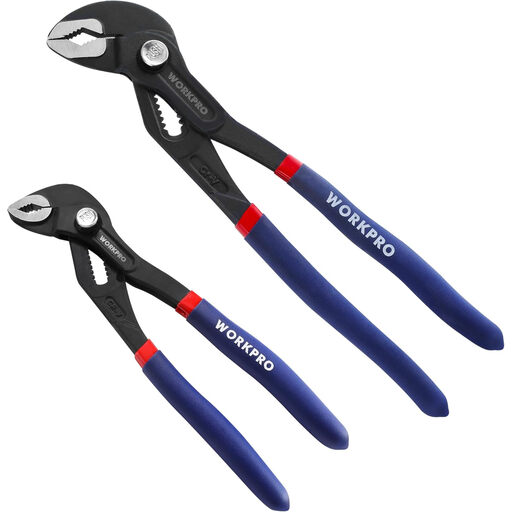
Why this product suits this profile: Two sizes cover smaller and larger gripping tasks around the home, in the garage and during installation work. The stated maximum openings are 33 mm and 43 mm.
The two lengths avoid having to rely on a single, unsuitable universal size. The Cr-V steel construction and serrated jaws are clearly specified in the product details.
180 mm and 250 mm sizes, push-button adjustment, ergonomic plastic handles and a design suitable for round, flat, square and hexagonal shapes.
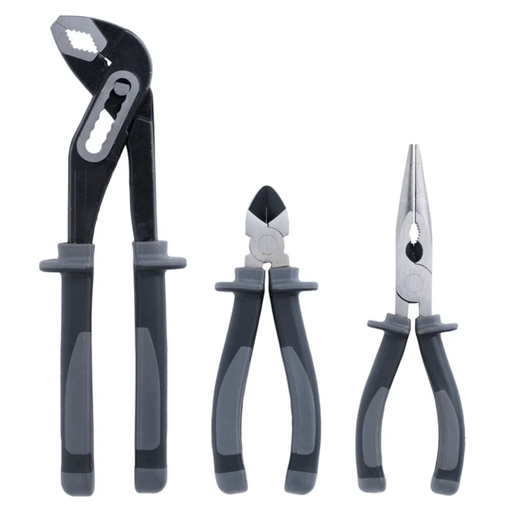
Why this product suits this profile: The set combines three distinct core functions: 380-mm water pump pliers, 190-mm long-nose pliers and 160-mm side cutters. This lets you choose your tools according to the task rather than appearance.
The three pliers are clearly differentiated by function and size. The side cutters are not described as combination pliers and should therefore only be used for suitable wires and cables.
Steel construction, PP/TPR handles, three clearly defined areas of use and a stated net weight of 0.83 kg.
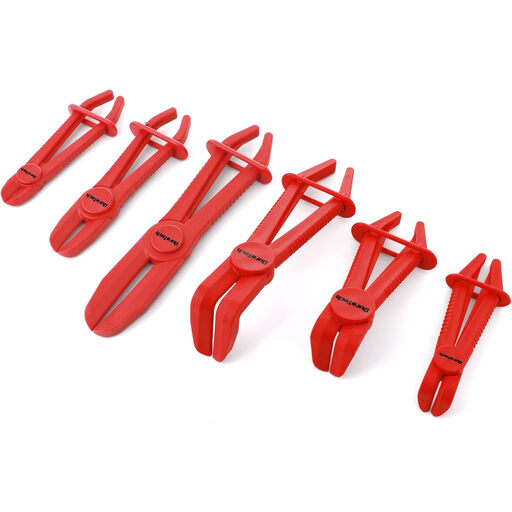
Why this product suits this profile: For regular work on flexible fuel, brake, coolant or radiator hoses, six straight and angled sizes are available.
The size ranges are stated individually: straight 3–8, 13–19 and 19–64 mm, plus angled 0–10, 0–15 and 0–25 mm. This makes it easier to check suitability before buying.
PA6 construction, non-conductive material, safety lock and rounded jaws for flexible hoses. Not designed for hard, reinforced or high-pressure lines.
For oil changes, Joybuy offers options including DURATECH 2-Piece Oil Filter Pliers with a 63–103 mm capacity and WORKPRO 12-inch Oil Filter Pliers with an adjustment range of 60–102 mm. If you fit circlips, you can consider the ValueMax 180-mm Circlip Pliers Set with four versions for internal and external rings. For hard-to-reach spring clamps, WORKPRO Hose Clamp Pliers with 67-cm Flexible Shaft are designed for the job.
For delicate electronics, jewellery or craft work, the WORKPRO W001305 Mini Precision Pliers Set with five types of pliers and a nylon case is a practical choice. Before placing an order, however, you should compare the jaw shape, length and material thickness with the task you intend to carry out.
We have put together a complete, regularly updated list of products that fully meet these strict selection criteria and the safety regulations applicable in the EU.
For general repairs, combination pliers, side cutters and long-nose pliers provide a practical foundation. A pair of water pump pliers adds useful versatility for plumbing work. Depending on the vehicle, car enthusiasts may also benefit from oil filter pliers, hose clamp pliers and circlip pliers.
Service life depends on the material, use, care and load. Wipe the pliers dry after use, avoid storing them permanently in damp conditions and apply a small amount of oil to the joints when necessary. Damaged handles, loose joints or chipped cutting edges are all reasons to stop using the tool.
The price depends mainly on the number of tools, material, size range and specialist functions. A small set may be sufficient for occasional tasks, while a DIY pliers set with several sizes or specialist car-repair pliers may cost more initially. What matters is whether the pliers included actually suit the way you plan to use them.