
Lieferung heute & morgen

Qualitätsgarantie

Willkommens-Angebote freischalten: KOSTENLOSE Lieferung | Bis zu 80 % RABATT | Kostenlose 30-Tage-JoyPlus-Testphase
App herunterladen
A pliers set can cover a wide range of repair tasks—provided the included pliers match the jobs you intend to tackle. However, many buyers focus primarily on the number of pieces: a 5-piece pliers set may initially seem more versatile than a 3-piece set, yet it may contain tools that are rarely needed in everyday use. The key factors are design, material, jaw opening and intended application.
A 4-piece or 5-piece pliers set can cover a variety of gripping and cutting tasks. However, if it lacks a suitable water-pump pliers or includes several tools designed for similar jobs, its practical versatility remains limited. For basic tasks, combination pliers, long-nose pliers and diagonal cutters are often more useful than a large, confusing assortment.
Red or blue plastic handles are not automatically insulated. Many pliers simply feature non-slip grips made from PP, TPR or PVC. These grips do not provide reliable protection against electric shock. When working on electrical installations, only tools specifically marked and approved for such work should be used. According to the product information, the sets mentioned here are not intended for work on live electrical circuits.
Pliers are not a universal lever for every task. Cutting hardened wire, loosening heavily corroded screw connections or extending the handles can damage the cutters, joint and jaws. Specifications such as cutting diameter, material hardness and maximum jaw opening should therefore be checked before purchase.
For frequent use, heat-treated steel, carbon steel, chrome vanadium steel or alloy steel are common material specifications. A coating or nickel plating can reduce the effects of moisture and corrosion, but it does not replace dry storage.
Hardened cutting edges are important for cutting pliers. However, the hardness rating alone does not indicate which materials can be cut. Checking the manufacturer’s specifications for wire type and maximum diameter helps prevent unsuitable purchases.
Longer pliers often provide greater leverage but require more storage space. A 305 mm water-pump pliers with a maximum 50 mm opening is better suited to pipe and workshop tasks than to small assembly jobs. For confined spaces, tools measuring 160 to 200 mm may be more practical.
Ergonomic TPR, PP or PVC grips improve handling and can be more comfortable during repetitive hand movements. However, they are not equivalent to electrical insulation. The joint, cutting edges and adjustment mechanism should be checked for damage before every use.
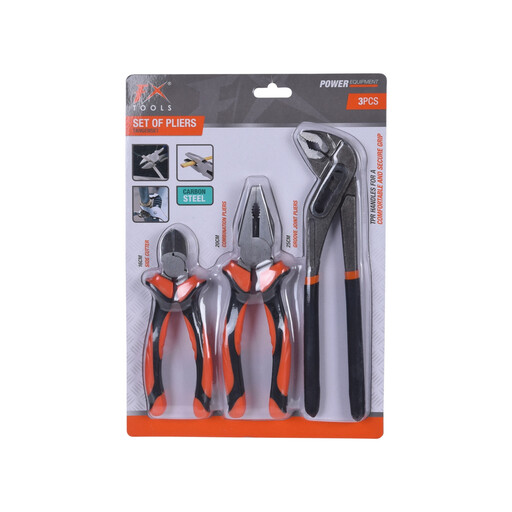
Why it’s a good fit: This set combines combination pliers, long-nose pliers and diagonal cutters for typical household, gardening and DIY tasks.
The three distinct designs cover clearly different tasks rather than duplicating similar tools. According to the product information, the pliers are not insulated.
Carbon-steel heads, hardened cutting edges, and PP and TPR grips. Suitable for gripping, bending and cutting wires approved by the manufacturer.
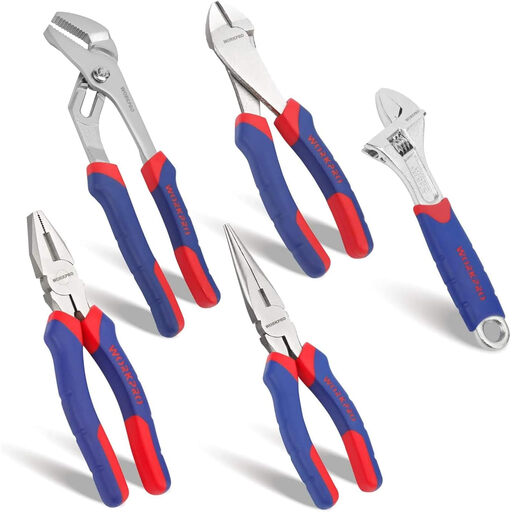
Why it’s a good fit: For users who need an adjustable wrench alongside pliers for assembly and repair tasks.
The five components are clearly identified: water-pump pliers, combination pliers, diagonal cutters, long-nose pliers and an adjustable wrench.
Heat-treated alloy steel with nickel coating, hardened cutting edges, and TPR and PP grips. The set includes pliers ranging from 190 to 250 mm in length.
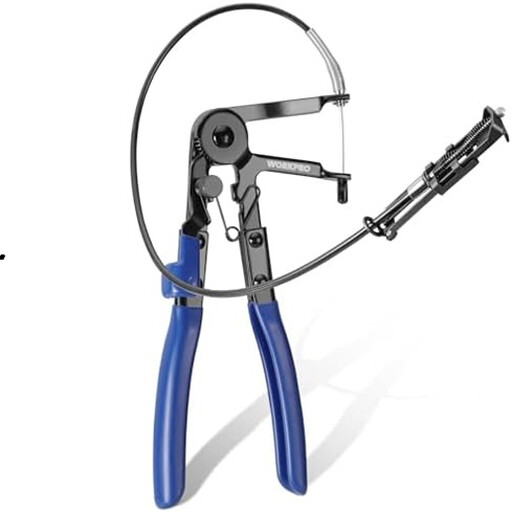
Why it’s a good fit: For working on fuel, oil, coolant and radiator hoses in hard-to-reach areas.
Before purchasing, check that the 67 cm reach and specified 10 to 50 mm opening range match the installation location and hose clamp.
Flexible cable, ratchet locking mechanism and heat-treated carbon steel. The lock allows the clamp to be held in a compressed position.
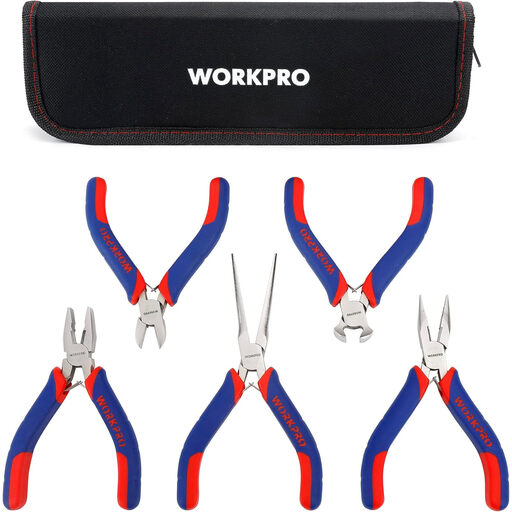
Why it’s a good fit: For jewellery work, electronics, model-making and small components where full-size pliers would be too imprecise.
The compact design is specifically intended for small components and is not a substitute for pipe or heavy-duty pliers.
Five mini pliers, including flat-nose pliers, long-nose pliers, end cutters, combination pliers and diagonal cutters, supplied with a nylon storage pouch.
Our complete selection includes a range of gripping tools for household tasks, workshops, plumbing, vehicle maintenance and precision repairs.
For a long service life, remove dust, oil and moisture from pliers after use. Applying a small drop of suitable lubricant to the joint can help maintain smooth operation. Tools showing rust, joint play, damaged handles or chipped cutting edges should no longer be used.
When cutting, safety glasses and a safe distance from other people are advisable. Cut wire fragments can fly off unexpectedly. Pliers should never be used as a hammer or as a substitute for a wrench. When working on vehicles, also follow the vehicle manufacturer’s instructions and verify suitability for the specific hose, filter or connection.
For general repairs, a 3-piece pliers set with combination pliers, long-nose pliers and diagonal cutters provides a straightforward basic kit. If you also work with pipes or larger nuts, consider a 4-piece set that includes water-pump pliers.
Hose-clamp pliers, oil-filter pliers or flexible long-reach pliers are worthwhile when a specific repair requires them and standard pliers cannot provide safe access. Before buying, compare the opening range, hose type and installation position.
Keep it dry, clean and protected from moisture. A pouch or toolbox prevents the cutting edges from knocking against one another. After working with oil, coolant or other fluids, clean the pliers and lightly lubricate the joint if necessary.