
Lieferung heute & morgen

Qualitätsgarantie

Willkommens-Angebote freischalten: KOSTENLOSE Lieferung | Bis zu 80 % RABATT | Kostenlose 30-Tage-JoyPlus-Testphase
App herunterladen
A plug-in lamp can illuminate your bedside table, hallway, child’s bedroom or home office without taking up much space. But the wide choice doesn’t automatically make it easy to find the right model. Products may look high-quality in pictures, yet their size, plug or lighting controls might not suit the place you intend to use them.
Before you buy, it’s worth checking the technical details rather than focusing only on the design and product claims.
Not every plug-in lamp is suitable for every socket in Germany. Check whether the product is designed for 220–240 volts and the German or European plug type. Imported table lamps may have different voltage specifications or an incompatible plug, meaning you’ll need an additional adaptor. Adaptors should not create a loose or unsafe connection, and must not exceed the permitted load.
The position of the socket matters too. A very wide plug-in LED lamp may block neighbouring sockets. If the socket is behind a bedside table, however, a compact plug-in table lamp may be more practical.
The brightness controls on a dimmable table lamp can vary considerably from one model to another. Some lamps offer four fixed settings, while others can be adjusted continuously. Touch controls are convenient, but very sensitive sensors can be triggered accidentally.
Also check whether the lamp has an integrated LED or needs a replaceable bulb. With a lamp that has an E26 fitting, you’ll need to choose the bulb separately. This gives you more flexibility over colour temperature and brightness, but adds to the selection process.
For a bedside or bedroom lamp, warm white at around 2,700 to 3,000 Kelvin is a popular choice. Neutral or cool daylight-style lighting can be useful for a home office or focused work, but may feel too clinical beside the bed.
Height matters too. A tall table lamp could tip over on a narrow bedside table or cause glare when you’re reading. A small LED bedside lamp takes up little space, but may not spread the light as far.
Compare:
A night light with a dusk sensor is particularly useful in hallways, on staircases and in children’s bedrooms. Position it so the sensor isn’t constantly affected by furniture, curtains or direct artificial light.
Measure the available space before you buy. Width and height aren’t the only things to consider: check the cable length and the position of the switch or USB port too. A heavy or non-slip base can be useful on a bedside table. If the lamp plugs directly into a socket, it’s best for the housing to be as compact as possible.
Fabric shades create a soft lighting effect, but need regular dry cleaning. Glass and acrylic elements can look decorative, but shouldn’t be cleaned with water unless the manufacturer recommends it. All indoor lamps should be used in dry rooms. Don’t cover ventilation openings, and stop using the lamp if its cable or housing is damaged.
If the lamp has a built-in USB port, check the stated charging output. A USB port on a lamp is handy for a mobile phone or e-reader, but it won’t necessarily replace a high-powered charger.
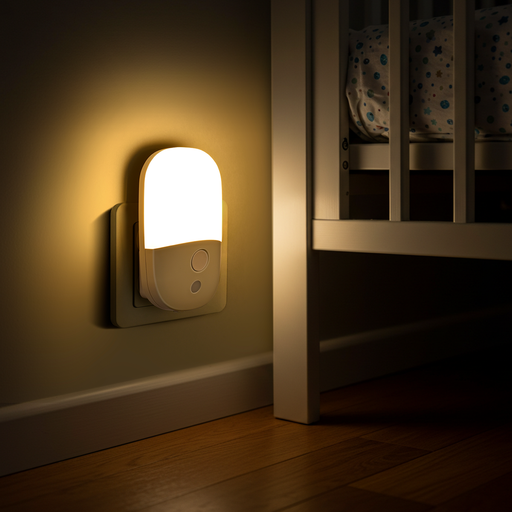
Why this product suits this type of user: According to the product details, this compact wall light is designed for hallways, stairs, kitchens, bedrooms and children’s bedrooms. A dusk sensor and adjustable brightness mean fewer controls to worry about.
The sensor switches the light on and off for you, so there’s no need to reach for an awkwardly placed switch beside the bed or in the hallway.
LED lighting, warm white at 2,700 Kelvin according to the product details, a dusk sensor and adjustable brightness.
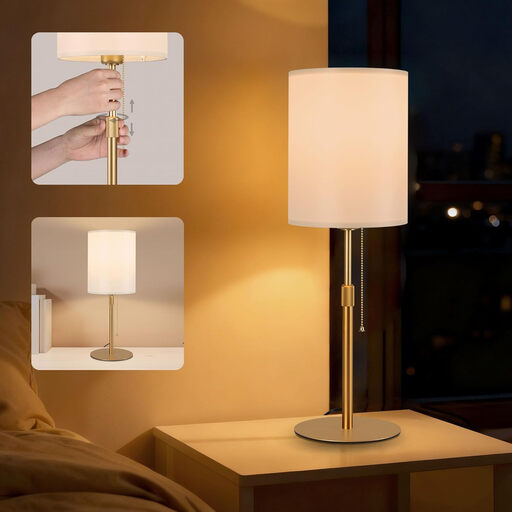
Why this product suits this type of user: The fabric shade, adjustable-height stem and pull cord combine decorative style with flexible positioning on a bedside table, desk or sideboard.
Adjusting the height helps you avoid having a light source that’s too low or too high. The pull cord is easy to reach, so there’s no need to search for an in-line switch.
E26 fitting, adjustable-height stem, fabric shade and metal base with a gold-coloured finish, according to the product description.

Why this product suits this type of user: According to the product description, the lamp is 40 cm tall and combines touch controls, three colour temperatures, continuous dimming and a USB port.
Choosing from three colour temperatures and adjusting the brightness continuously means you aren’t limited to just one brightness setting.
Touch switch, three colour modes, continuous dimming and an integrated USB port, according to the product details.

Why this product suits this type of user: This 6.4-inch-high LED bedside lamp is designed for bedside tables, shelves and small desks. It offers four touch-dimming levels and a memory function.
Its compact design takes up less space. The memory function saves you having to select your preferred brightness again every time you switch it on.
LED lighting, four dimming levels, touch controls and a memory function, according to the product description.
We’ve put together a complete, regularly updated list of products that meet these strict selection criteria and fully comply with the safety regulations applicable in the EU.
Place the lamp on a stable, dry surface or plug it directly into a suitable wall socket. First, check the voltage, plug type and instruction manual. Don’t trap cables, run them over sharp edges or place them under rugs.
Its lifespan depends on the LED module, heat dissipation, power supply and how many hours it’s used each day. Only rely on a specific lifespan if it’s stated in the technical product details. With integrated LEDs, you often can’t replace the bulb separately, so be sure to compare this before buying.
Electricity use mainly depends on the lamp’s power consumption in watts and how long it runs each day. For example, a 6-watt lamp running for five hours a day uses 0.03 kWh per day. To work out the running cost, multiply this figure by your current electricity rate. A dusk sensor or a lower dimming setting can reduce the operating time or power consumption, provided the model supports these features.