What to consider when buying
Start with a test recording from your usual sitting position, with the ventilation running. You can then compare connection options, monitoring and the speaking distance you need more effectively.
| What matters |
What to check before buying |
Who it matters most to |
| Booth acoustics |
Check the speaking direction, whether you can reach the microphone position and how a test recording sounds with the ventilation running as usual. |
If I can hear ventilation noise or reflections in a recording made in my small booth, I want to test my voice and the room acoustics where I’ll actually be sitting. Around 31% of consumers say booth acoustics are their main concern. |
| Computer connection |
Check the model’s connections and included cables against the inputs you already have. |
If I want to record on a computer without a separate audio interface, I need a suitable USB connection and the right cable. Around 25% of consumers say an easy computer connection is their main concern. |
| Monitoring |
Check whether the specific model has a headphone socket and, if relevant, level or mix controls. |
When recording, I want to hear my voice directly and be able to monitor the level. Around 19% of consumers say monitoring is their top priority. |
| Speaking distance |
Try recording from both near and further away while seated, and check which side of the microphone to speak into. |
If I don’t want to speak very close to the microphone throughout my intro, I need to be able to use my preferred distance in the booth. Around 13% of consumers are mainly looking for a suitable speaking distance. |
| XLR expansion |
Check whether you have or plan to get an audio interface, and whether the model actually offers both USB and XLR. |
If I already use an XLR setup or want to build one, I want to choose the microphone and the necessary components together. Around 12% of consumers say adding to an XLR setup is their main concern. |
Joybuy products for podcast intros
This selection includes dynamic USB/XLR microphones, as well as podcast kits with a mixer or condenser microphone. For each kit, check that the connections and mount suit your booth and recording setup.
 No image available
FIFINE AM8 USB/XLR Dynamic Microphone
For recording speech at close range, with a USB connection to your computer and the option to use an XLR recording setup.
Dynamic, unidirectional USB/XLR microphone with USB-C, mute function, headphone monitoring and desk stand. A microphone arm and XLR cable aren’t included; according to the product description, the function buttons work only in USB mode.
View at Joybuy
 No image available
FIFINE K688CT USB/XLR Podcast Microphone Kit
For close-range speech recording, if you can attach the included microphone arm to your desk.
Dynamic USB/XLR microphone with cardioid pickup pattern, headphone socket, gain control and microphone arm kit. The XLR cable isn’t included; according to the product description, the function buttons work only over USB. The C-clamp is designed for desk tops under 2 inches thick.
View at Joybuy
 No image available
Dynamic USB XLR Microphone Set with Table Stand
For podcast and voice recording if USB-C or XLR and a desk stand suit your planned setup.
The product description lists a dynamic cardioid microphone with USB-C and XLR, a headphone socket, mute function and gain control.
View at Joybuy
 No image available
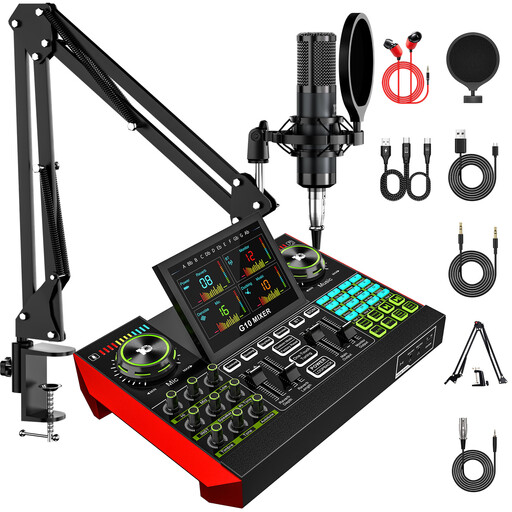
Yinkaer G10-P15-XB Podcast Microphone Kit
For a recording setup where you want to include a sound card audio mixer and a microphone arm.
The product title lists a mixer, a 3.5 mm condenser microphone and a microphone arm.
View at Joybuy
 No image available
Yinkaer G10-P17 Podcast Microphone Kit
For podcast recording if an additional mixer is part of your planned recording setup.
The product title lists a 3.5 mm condenser microphone and an audio mixer.
View at Joybuy
Frequently asked questions
How do I set up a microphone for a short intro?
Point the intended speaking side towards your mouth, then listen to a test recording at your usual volume with the booth ventilation on. If you’re speaking close to a dynamic microphone, it’s important to keep your position consistent. Don’t apply a recommended distance to a different model without checking it first.
Do I need another device to connect an XLR microphone to my computer?
With an XLR-only model such as the Wave DX, you’ll need an XLR audio interface and a three-pin XLR cable to connect it to a computer; Elgato also lists a mount. A suitable USB microphone, on the other hand, can record on a computer without a separate audio interface.
What should I check after recording, and what if there’s a fault?
Listen to a short test recording for clear speech, sudden changes in level and background noise before recording several intros. If a newly purchased item is faulty in Germany, you generally have statutory warranty rights against the seller; the German Federal Government states that these last for two years. A voluntary guarantee is separate from this.
Are these microphones subject to radio frequency rules in Germany?
The USB and XLR connections described here are wired. Germany’s Federal Network Agency describes its general frequency allocation from April 2026 for wireless microphones as an alternative to a microphone cable. For a wireless system, check the frequency band and conditions of use against the allocation in force.
How should I dispose of an old electric microphone?
In Germany, old electrical equipment must not go in household waste. The Federal Environment Agency recommends taking it to a separate collection point, such as a recycling centre or an appropriate retailer take-back point.


