For recording poetry, your choice of microphone depends above all on the room and on how consistently you can speak close to the mic. A dynamic microphone may work well if you can maintain a steady, close position, while a condenser microphone is more suited to a quiet room with controlled acoustics. USB makes it easy to connect to a computer; XLR is a good fit for a suitable interface or a recording setup you can expand later. None of these options automatically eliminates echo or background noise, so check the levels, pop shield and what’s included with the specific model too.
Which solution suits you?
Readers in a room with lots of background noise
If you can’t eliminate echo or background noise completely, look for a setup that lets you speak from a close, consistent position. A test recording from the spot you plan to use will show how room noise and the rustling of pages come through during pauses.
Readers with a quiet recording room
If you want to capture quiet syllables and changes in delivery, you’ll also need to control page noise and reflections. A more sensitive microphone can pick up these sounds as well as the nuances in your voice.
Readers with a simple computer setup
If you want to get started without a separate interface and monitor your voice as you record, check for a USB connection, headphone output and easy-to-use controls. If you may want to change your recording setup later, check which connections the specific model actually has.
What to look for when buying
Dynamic microphone, used up close
A good fit if: You can’t sufficiently quieten the room and can maintain a close, consistent position while reading.
The trade-off: Distance and positioning affect the recording. Shure notes that speaking very close to directional microphones can boost the bass.
Condenser microphone in a quiet room
A good fit if: You want to capture quiet articulation and can control reflections and noise in the room.
The trade-off: Audio-Technica points out that condenser microphones can also pick up background and room noise.
| Buying priority |
What to check |
Who it matters most to |
| Room noise and echo |
Positioning and a consistent speaking distance; make a test recording with the actual room and page noise. |
If I’m reading in a room with lots of background noise, I want to get a clear idea of disruptive sounds during pauses. Around 33% of consumers put this first. |
| Quiet and emphatic verses |
Test a quiet and a loud passage; check headphone monitoring and input levels. |
If my delivery shifts between quiet and emphatic passages, I want to be able to assess both when listening back. Around 27% of consumers with this as their main priority feel the same. |
| Easy to get started on a computer |
Check USB compatibility, the cable actually included, headphone output and level controls. |
If I’m recording on my own at my computer, I want to get started without a separate interface and monitor my voice directly. Around 20% of consumers prioritise this straightforward setup. |
| A recording setup you can expand |
Check the USB and XLR connections on the exact model, and make sure they’re compatible with your interface, cable, power supply and gain requirements. |
If I already use an interface or may switch to XLR later, I need a signal path that works with it. Around 20% of consumers prioritise a setup they can expand. |
Common misconceptions
-
A sensitive microphone can make up for poor room acoustics
A condenser microphone can pick up reflections and page noise as well as quiet nuances in your voice. Choosing a microphone alone won’t soundproof a room with lots of echo.
Try a test recording in the room you plan to use before settling on a microphone type.
If room noise is distracting, you may need to run more tests and make additional recordings.
-
USB, XLR and similarly named model variants are interchangeable
Models with similar names can have different connections and come with different accessories. For example, RØDE distinguishes between the NT-USB and NT-USB+; the AT2020 and AT2020USB-X also use different connections.
Compare the full model name, connections and accessories included with the specific variant.
-
With an XLR microphone, only the mic itself matters
Your recording setup may need an interface and cable, plus a suitable power supply or extra gain, depending on the model. Shure recommends around +60 dB of clean gain for the SM7B; this figure doesn’t apply to all microphones.
Before buying, put together the complete signal path for the exact model you’ve chosen.
-
Speaking close to the mic or digital processing will solve every sound problem
With directional microphones, a very short distance can boost the bass. Noise-processing features don’t guarantee that you’ll get a clean recording in your room.
Test the same text from a consistent distance and listen back through headphones. Adjust the distance and pop shield one at a time.
Brands to consider
Shure
Worth considering for close-miked speech with USB/XLR hybrid models or an XLR studio setup.
- The MV7+ offers USB-C and XLR; Shure documents monitoring and adjustable processing.
- Information about the effect of processing comes from the manufacturer and isn’t a measurement in your room. For the SM7B, Shure recommends around +60 dB of clean gain.
RØDE
The PodMic USB is a dynamic USB/XLR model; the NT1 5th Generation is a USB/XLR condenser microphone for a controlled recording environment.
- The PodMic USB is documented as having a headphone output and pop shield. The NT1 5th Generation is listed with a shock mount, pop shield and both cables.
- The models differ in capsule type and room requirements. Manufacturer claims about sound quality are no substitute for listening to them at your own recording spot.
Audio-Technica
The AT2020USB-X is for USB recording with monitoring; the AT2020 is an XLR condenser microphone for a compatible recording setup.
- A desk stand and USB cable are listed as included with the AT2020USB-X.
- The XLR cable for the AT2020 is sold separately. The required power must be supplied through a suitable XLR recording setup.
Sennheiser
The Profile USB is a USB option for recording spoken text on your own at a computer.
- For the Profile USB, item number 700065, Sennheiser lists gain, mix and volume controls, a headphone output, desk stand and USB-C cable.
- According to the manufacturer, the cardioid pickup pattern can reduce off-axis noise, but it won’t soundproof a room with lots of echo.
Samson
The Q2U is a dynamic USB/XLR model; the Meteor Mic is a compact USB condenser microphone.
- Samson lists a desk stand, windscreen, USB cable and XLR cable among the accessories for the Q2U.
- The models have different capsule types and connections. Manufacturer claims about suitability for untreated rooms should be checked at your own recording spot.
Microphones and recording solutions at Joybuy
The selection includes dynamic USB/XLR microphones, as well as USB and clip-on options for different speech-recording setups.
 No image available
FIFINE K688CTW, dynamic USB/XLR microphone
This dynamic USB/XLR model is worth considering for close-miked speech at your desk.
A unidirectional pickup pattern, headphone socket and gain control are listed. A boom arm, shock mount and windscreen are also mentioned; according to the product description, an XLR cable is not included.
According to the product description, the controls and function buttons are only active in USB mode.
View at Joybuy
 No image available
FIFINE AM8, dynamic USB/XLR microphone
If you’re looking for a dynamic microphone with a choice of USB or XLR connection, this model could be a practical desk setup.
The product description lists a unidirectional pickup pattern, gain control, mute button and headphone socket. A desk stand, windscreen and USB cable are also listed.
According to the product description, the XLR cable and boom arm are not included. RGB lighting and function buttons are only available in USB mode.
View at Joybuy
 No image available
DJI Mic Mini 2S (2 TX + 1 RX + Charging Case)
This set is worth considering if you’d prefer clip-on transmitters for recording speech rather than a single desk microphone.
The product name lists two transmitters, one receiver and a charging case. The product description lists PC compatibility and internal 32-bit float recording.
View at Joybuy
 No image available
USB condenser microphone for PC, 7-piece set
This USB condenser microphone could be an option for recording on a PC in a quiet room. First, check that the room is suitable for your reading.
The product description lists a headphone socket for monitoring and a mute button. The product name identifies it as a seven-piece set.
View at Joybuy
 No image available
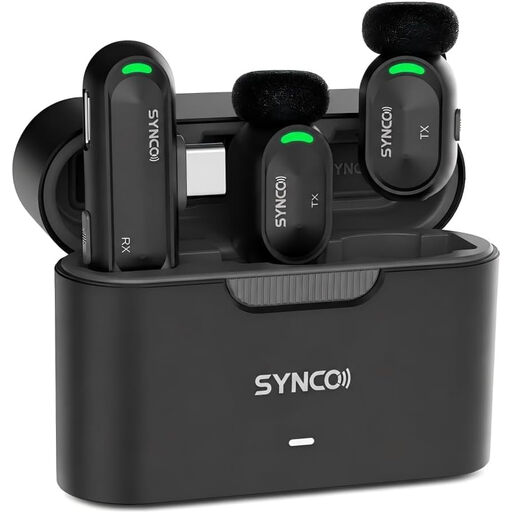
SYNCO SMIC AI, wireless USB-C microphone for Android
This model is designed for recording with an Android device, rather than as a conventional XLR or USB desk microphone.
The product description lists a clip-on design and USB-C. OTG support is required for the connection described.
View at Joybuy
Frequently asked questions
Do I need an audio interface for an XLR microphone?
Only if you don’t have another suitable XLR recording setup. A USB-only microphone can be connected directly to a compatible computer; with the AT2020 XLR condenser microphone, the required power must be supplied through a suitable recording setup. You should also consider the available clean gain when using the Shure SM7B.
How do I test the microphone position for quiet and loud verses?
At the spot you plan to use, read a quiet passage, an emphatic passage and some words with P and B sounds. Listen for echo, page noise and plosives, and check that the input doesn’t clip on emphatic lines. Adjust the distance and pop shield one at a time. With directional microphones, speaking very close can also boost the bass.
Which accessories should I compare when choosing a microphone?
Check the exact variant for its cables, desk stand or microphone arm mount, pop shield and headphone socket. USB and XLR versions with similar names can differ in their connections and what’s included.
Can I record someone else’s poem and publish it online?
Not automatically just because you’re the one reading it aloud. The German Patent and Trade Mark Office lists reproduction and making a work available to the public online as relevant exploitation rights. For the specific poem and how you plan to use it, check whether you have the necessary rights, need permission or the work is in the public domain.


