
Lieferung heute & morgen

Qualitätsgarantie

Willkommens-Angebote freischalten: KOSTENLOSE Lieferung | Bis zu 80 % RABATT | Kostenlose 30-Tage-JoyPlus-Testphase
App herunterladen
A police toy vehicle can look impressive in product photos: flashing lights, a siren, detailed stickers and a matching figure promise plenty of imaginative play. In practice, though, other details determine whether the vehicle gets played with regularly or ends up in the toy cupboard after a short time.
As a Joybuy Product Recommendation Officer, I assess product information against clear criteria. This guide explains which features matter in a police car for children, which marketing claims are worth checking more closely, and which model suits different types of play.
A police car with lights and sounds needs batteries. If the battery type, what’s included or the battery compartment isn’t specified, you could face extra costs and hassle. Some vehicles come with batteries, while others require you to buy them separately. You can’t tell how loud a toy is from product photos, either.
Before you buy, check:
A small metal model such as a Siku ambulance is suitable for imaginative play and collecting, but it usually has fewer features than a larger vehicle with a figure. On the other hand, a detailed 1:16 scale model may be harder for younger children to handle.
The key things to consider are scale, weight, moving parts and age recommendation. A vehicle with lots of small parts is not suitable for a child under three. For children aged around 3 to 9, the choice should also suit their fine motor skills and the type of play you have in mind.
With terms such as ‘assorted’, the specific colour or figure may vary. This can apply to vehicles from a series such as Paw Patrol, for example. If you’re looking for Chase, Marshall or a particular design, check before buying whether you can choose one or whether a model will be sent at random.
The age recommendation is an important safety guide, but it doesn’t replace adult supervision. Several of the vehicles listed here include figures or moving parts. Products with small parts are not suitable for children under 36 months. Before buying a police toy for ages 3 and up, read the packaging information and warnings.
For everyday play, it makes a difference whether a police toy car is simply pushed along, has freewheeling wheels or moves using a push-and-go or friction mechanism. Freewheeling wheels are simple to use and don’t need batteries. Light and sound modules add more features, but may require extra batteries and regular checks of the battery compartment.
Look out for:
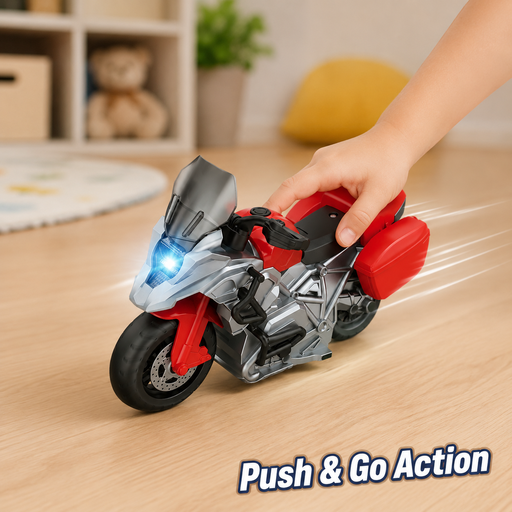
Why it suits this type of play: This police motorbike uses a push-and-go mechanism, with lights and music to add to the action. There’s no need to keep pushing it along using a remote control.
The product description clearly specifies the push-and-go mechanism, so there’s no ambiguity about whether it’s remote-controlled.
Push-and-go mechanism, lights and sound, and a 1:20 scale; as a single vehicle, it’s easy to add to existing play scenarios.
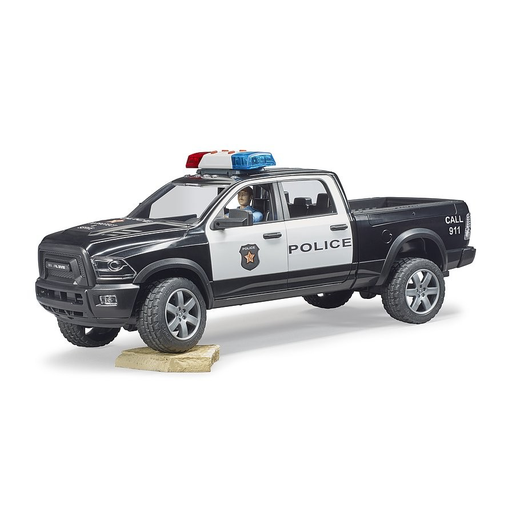
Why it suits this type of play: This 1:16 scale model comes with a police figure, opening doors and tailgate, a steerable front axle, and a light and sound module.
The product details specify the scale, features, figure and battery type. The three LR44 batteries required are not included, according to the product information.
1:16 scale, four opening doors, steerable front axle, tailgate and included bworld police figure.
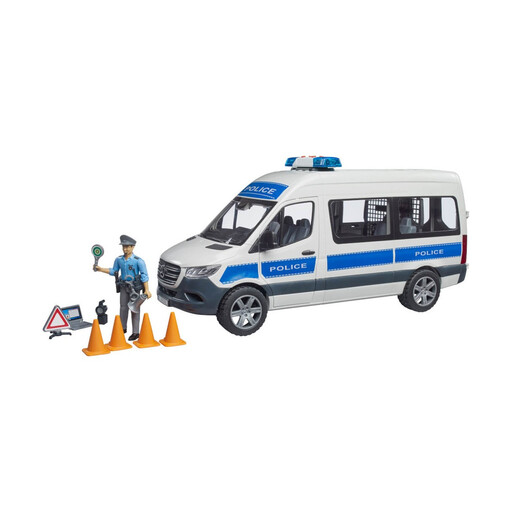
Why it suits this type of play: This large 1:16 scale Sprinter is designed for imaginative play with a police figure, and can be combined with other Bruder vehicles.
The product details list the age recommendation, materials, light and sound module, and guidance on dry use and storage.
Included bworld police figure, 1:16 scale and built-in light and sound module; recommended for ages 4 and up.
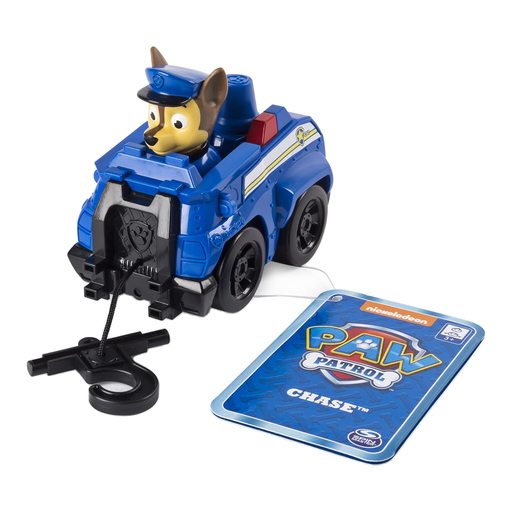
Why it suits this type of play: These vehicles are designed for children aged 3 to 9 and come with figures permanently attached from the Paw Patrol series.
The product information states that the set needs no batteries and requires no assembly. However, ‘assorted’ means the item may be selected at random.
Freewheeling wheels, a permanently attached figure, no batteries, and action features on some models, such as a winch with a rescue hook.
We’ve put together a complete, regularly updated list of products that meet these strict selection criteria and fully comply with the safety regulations in force in the EU.
Choose models with an appropriate age recommendation and as few loose small parts as possible. Before use, check a police toy for ages 3 and up for any damaged parts. If the vehicle comes with figures, it’s a good idea to store it out of reach of younger siblings.
It depends on how your child plays and where you live. Lights and sounds can add to imaginative play, but they need batteries and may not be welcome in every setting. For simple play without ongoing battery costs, consider a freewheeling or push-powered model.
A police car with a figure usually offers more scope for longer imaginative play. A police motorbike takes up less space and is easy to move around. A Paw Patrol rescue vehicle is especially suited to fans of the series, while a Siku ambulance is better for compact play scenarios and collections. Scale, age recommendation, features and any accessories you already have should guide your choice.