
Lieferung heute & morgen

Qualitätsgarantie

Willkommens-Angebote freischalten: KOSTENLOSE Lieferung | Bis zu 80 % RABATT | Kostenlose 30-Tage-JoyPlus-Testphase
App herunterladen
Sand on the pool floor, leaves after a windy day or deposits along the waterline: a pool robot can make regular maintenance considerably easier. However, automatic pool cleaners vary significantly in terms of cleaning coverage, battery life, filtration system and operation. The right choice therefore depends less on advertising promises than on pool size, shape and the cleaning coverage you require.
A cordless pool robot can move independently across the pool floor. A manual battery-powered pool cleaner, by contrast, must be guided by hand, much like a pool vacuum. This is practical for removing isolated dirt but does not replace automatic cleaning of the floor, walls and waterline.
Check whether the device is genuinely designed for the area you want to clean and which sections it can reach. Some models are intended exclusively for flat pool floors, while others can also clean walls or the waterline.
Claims such as “up to 180 minutes” or “up to 3 hours” refer to specific operating modes. Wall cleaning, heavier soiling and complex pool shapes can increase energy consumption. Charging time, battery capacity and the return function must also be taken into account.
For a small above-ground pool, a runtime of 30 to 75 minutes may be sufficient. Larger in-ground pools benefit from longer cleaning cycles and automatic parking at the pool edge.
A fine filter can capture smaller particles, but it will clog more quickly when dealing with large quantities of leaves or coarse debris. A larger filter capacity reduces how often the filter needs to be emptied. Pay attention to both specifications:
Compare the permitted pool volume or maximum cleaning area with your pool’s actual dimensions. According to the product specifications, the BWT BC02 is designed for pools up to 10 m³, while the BWT BC50 and BWT ES50 are specified for pools up to 25 m³. Other devices refer to square metres, such as the WYBOT C2, which is specified for areas of up to 200 m².
For above-ground pools, the shape of the floor, wall angle and liner material are also important. For in-ground pools made of tiles, concrete, liner or fibreglass, compatibility should be explicitly stated.
Distinguish between:
A device with app control does not automatically provide more comprehensive cleaning. Brushes, drive system, sensors and the coverage specified by the manufacturer remain the decisive factors.
A battery-powered pool cleaner should be fully charged before it is placed in the water. Charging ports and power supplies must remain dry. Also check whether a pool pole, retrieval hook or charging station is included.
With a manual pool cleaner such as the BWT ES50, direct control and targeted cleaning are the priorities. An automatic pool cleaner such as the WYBOT OS800 or WYBOT C2, on the other hand, handles the cleaning cycle independently. App features such as schedules, cleaning modes or firmware updates can be useful, but are not essential for small pools.
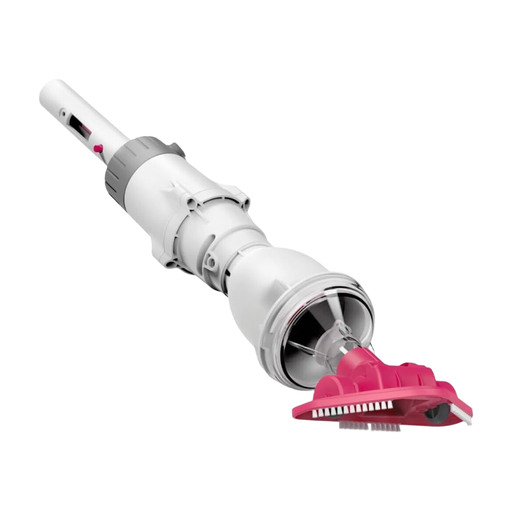
Why this model is a good fit: For children's pools, hot tubs and smaller above-ground pools up to 10 m³, a compact, manually operated battery-powered pool cleaner is sufficient.
The specified pool size and manual operation make it clear that this device is intended for targeted floor, corner and step cleaning.
Up to 30 minutes of runtime, a 0.42-litre debris container, fine filter and pool pole according to the product description.
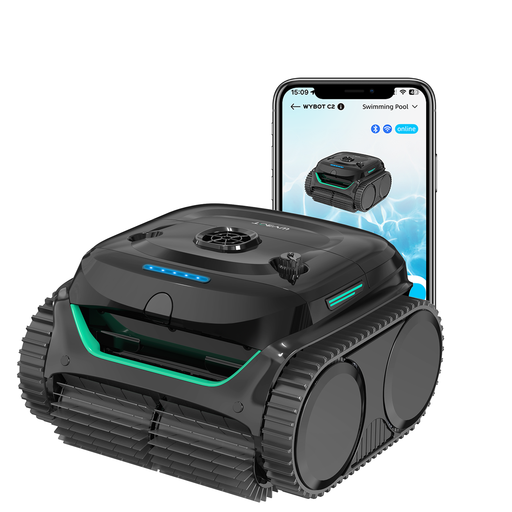
Why this model is a good fit: For users who want to automate floor, wall and waterline cleaning and schedule cleaning routines via the app.
The cleaning coverage is specifically stated as including the floor, walls and waterline, rather than being promoted merely as general automation.
Up to 180 minutes in Eco mode, a 180-micron pre-filter plus a 10-micron HEPA filter, five modes and up to four schedules per week according to the product specifications.
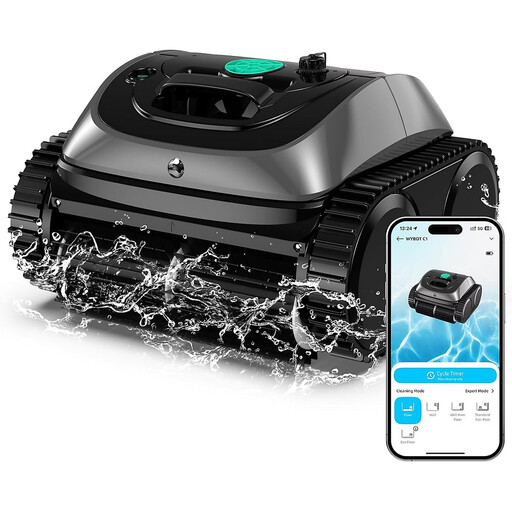
Why this model is a good fit: For pool owners who need longer battery life, multiple cleaning modes and an automatic return to the pool edge.
The four cleaning modes allow you to select the right programme for the level of soiling and the area, rather than using the same setting for every application.
Up to 150 minutes of battery life, 11.5 m³/h suction capacity, a 180-micron filter and floor, wall and waterline cleaning according to the product description.
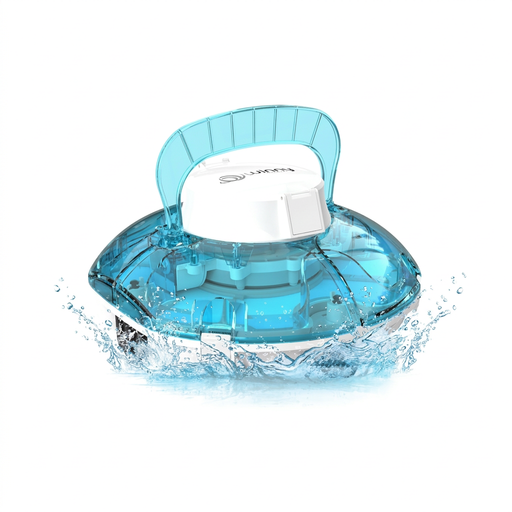
Why this model is a good fit: For flat above-ground pools with different layouts when only the pool floor needs to be cleaned.
The product specifications explicitly state that it cleans flat pool floors. If you expect wall or waterline cleaning, choose a different model.
Up to 75 minutes of runtime, dual filtration with a 180-micron filter and foam element, plus an automatic parking function.
Our selection includes additional models for different pool sizes, cleaning areas and operating concepts. Check the technical specifications and confirm that the cleaner is suitable for your pool before buying.
Rinse the filter basket or debris container after every cleaning cycle. Fine sand and organic residue can impair filtration performance if they are allowed to dry inside. Charge the pool robot only outside the water and with a dry charging port. For storage, choose a dry, shaded indoor area.
No people or pets should be in the pool while the device is operating. Observe the maximum water depth, temperature range and the instructions provided by the relevant manufacturer. A pool robot also does not replace checks of the pH level, disinfectant and water level.
Consumption depends on battery capacity, runtime, motor power and charging frequency. With battery-powered models, electricity is drawn during charging; without knowing the charging power and electricity tariff, it is not possible to provide a reliable blanket cost estimate. Shorter cleaning programmes and a clean filter can reduce operating time per cycle.
There is no universal service life. It depends on frequency of use, water chemistry, filter maintenance, storage conditions and the condition of the brushes, wheels and battery. Regular rinsing, dry storage and compliance with the manufacturer’s instructions can reduce stress on the components.
No. Check the floor shape, pool depth, wall material and cleaning coverage. Models designed for flat floors are not automatically suitable for walls or waterlines. For an above-ground pool cleaner, the specified maximum area or permitted volume should also match the pool’s actual dimensions.