
Lieferung heute & morgen

Qualitätsgarantie

Willkommens-Angebote freischalten: KOSTENLOSE Lieferung | Bis zu 80 % RABATT | Kostenlose 30-Tage-JoyPlus-Testphase
App herunterladen
A pop-up camping tent promises a hassle-free set-up. In practice, however, automatic tents, quick-setup tents and traditional dome tents differ considerably in terms of space, materials and weather protection. If you focus only on how quickly the tent can be erected, it is easy to overlook important details.
The term waterproof tent alone says little about the actual construction. Important factors include the hydrostatic head of the outer tent, taped seams, a raised groundsheet and the quality of the zips. A model with a 3,000 mm hydrostatic head provides a useful basis for comparison. Whether it stays dry in heavy rain also depends on how it is pitched, guyed out and positioned on the ground.
A 2-6-person tent may offer several sleeping spaces without providing enough room for luggage or longer stays. For families and groups of friends, interior height, floor area, sleeping compartments and a covered entrance are also important. A family tent with a sun canopy often provides more usable living space than a tent of the same size without an awning.
A camping tent with UV protection can reduce exposure to solar radiation. However, the actual temperature inside also depends on the colour, ventilation, opening areas and shade. Coatings such as UPF50+ or UV30 should therefore be regarded as technical product features, not as a guarantee of a particular interior temperature.
An automatic tent with pre-assembled poles can make pitching easier. Even so, the corners, guy lines and tent pegs must be secured correctly. An advertised set-up time of just a few seconds often refers to unfolding the tent; fully securing it takes longer.
You should also check:
A hydrostatic head of 2,000 to 3,000 mm is a useful technical specification for the outer tent. A groundsheet with a water-repellent coating and taped seams is equally important. The tent floor should be placed on a flat, stone-free surface. An additional footprint can protect the groundsheet from abrasion and dirt, but it must not extend beyond the tent’s footprint, as rainwater could collect underneath.
Large mesh windows and multiple doors improve air circulation. At the same time, they should be fully closable in wet weather. For longer stays, a porch, a tent with a sun canopy or side awnings can be useful. With a glamping tent, standing height, interior layout and the option to store luggage outside the sleeping area are also important.
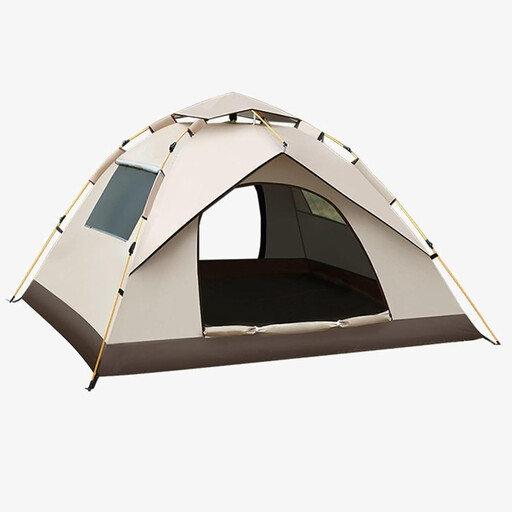
Why this product suits the profile: This pop-up tent is aimed at couples, beginners and short camping trips, with a stated set-up time of around one minute.
The stated 3,000 mm hydrostatic head, two-layer design and hard-wearing groundsheet provide specific details rather than vague claims about all-weather performance.
Two doors, two windows, pre-assembled poles and a compact packed size of approximately 76 × 17,3 × 14,5 cm.
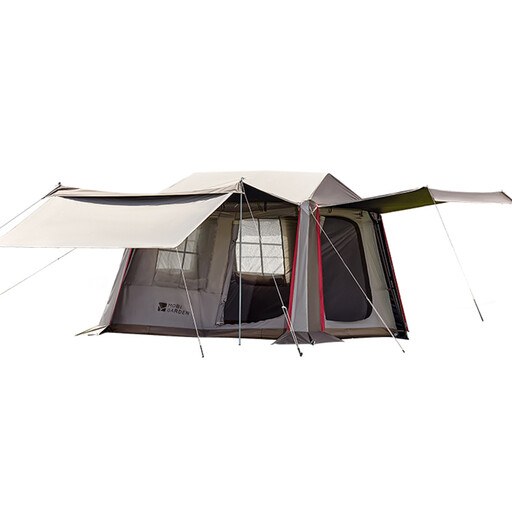
Why this product suits the profile: Ideal for families or couples who want to combine sleeping space and a covered living area in one outdoor tent.
The living space is not described solely in terms of sleeping capacity: the model offers approximately 5,9 m² of tent area and up to 15,2 m² with the awnings extended.
Automatic aluminium poles, PU2000 mm, UPF50+, taped groundsheet seams and windows on all four sides.
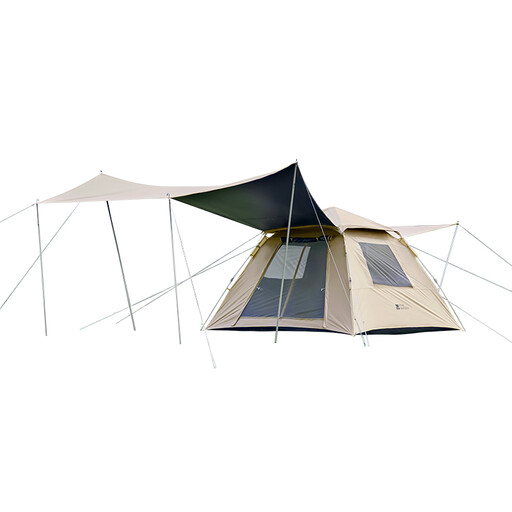
Why this product suits the profile: A great option for picnics, festivals and camping when quick set-up, blackout fabric and additional outdoor space are important.
Alongside the stated set-up time of approximately three seconds, the description gives specific figures for PU2000 mm, UPF50+ and the material construction.
240 × 240 × 155 cm inner tent, 338 × 300 × 190 cm tarp area, five-sided mesh ventilation and capacity for 2–5 people.

Why this product suits the profile: This glamping tent is ideal for families and groups who prefer standing height and generous interior space over the most compact storage possible.
The generous size is clearly set out with external dimensions of 450 × 390 cm, a height of 3 m, a 3,000 mm hydrostatic head and taped seams.
150D Oxford polyester, UV30 coating, mosquito nets, ventilation openings, 14 tent pegs and 10 guy lines.
Even a quick-setup tent needs careful handling. Before packing it away, the outer tent, inner tent, groundsheet, poles and tent pegs should be completely dry. Moisture inside the carry bag can encourage mould and unpleasant odours. Coated tents should not be washed in a washing machine; in most cases, water, a mild non-alkaline cleaning product and air-drying in the shade are more suitable.
Avoid naked flames, camping stoves and smoking inside the tent. With tall or tipi-style constructions, all guy lines must be secured, particularly in changeable weather. The actual lifespan depends on exposure to UV rays, wind, cleaning, storage and folding technique. Coated fabrics should not be left permanently exposed to sunlight without protection.
Depending on the construction, the tent body may unfold in just a few seconds or within around one minute. For a secure pitch, you will also need to insert the tent pegs, tension the guy lines and, where applicable, attach the outer tent.
This cannot be determined from the term “pop-up” alone. Check the hydrostatic head, taped seams, groundsheet coating and correct guying. Even a tent designed to be waterproof should not be exposed to extreme winds or storms for prolonged periods.
The manufacturer’s stated capacity is intended as a guide to sleeping capacity. For luggage and longer stays, a model with a porch, tarp or sun canopy is a sensible choice. Couples may enjoy more freedom of movement in a 2-4-person tent, while families should allow for the additional living space provided by a larger family tent.
We have put together a complete, regularly updated list of products that fully meet these strict selection criteria and the safety regulations applicable in the EU.