
Lieferung heute & morgen

Qualitätsgarantie

Willkommens-Angebote freischalten: KOSTENLOSE Lieferung | Bis zu 80 % RABATT | Kostenlose 30-Tage-JoyPlus-Testphase
App herunterladen
A pop-up camping tent should be quick to pitch, keep you dry and pack away compactly after your trip. In practice, however, some models fall short on important details: a large external footprint does not automatically mean enough sleeping space, a UV-protective coating says little about ventilation, and “quick to pitch” can still involve several steps with pegs and guy lines.
These three buying pitfalls are particularly common:
An automatic tent has a pre-assembled frame that unfolds by opening or lifting it. This reduces the number of individual poles and is practical for beginners, festivals or spontaneous overnight stays. A folding tent should also fit into a carry bag whose dimensions are suitable for your boot, bicycle trailer or public transport.
An inflatable camping tent uses an air pump instead of conventional poles. This can reduce the weight of the frame, but you need to take the pump, valves and replacement options into account. When buying, check whether the pump is included.
The hydrostatic head is measured in millimetres. A rating of PU2000 mm describes the stated water pressure that the material can withstand under defined conditions. This figure alone does not guarantee a dry interior. The following are equally important:
In heavy rain, snow or storms, a pop-up camping tent should only be used within its intended limits. No leisure tent can replace choosing a location suited to the weather.
Large mesh windows and doors improve air circulation and keep insects out when the mesh panels are closed. Cross-ventilation is particularly useful in a 2-5 person tent, as several people inside can quickly increase humidity.
A UV-protection tent can reduce direct sunlight through coated materials. A blackout tent also uses an opaque layer. This is practical for midday breaks, children or bright summer evenings, but it cannot completely prevent the tent from heating up in every situation. Openings and mesh panels remain important for regulating the temperature.
A camping tent with a sun canopy extends the sheltered living area. For garden parties, market stalls or larger groups, a separate outdoor gazebo or garden gazebo with side walls may be more suitable than a conventional sleeping tent.
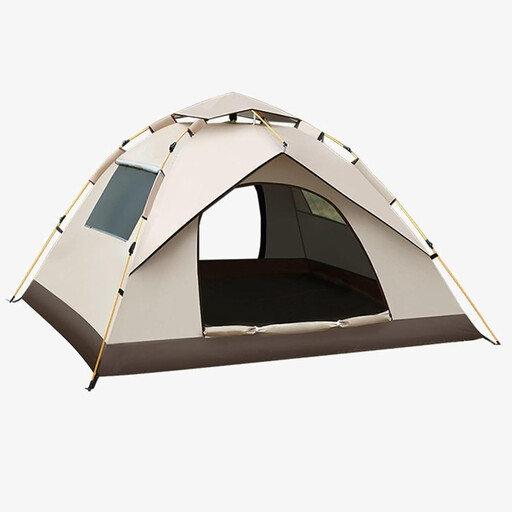
Why this product suits this profile: The pre-assembled construction is designed for straightforward pitching. With two doors and two windows, this model is suitable for short camping trips and outings with two or three adults or several children.
The product details state a compact packed size of around 30 × 6,8 × 5,7 inches, as well as a stated hydrostatic-head rating of up to 3.000 mm for the outer fabric.
Two doors, two windows, a two-layer construction and a removable outer tent; the outer tent can also be used as sun protection or a canopy.
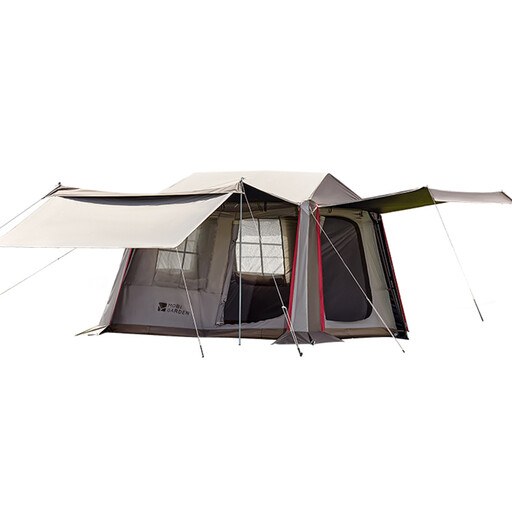
Why this product suits this profile: This family tent combines an automatic aluminium frame with an extended front area. This gives you additional living space alongside the interior sleeping area.
The specifications list PU2000 mm, taped groundsheet seams, UPF50+ and a six-layer blackout coating. Mesh windows on all four sides support ventilation.
An interior area of around 5,9 m², an extended total area of around 15,2 m² and an aluminium frame with stated dimensions of 270 × 240 × 190 cm.
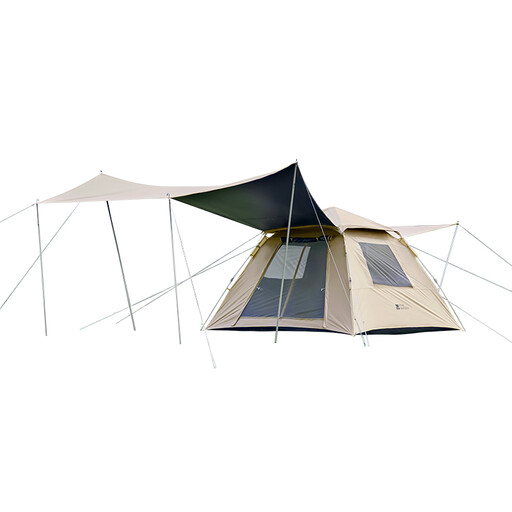
Why this product suits this profile: This 2-5 person tent combines quick pop-up pitching with an extendable front area. It is suitable for camping, picnics and longer stays with additional shade.
The stated packed size is around 86 × 18 × 18 cm. The specifications also mention PU2000 mm, taped groundsheet seams, mesh panels and a blackout layer.
Pitching dimensions of 240 × 240 × 155 cm, an extended canopy area and five-sided ventilation with insect protection.
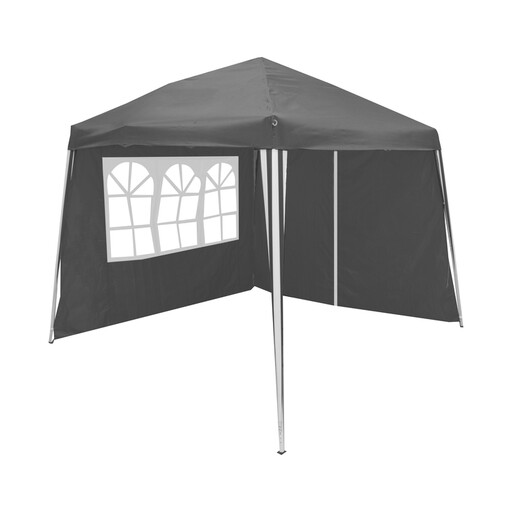
Why this product suits this profile: For gardens, patios, parties and festivals, a garden gazebo with side panels is often more practical than a sleeping tent. It creates an open living area, but is not intended for overnight stays.
The product description states that it has two side panels, 140-g/m² polyester and is designed in accordance with EN 13561:2015 for external sun-protection products.
Pitching dimensions of 300 × 300 × 245 cm, UPF50+ and a weight of around 10,8 kg; suitable for sheltered outdoor living areas.
We have put together a complete, regularly updated list of products that fully meet these strict selection criteria and the safety regulations applicable in the EU.
Even a quick-pitch tent requires a little preparation:
Depending on the frame design, the actual opening process can take anywhere from a few seconds to around one minute. Pegs, guy lines, the outer tent and sun canopy require additional time. For a secure pitch, allow time for the complete set-up rather than just opening the frame.
Its lifespan depends on the material, UV exposure, wind, moisture and care. A tent should be stored clean and dry, and should not be left outdoors permanently. Repeatedly folding it along the same crease can put strain on the coating and fabric.
The tent itself does not require a continuous power connection. Possible additional costs include pegs, replacement parts, a pump for inflatable models, waterproofing spray or transport accessories. It is therefore worth checking the contents of the package and available replacement components before buying.