
Lieferung heute & morgen

Qualitätsgarantie

Willkommens-Angebote freischalten: KOSTENLOSE Lieferung | Bis zu 80 % RABATT | Kostenlose 30-Tage-JoyPlus-Testphase
App herunterladen
A pop-up tent, often called an instant tent, promises maximum convenience with its quick setup. Take it out of the bag, toss it in the air, and the tent pops into shape—an ideal scenario for casual campers and families. However, the market is flooded with models whose real-world performance often falls short of their marketing promises. Before you make a decision, it's crucial to understand the common pitfalls that can lead to disappointment.
As your Joybuy Product Recommendation Officer, I'll help you identify the key features and make an informed choice.
Many buyers only realise after their first trip that their new tent doesn't meet their needs. Pay close attention to these three points to avoid a bad purchase:
To find the right model, you should focus on objective criteria rather than advertising claims.
Always check the dimensions of the sleeping area. A rule of thumb for comfortable camping is to allow about 60 cm of width per person. For four adults, the tent's width should therefore be at least 240 cm. Also, consider extra space for luggage, shoes, and freedom of movement. A tent with a floor area of 240 x 240 cm offers a realistic amount of space for a family of four.
The waterproofness of a tent fabric is indicated in millimetres of water column (mm). This value describes the water pressure the material can withstand before moisture penetrates.
Modern tents offer more than just a dry place to sleep. A tent with blackout technology uses special coatings that keep the interior dark and cooler, even in daylight. This is particularly beneficial for families with children or festival-goers. A high UV protection tent (e.g., UPF 50+) also protects the material and occupants from harmful solar radiation. Good ventilation through multiple openings equipped with mosquito nets is also important to minimise condensation.
Here are some models that are suitable for specific user groups based on objective features.
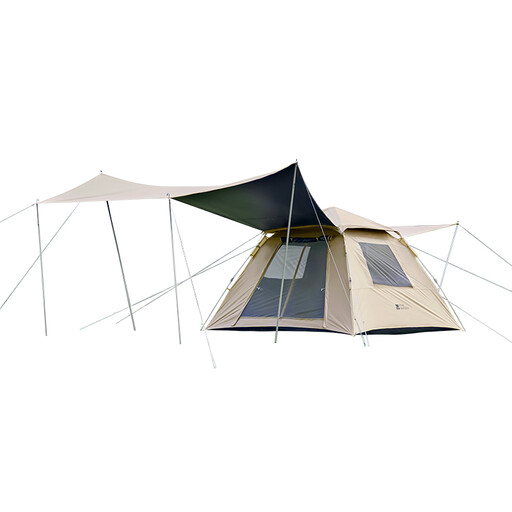
Why it's a great fit: Ideal for families who want an effortless setup and appreciate the additional covered space provided by the included tarp, perfect as a play or seating area. The light colour heats up less in the sun.
With a floor area of 240 x 240 cm, it offers realistic space, avoiding the trap of undersized "4-person" tents. The PU2000mm water column rating and sealed seams provide reliable protection during typical summer rain.
Combination of a pop-up tent and a tarp for an extended, sheltered outdoor area. The 6-layer blackout fabric with UPF50+ blocks ≥99.9% of UV rays according to the manufacturer, ensuring a more comfortable sleep.
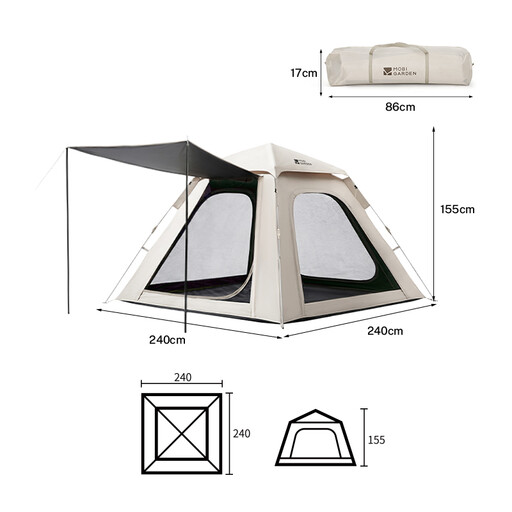
Why it's a great fit: Perfect for anyone who wants to sleep in after a long night. The superior blackout technology and straightforward folding mechanism are designed for dynamic use at festivals or on spontaneous trips.
The composite blackout fabric directly addresses the problem of overheating and brightness in basic tents. The folding mechanism is designed for intuitive handling to prevent frustration during disassembly.
Complete blackout for restful sleep, even in daylight. According to the manufacturer, the robust fibreglass frame is designed for wind speeds up to Force 6. A five-sided ventilation system with mesh panels ensures good air circulation.
We have compiled a complete, up-to-date list of products that fully meet these strict selection criteria and comply with European safety standards.
Although the exact technique varies by model, most pop-up tents follow the "figure-eight fold" principle. First, the pole arches are laid flat on top of each other. Then, the tent is grasped in the middle and twisted into a figure-eight, creating two round circles. These circles are then stacked on top of each other and slid into the carry bag. It is advisable to follow the manufacturer's instructions and practice the process once before your first trip.
The waterproofness depends directly on the specified water column rating and the quality of the construction. A rating of PU2000mm for the outer tent and an even higher rating for the groundsheet (e.g., PU3000mm) provide sufficient protection in most situations in Europe. Be sure to look for the "sealed seams" (taped seams) note, as this seals a critical weak point.
For a comfortable stay, you should subtract one person from the manufacturer's specification. A 4-person tent is therefore very suitable for three adults with luggage or a family with two adults and two small children. If four adults are travelling with a lot of gear, a model designated as a 5 or 6-person tent is often the better choice. Always check the floor area in square metres.