Anyone comparing kcal
You want to compare popcorn by its kcal per 100 g, without mistaking a lower figure in this selection for a “low energy” claim.


If you want to eat popcorn straight away on your way to breakfast, ready-to-eat popcorn is a better choice than a microwave bag. Compare the kcal per 100 g, sugar content and how much you’ll actually eat. A lower figure within this selection doesn’t make a product “low energy”. If you have access to a microwave before setting off, microwave popcorn is another option, but it takes time to prepare.
You want to compare popcorn by its kcal per 100 g, without mistaking a lower figure in this selection for a “low energy” claim.
You need popcorn you can open and eat straight away. A microwave bag is only suitable if you can prepare it before setting off.
As well as kcal, you want to compare the “of which sugars” figure for sweet varieties or the salt content of savoury options on the specific pack.
| What to consider | What to check | Who is it important for? |
|---|---|---|
| Putting calories into context | Compare kcal per 100 g and consider how much you intend to eat from the pack. | I want to compare the energy values of different varieties without assuming that the lower figure makes one a “low energy” choice. For around 42% of consumers, this calorie comparison is the main consideration. |
| Ready to eat | Check whether the popcorn is ready to eat or needs a microwave. | I can’t heat a bag on my way to breakfast. That’s why around 33% of consumers prioritise being able to eat their popcorn straight away. |
| Sugar and salt | Check the “of which sugars” and salt figures per 100 g in the nutritional information for the variety you’re considering. | With sweet popcorn, I check the sugar first; with savoury popcorn, I check the salt. For around 25% of consumers, one of these figures takes priority over comparing calories. |
The Verbraucherzentrale (German Consumer Advice Centre) says that, for solid foods, a “low energy” claim means no more than 40 kcal per 100 g. Even the Seeberger salted microwave popcorn considered here exceeds this, with 364 kcal per 100 g according to REWE.
Use kcal per 100 g to compare specific products, not as a substitute for checking whether a product meets this nutritional claim.
A microwave bag needs to be heated before you eat the popcorn. The bag and steam may be hot when you open it.
If you’re out and about without somewhere to prepare it, choose ready-to-eat popcorn. Only prepare a microwave bag somewhere with a suitable appliance, and follow the pack instructions.
Recipes also vary in their sugar and salt content: REWE lists 51 g of sugar per 100 g for Chio Sweet & Salty, while EDEKA lists 2.5 g of salt per 100 g for GUT&GÜNSTIG salted microwave popcorn.
Check the nutritional information and ingredients on the specific pack before making your choice.
EDEKA notes that the product information shown online may differ from the packaging.
Check the product itself for the latest nutritional information, ingredients, allergen details and best-before date.
The Seeberger salted microwave popcorn listed by REWE is an option if you can use a microwave before eating.
Chio’s ready-to-eat Sweet & Salty, listed by REWE, and its salted microwave popcorn differ in how they’re prepared.
EDEKA sells both ready-to-eat sweet popcorn and microwave varieties under the GUT&GÜNSTIG brand.
This selection features two options for a quick snack: ready-to-eat Cinema Popcorn and Seeberger microwave popcorn for when you have access to a microwave. Check the information on each pack to see how it fits your portion.
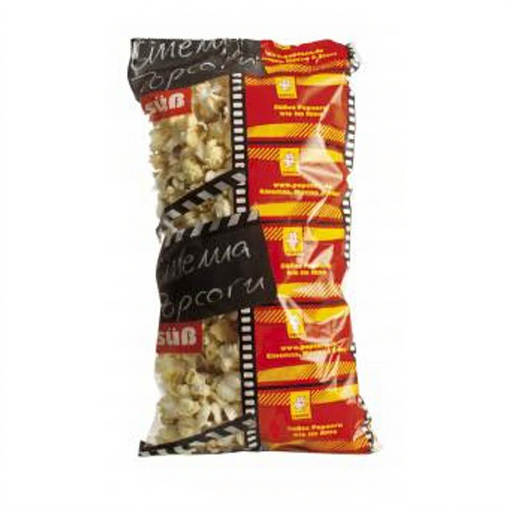 No image available
For a snack without a microwave: this popcorn is ready to eat straight from the bag.
Pack size: 150 g. Compare the nutritional information on the pack with the amount you plan to eat.
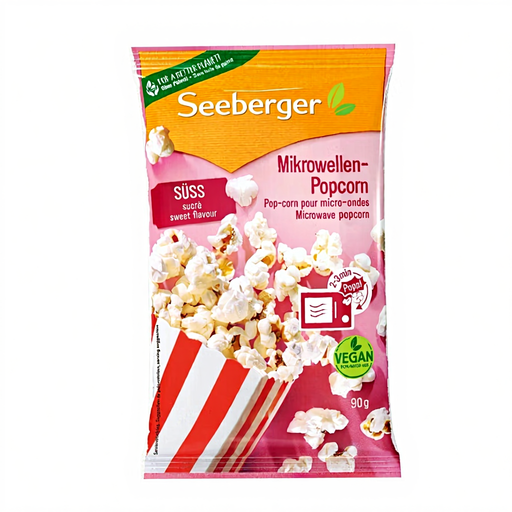 No image available
For a snack once it’s prepared: this variety needs a microwave, so it isn’t ready to eat while you’re out and about.
Pack size: 90 g. Follow the preparation instructions and take care when opening the hot bag.
None of the products considered meets the “low energy” threshold for solid foods given by the Verbraucherzentrale (German Consumer Advice Centre): no more than 40 kcal per 100 g. The listed values for the varieties considered range from 364 to 448 kcal per 100 g. Comparing products within this selection is therefore not the same as a “low energy” claim.
Ready-to-eat popcorn in a bag can be eaten without a microwave. Microwave popcorn must first be prepared according to the instructions on the relevant pack; the bag and steam may be hot.
For sweet popcorn, also compare the “of which sugars” figure; for savoury varieties, check the salt content. Both are given per 100 g. These figures can vary considerably between specific recipes. It’s also worth considering how much popcorn you’ll take from the pack, as this affects the amount you eat.
Use it to narrow down your options, then check the specific pack before buying. EDEKA notes on its product pages that the information shown may differ from the packaging.