For home poppers keeping an eye on added fat
You want to decide how much oil and seasoning to use when popping your popcorn, and you don’t mind taking the time to prepare it.


If you want to control how much fat you add, you can choose organic popcorn kernels and plan how to prepare them; ready-to-eat popcorn already has a set recipe. Alnatura and BIO COMPANY each state that their unpopped kernels contain 3.8 g of fat per 100 g, while HEIMATGUT states that its ready-made cinnamon popcorn contains 17 g per 100 g. These figures describe products in different states: when you make popcorn yourself, the amount of oil you use matters too.
You want to decide how much oil and seasoning to use when popping your popcorn, and you don’t mind taking the time to prepare it.
You want a bag you can enjoy straight away. Check the ingredients list and nutrition information to see whether the recipe suits you.
You look for terms such as ‘low fat’ or ‘reduced fat’ and want to understand whether a claim refers to a fixed threshold or a comparison with a similar product.
A good choice if: You want to measure out the oil and seasoning yourself and make your popcorn fresh.
The trade-off: Preparation takes time; the maker’s instructions for the kernels reviewed call for oil in the pan.
A good choice if: You want a seasoned option you can enjoy without any preparation.
The trade-off: Oil and sugar may already be part of the recipe, as they are in the HEIMATGUT cinnamon popcorn reviewed.
| What to check | What to look for | Who it matters to |
|---|---|---|
| Added fat | Only compare fat values for products in a similar state. With raw kernels, also factor in how much oil you use for the portion you eat. | If I pop it myself, I want to control the amount of oil and don’t mind the extra effort. This would be the main reason to buy for around 42% of consumers. |
| Other nutritional values | For ready-made varieties, check the fat, sugar and salt per 100 g, as well as the ingredients list. If a Nutri-Score is shown, it can help you compare products in the same category. | With sweet or seasoned popcorn, I want to consider sugar and salt as well as the fat content. Around 33% of consumers would make this their priority. |
| Fat-related claims | For ‘reduced fat’, check which comparable product it is measured against and the actual fat content; for ‘low fat’, check the fat content per 100 g. | If a bag says ‘reduced fat’, I want to understand the comparison before assuming it contains little fat. For around 25% of consumers, understanding claims like these would be the deciding factor. |
The two claims answer different questions. The Verbraucherzentrale says that ‘low fat’ means no more than 3 g of fat per 100 g for solid foods; Apotheken Umschau describes ‘reduced fat’ as containing at least 30% less fat than a comparable product. A relative difference doesn’t, on its own, mean the absolute fat content is low.
For a reduced-fat variety, check which product it is compared with and also read the fat and energy values per 100 g. According to the Federal Ministry of Agriculture, Food and Home Affairs, nutrition claims must meet the conditions set out in the annex to the EU Health Claims Regulation.
The 3.8 g of fat per 100 g stated by Alnatura and BIO COMPANY for their unpopped kernels doesn’t describe popcorn prepared with oil. HEIMATGUT’s figure of 17 g per 100 g, on the other hand, refers to its ready-to-eat cinnamon variety.
Compare raw kernels with raw kernels, and ready-made varieties with ready-made varieties. If you pop your own, factor in the amount of oil you actually use for your portion.
Organic certification doesn’t tell you how much fat or sugar a product contains. For example, the organic cinnamon popcorn from HEIMATGUT that we reviewed contains coconut oil and sugar.
Consider organic status and nutritional values separately, and check the information for the specific variety when buying ready-made popcorn.
According to the Verbraucherzentrale, the Nutri-Score is intended for comparisons within the same product category. It doesn’t replace the information on ingredients, fat, sugar and salt.
Use the Nutri-Score as an extra point of reference when comparing similar popcorn products, if one is shown.
The popcorn kernels reviewed are a Demeter-certified organic base for anyone who wants to decide how much fat and seasoning to add during preparation.
The organic popcorn kernels reviewed make a good starting point if you want to choose the ingredients yourself when popping.
The organic cinnamon popcorn reviewed is a ready-to-eat option for anyone who values a finished recipe over measuring out the ingredients themselves.
These popcorn kernels are for making at home: you decide what to add when popping, but remember to factor in the amount of oil you use when assessing your finished portion.
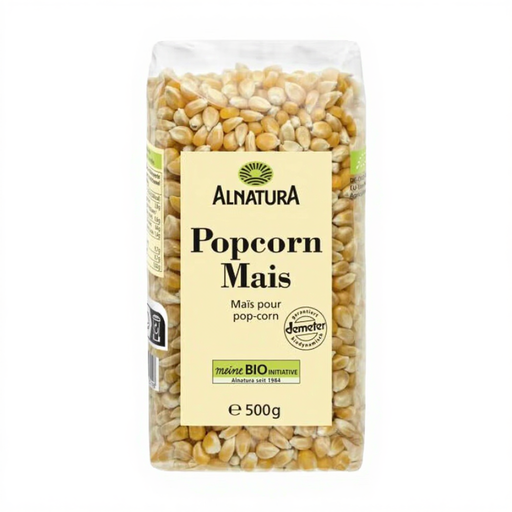 Image unavailable
For anyone who wants to make popcorn at home and control how much oil and seasoning to add.
Alnatura states that the unpopped kernels contain 3.8 g of fat and 0.02 g of salt per 100 g; popcorn kernels are listed as the ingredient.
Preparing them with fat changes the nutritional values of the finished snack. Check the allergen trace information on the pack if needed.
‘Low fat’ refers to an absolute fat value, while ‘reduced fat’ compares a product with a similar one. The Verbraucherzentrale says that ‘low fat’ means no more than 3 g of fat per 100 g for solid foods; according to Apotheken Umschau, ‘reduced fat’ means at least 30% less fat than the comparable product. So, when choosing popcorn, check both the basis for the comparison and the nutrition information.
No. You can’t tell the fat content of your finished portion from the value for the unpopped kernels alone. Alnatura and BIO COMPANY each state that their raw kernels reviewed contain 3.8 g of fat per 100 g; if you prepare them with oil, you’ll need to add the amount you use.
If shown, the Nutri-Score can be a useful extra when comparing similar popcorn products. The Verbraucherzentrale recommends comparisons within the same product category; you should still check the ingredients list and nutrition information too.
The ingredients you use to prepare popcorn kernels affect what ends up in your finished portion. The instructions for the products reviewed call for oil; also follow the storage and preparation guidance on your pack.