If you’re watching your fat intake
If you’re choosing between ready-to-eat popcorn varieties, compare their fat content per 100 g. The word ‘light’ and the size of the bag are no substitute for checking.


Ready-to-eat popcorn is the obvious choice for your gym bag if you want a snack that needs no preparation. When comparing similar products, check the fat and sugar per 100 g, as well as the amount in the bag: a small pack or the word ‘popcorn’ alone tells you nothing about its fat content. Popcorn kernels and microwave popcorn are better suited to situations where you prepare the snack before packing it.
If you’re choosing between ready-to-eat popcorn varieties, compare their fat content per 100 g. The word ‘light’ and the size of the bag are no substitute for checking.
Ready-popped popcorn is an option for the journey to or from the gym. Check how much you’re taking with you and the fat, sugar and salt values listed for that variety.
With popcorn kernels, you can decide how much fat to add during preparation. Microwave popcorn, on the other hand, requires a microwave; either way, you’ll need to prepare the snack before packing it.
First, decide whether the popcorn needs to be ready to eat. Then compare the nutritional information per 100 g for similar products, and check how much you actually want to eat.
| What to consider | What to check when buying | Who it matters to |
|---|---|---|
| Fat content | Compare the fat per 100 g in similar popcorn products, and check the ingredients list too. | If you’re looking for a variety with less fat, don’t rely on the packaging or pack size. For around 50 % of consumers, this comparison comes first. |
| Ready to take with you | Check whether the popcorn is ready to eat, and compare the pack size with the portion you have in mind. | If you want a snack you can eat on the way to the gym without a microwave or pan, what matters most is that it’s ready to eat. This is the main priority for around 30 % of consumers. |
| Preparation and ingredients | For popcorn kernels, take into account how much fat you use; for ready-made varieties, check the sugar and salt content, as well as any allergen information. | If you prepare your popcorn in advance, you may want to decide how much fat and seasoning to add yourself. This is the priority for around 20 % of consumers. |
A reduced-fat claim refers to a comparison with another product. On its own, it doesn’t tell you how much fat the popcorn actually contains.
Check the fat per 100 g and see what product the pack’s comparison is based on.
For its cream caramel popcorn, EDEKA Herzstücke lists 25,9 g of fat and 51,7 g of sugar per 100 g. The flavour doesn’t tell you what the nutritional values are.
Before choosing a sweet variety based on its flavour or bag size, check the fat and sugar on the specific pack.
The way it’s prepared doesn’t determine its fat content: HEIMATGUT lists 18 g of fat per 100 g for its salted microwave popcorn. You’ll also need to prepare it before putting it in your gym bag.
Check the ingredients and nutritional information, and plan to prepare it before packing.
A smaller bag doesn’t change the nutritional values per 100 g. A Nutri-Score, if shown, also won’t tell you on its own how much you’ll eat or what ingredients the popcorn contains.
Look at the nutritional information and pack size together. Use the Nutri-Score only as an additional guide when comparing similar products.
The brand offers ready-to-eat organic popcorn and microwave popcorn. For your gym bag, the main difference is whether you need to prepare it before eating.
Its cream caramel popcorn is a good example of why you should check the nutritional values of sweet varieties individually.
REWE lists popcorn kernels, microwave popcorn and ready-to-eat popcorn as different product types.
The brand describes its popchips as popped crisps. They’re a different type of snack, not popcorn.
Lorenz Naturals Leicht are potato crisps, not popcorn. Their name isn’t a useful way to choose between popcorn varieties.
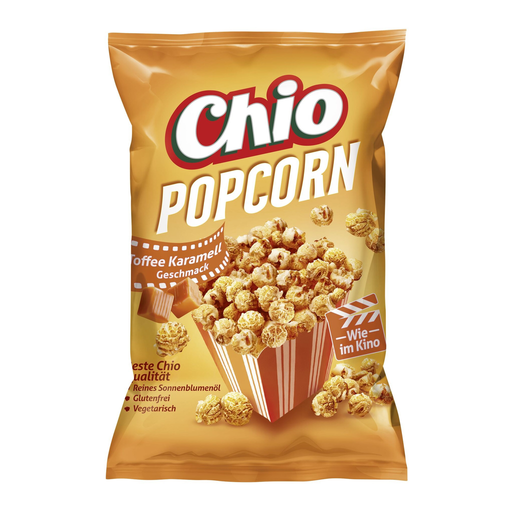
This ready-to-eat caramel popcorn is an option if you want something to take with you. If you’re mainly looking to limit your fat intake, check the fat and sugar information on the product as well as the pack size.
 No image available
Ready-to-eat popcorn to take with you, with no preparation needed. The pack contains 120 g. For this caramel variety, compare the fat and sugar per 100 g, as well as the amount you plan to eat.
Compare the fat per 100 g in similar popcorn products. Also check the pack size and ingredients, rather than choosing based only on words such as ‘light’ or the size of the bag.
Microwave popcorn is suitable to take with you if you prepare it beforehand; unpopped popcorn isn’t a ready-to-eat snack for when you’re out and about. The preparation method also doesn’t mean it will be low in fat: HEIMATGUT lists 18 g of fat per 100 g for its salted microwave popcorn.
Read the ingredients list and the allergen and ‘may contain’ information on the specific pack. For example, the cream caramel popcorn described by EDEKA contains milk; you can’t assume the same applies to other popcorn varieties.
Seal the bag well and follow the product’s storage instructions. HEIMATGUT recommends storing its ready-to-eat salted popcorn in a cool, dry place.